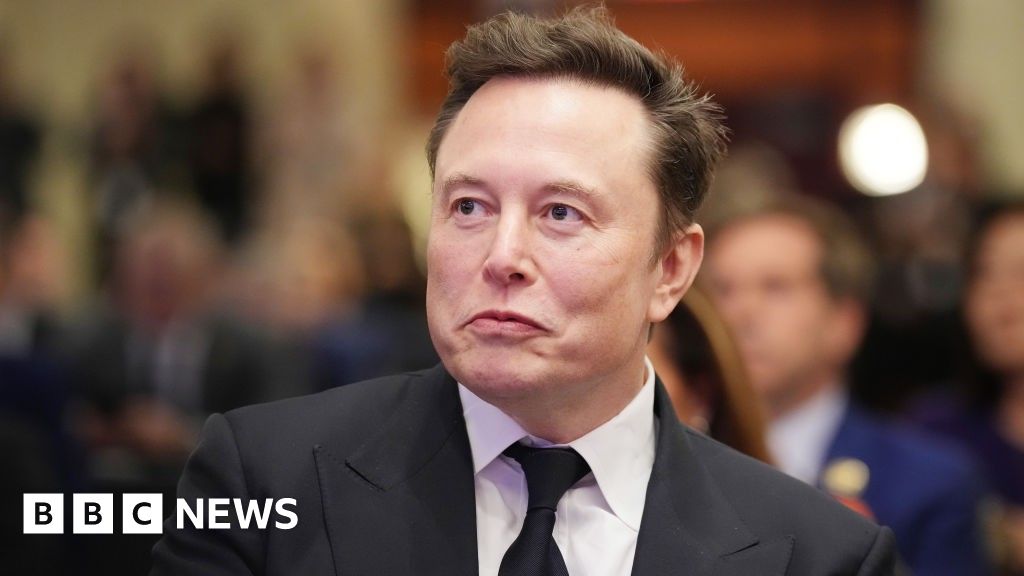
Tesla boss Elon Musk has said H-1B visas were being “gamed” by “some outsourcing companies”, but the solution was stopping the abuse and not dismantling the system.
Roughly 70% of these visas – that allow US companies to hire skilled foreign workers – are used by Indian citizens working in sectors like technology and medicine.
In September, US President Donald Trump added a $100,000 (£74,000) fee for applicants to the H-1B visa programme, sparking anxiety among Indian workers and employers.
Musk was speaking to Indian entrepreneur Nikhil Kamath on his podcast, released on Sunday evening, and also touched on a range of other issues from tariffs to immigration.
During the conversation Musk maintained that America has “long benefitted” from talented Indian migrant workers, but acknowledged concerns about the “misuse” of the H-1B visa programme.
H-1B visas are given out through a lottery, and outsourcing and staffing firms have often been accused of manipulating the system using tactics such as submitting multiple entries for the same worker, or using the visa to hire low-cost contract workers rather than for specialty occupations.
“We need to stop the gaming of the system,” Musk said.
“But I’m certainly not in the school of thought that we should shut down the H-1B programme…which some on the Right are. I think they don’t realise that that would actually be very bad.”
According to data released this month by a think tank, H-1B visa approvals for Indian outsourcing companies have fallen to the lowest level in a decade.
In this financial year, the top seven Indian companies had only 4,573 H-1B petitions approved for initial employment, a 70% drop from 2015 and 37% fewer than 2024, according to the National Foundation for American Policy (NFAP).
Trump’s policies “could lead to higher denial rates and other problems for employers”, the NFAP report warned.
Besides H-1B visas, Musk also spoke about Trump’s decision to use tariffs as a centrepiece of his economic policy during his second term.
Musk said he had “unsuccessfully” tried to dissuade Trump from raising tariffs, which he said, “create distortions in markets”. But “the President has made it clear he loves tariffs”.
Earlier this year, the US imposed 50% tariffs on Indian goods, including a 25% penalty for buying Russian oil.
While several other countries have inked trade deals with the US , Indian goods exports to the US continue to attract some of the steepest levies in the world.
Negotiations for a trade deal between the two countries are under way, with the goal of concluding an agreement by the end of this year.
Follow BBC News India on Instagram, YouTube, Twitter and Facebook.