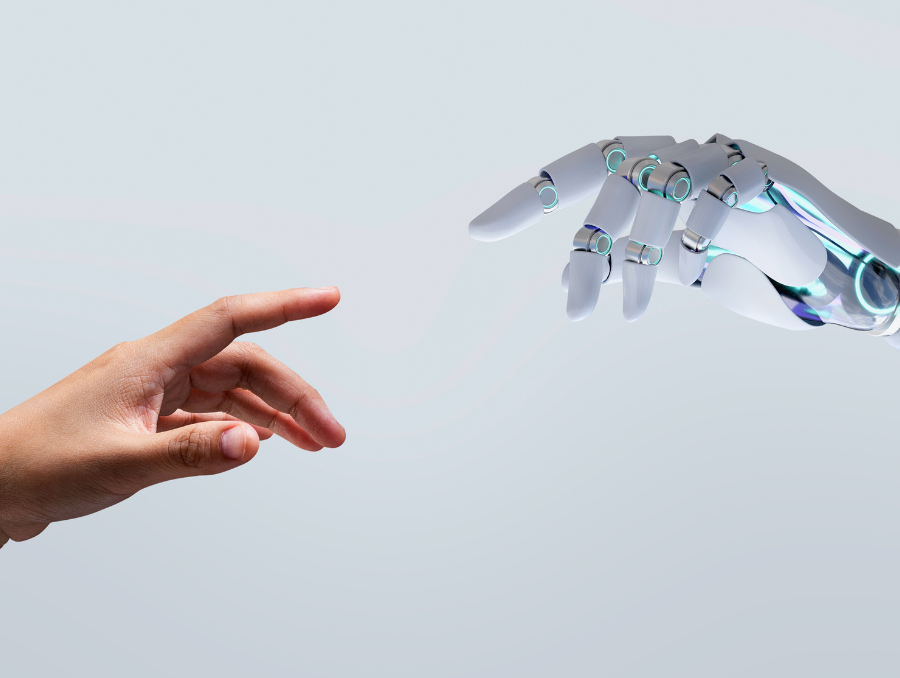
There tend to be strong reactions to AI-generated art, often forming pro- and anti-AI camps based on how AI is understood and who the AI directly impacts. But the reality of how AI intersects with creativity is much more complicated than a binary understanding allows.
Broader and faster (creative) intelligence
AI is helpful for rapid visualization in the creative process, effectively acting as a time-saving tool by increasing the number of variations or iterations an artist might make anyway while producing work. Generative AI can also broaden an artist’s effective skillset. Contemporary artistic practices are increasingly interdisciplinary and artists often need to learn various skillsets to complete projects.
AI-generated art that is created purely from text prompts makes for a clear example of AI use in creative endeavors. Some artists laud the depth of the iterative process in prompt engineering, while others deride the reliance on text to creative visual output, deeming it low-effort and low-skill. Historically speaking, however, effort (i.e., perceived effort) and technical skill are poor metrics for creativity, as many art movements and famous works of art that are now considered canon in the fine art world lack these qualities; see the readymade art pioneered by Marcel Duchamp (a urinal recontextualized as an art object), and conceptual art like Sol Lewitt’s Wall Drawings (which were simply instructions for drafts people to implement). Both art forms champion creative ideas over the artist’s technical execution and make for a useful reminder about what exactly is new and what is not-so-new in how AI is changing the landscape of creativity.
“Intelligence” is everywhere
Generative AI is finding its way into all creative processes that use digital tools. Adobe has not only integrated generative AI within its programs, but it is also encouraging artists to use these tools and sometimes making it difficult not to use them. For example, Photoshop’s relatively new Contextual Task Bar will give just one suggested action for the user, usually beginning with “Generative…”
However, I see generative AI having a broader and more subtle contribution and challenge to traditional notions of creativity in otherwise “non-AI” processes. “Intelligent” assistive tools have been around for a lot longer than “Generative AI” – face detection in camera software, smart selection tools in Photoshop. Even if they don’t rely on a large language model, there is a long-evolving history of technological tools aiding creative activity and production. I make sure my students are aware of this so they can see the contours of this technology and make their own determinations about when to outsource a technique to an automated system.
Opting out
There are also plenty of reasons for artists to resist or reject the use of AI for moral and ethical reasons, from the environmental impact of AI data centers and use of AI in military operations and its possible role in committing war crimes, to the proliferation of political propaganda, disinformation and deepfakes more broadly. Some artists don’t want to be associated or implicated with the technology.
Many artists and designers are also rightfully concerned about AI replacing their jobs – this is a return of the “low effort” critique; it’s faster and cheaper for an employer to use AI than to hire an artist or designer. Often this low effort AI approach is visible in the result, so projects or jobs that demand more sophisticated results still need artists, even if the artists may be implementing AI tools in a broader creative workflow.
One of the sharpest critiques of AI-generated art by artists themselves is the use of their own work in the data sets that train AI. If an artist’s work has been fed into an AI model for anyone to use, their work has, in a sense, been stolen. Artists have taken multiple approaches to these concerns, including creating a search tool to allow artists to see if their work has been included in data sets used by Stable Diffusion. Adobe is trying to work around this concern by drawing from proprietary and public domain in its generative AI models. This will likely be an increasingly popular approach for AI tools made for artists.
A new slop kitsch
While AI generated art is able and sometimes virally infamous for, being able to change the style of any artwork, generative AI is doing something else with our visual culture. Rather than simply replacing all human creativity, it’s also defining a new aesthetic. Artists can now work in a style determined by the behemoth computing power and aesthetic limitations of generative AI tools. Different users tend to get remarkably consistent stylistic results when using the same AI models, flattening out potential aesthetic variation. This is why AI art can be so immediately recognized.
In such a quickly evolving field, the latest and most powerful generative AI models have been able to generate images and video that are convincing enough to “pass” as real, yet across the broad generative AI ecosystem, there is also a growing body of improbable and unconvincing AI content that is saturating our visual environment. I see this AI slop becoming a new camp or kitsch. When AI-generated content is unsettling it contributes to a real aesthetic that artists can replicate and respond to. Strangely non-human movement or facial expressions can act as pop cultural references that viewers recognize and normalize, and this makes them viable artistic subject matter.
Moving forward, artists may find themselves asking if they should embrace the imperfections of the handmade or the imperfections of AI.
About the professor
Tyler Calkin, MFA, is an associate professor of art and head of digital media at the University of Nevada, Reno, in the College of Liberal Arts, who specializes in visualizing social experience through interactive XR and connecting AI and machine learning workflows to motion capture, 3D modeling and digital simulation.