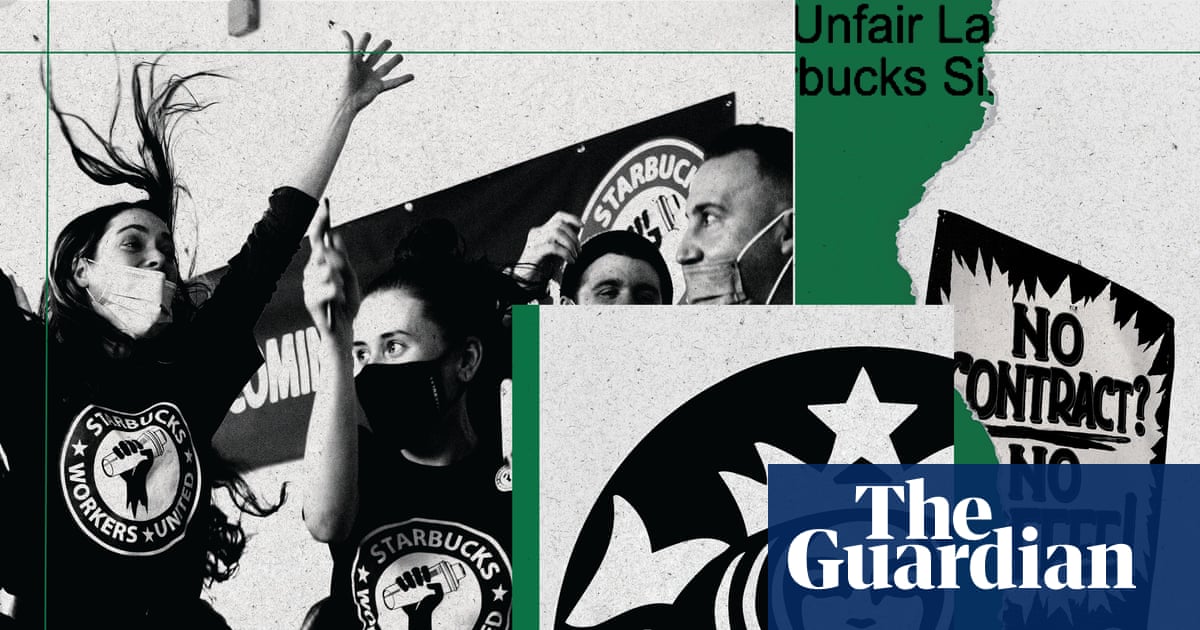
2000Thousands of Starbucks baristas are on strike across the US, warning the world’s largest coffee chain to brace for the “longest and biggest” bout of industrial action in its history.
Barely a year after Brian Niccol, the Starbucks CEO, tried to draw a line under bitter divisions between its management and unionized workers, pledging to “engage constructively” with them, the American coffee giant is now grappling with an escalating strike during its lucrative holiday trading season.
About 2,500 workers are striking across 85 cities and 120 stores – and urging customers to steer clear. Starbucks claims less than 1% of its coffee houses have experienced disruption due to the industrial action.
But the union, Starbucks Workers United, which represents 11,000 baristas at more than 550 stores, is threatening to escalate the strike far beyond its current footprint unless executives make concessions during contract negotiations.
Four years after the first Starbucks-owned US store voted to form a union, defying intense resistance from the company, relations between both sides have deteriorated.
“It’s still shocking to me to wake up and have them every day still fighting us the way that they’re fighting us,” Michelle Eisen, spokesperson for Starbucks Workers United, told the Guardian. “Because we have proven time and time again that we’re not going anywhere.”
For decades, Starbucks, founded in the 1970s, and taken over in the 1980s by Howard Schultz, who built it into the global coffee colossus it is today, successfully fought off unionization.
The chain dubbed its workers “partners”, and promoted a package of “industry-leading” benefits, including healthcare coverage and education costs.
“I’m not an anti-union person. I am pro-Starbucks, pro-partner, pro-Starbucks culture,” Schultz told employees in 2022. “We didn’t get here by having a union.”
By then, however, cracks had already started to appear in the dam. The previous year baristas at a store in Buffalo, New York, voted 19-8 in favor of unionizing – setting the stage for hundreds of outlets across the US to follow suit.
Michelle Eisen started working at the Buffalo store in August 2010, to supplement her job as a production stage manager, in between theater shows.
She was a longtime Starbucks customer, and trusted its reputation for treating workers well. And for years, Eisen felt valued as an employee, receiving regular wage increases and working around her production schedule.
But things started to change in about 2016, according to Eisen. “We saw our benefits costs go up significantly. Those twice a year raises went away completely,” she said in an interview. “All of a sudden, we were getting one cost of living raise at the beginning of the calendar year, which, most of the time, was significantly less than the raises previous to that. And that’s really when we started to see the staffing levels slowly start to decline in these stores.”
Four years later, things “really, really, really came to a head”, Eisen said.
Starbucks stores stayed open when Covid hit in 2020. Baristas startled to encounter increasingly aggressive and confrontational customers, and some workers felt their pay was too low for what they believed had become more intense work in deteriorating conditions.
Eisen, whose theater job was shut down due to the pandemic, took on as many hours as she could at Starbucks, but still struggled to make ends meet. After 11 years at the company, she was only making a few cents more an hour than a new hire. In 2021, she considered quitting.
But then she started speaking with co-workers about organizing a union. A group of about 50 Starbucks baristas in the Buffalo area went public with their plan in August 2021.
“To me, it was a no-brainer,” said Eisen. “Because it gave an opportunity to try to address some of these problems, and fix them from the inside. And I was hoping, beyond hope, that it would work, we would be successful, and I wouldn’t have to leave. Because I didn’t want to.”
Starbucks executives did not see the move as a no-brainer. Managers and corporate executives, including the chain’s then North American president, Rossann Williams, and Schultz, descended on Buffalo in a bid to try to stop the effort to unionize.
“No partner [employee] has ever needed to have a representative seek to obtain things we all have as partners at Starbucks,” Schultz wrote in a letter to workers. “And I am saddened and concerned to hear anyone thinks that is needed now.”
“They waged an absolutely vicious union-busting campaign,” claimed Eisen. “They still are, but it started there in Buffalo, from the very beginning. And against all odds, in spite of that, my store was able to win their union election on December 9, 2021 and became the first [unionized] store. And then it was kind of a whirlwind.”
Since that first victory, mobilizing workers have won over 650 union elections, and lost about 120.
The chain has since moved to closed 59 unionized stores, according to Starbucks Workers United. Others are still awaiting for results to be certified.
As as a wave of mobilization started to sweep the firm’s ranks in early 2022, its top tier was overhauled. Three months after the Buffalo vote, Starbucks abruptly announced its CEO Kevin Johnson was standing down, and Schultz, its veteran boss, would return for a third stint in charge.
Shares in Starbucks were under pressure, costs were rising as Covid continued to disrupt supply chains, and – while the firm continued to generate billions of dollars in sales every quarter – customers were spending less time inside its stores.
Schultz was tasked with turning around a business many on Wall Street felt was losing its way. Many of his freshly unionized baristas agreed. But Schultz declined to work with Starbucks Workers United, declaring he would never embrace the union, and offering new benefits and pay increases to non-union workers.
“It was just infuriating that we were being bullied in this way, and made to feel like we were doing something wrong, because we were trying to hold the company accountable and trying to make them better,” said Eisen.
A new CEO, Laxman Narasimhan, was tapped later that year. Unionized baristas started to take action, including by demonstrating on the chain’s “red cup day” holiday in November 2022 and 2023.
Relations slowly improved. In early 2024, Starbucks and Starbucks Workers United agreed a new framework for collective bargaining agreements, sparking hope of a first union contract by the end of that year. Workers at unionized stores were granted the benefits that had been given to non-union workers in 2022.
But the chain’s business woes appeared to worsen, with competition mounting and footfall declining. Narasimhan was ousted after 16 months as CEO last year, and replaced by Brian Niccol, the Chipotle boss.
Bargaining stuttered to a halt following Niccol’s arrival, according to the union. “The company picked right back up where they left off at the end of 2023, when it came to violating workers rights,” said Eisen. “And we still don’t have a contract.”
Niccol moved fast in a bid to turn around the chain, launching a “Back to Starbucks” campaign, aimed at reversing declining sales. He faced criticism after it emerged he would commute from his home in Newport Beach, California, to the firm’s Seattle headquarters, rather than relocate.
Progress at the bargaining table, meanwhile, stalled. Niccol remained mum on the union, and its pursuit of a first union contract.
“The changing of CEOs within the last five years alone has kind of shown that this company has a lot it’s still figuring out,” Zarian Antonio Pouncy, who has worked for 11 years as a barista in Las Vegas, told the Guardian. His store unionized in late 2023.
Pouncy said: “Instead of listening to the partners – listening to those on the forefront, dealing with the business every day – they’re relying too much on leadership in their opinion, and AI, algorithms and numbers, to kind of show them how business works.”
Julie Su has been watching closely. As US deputy secretary of labor, and acting labor secretary, between 2021 and 2025, she helped oversee the Biden administration’s efforts to reinvigorate the US labor movement — as thousands of Starbucks baristas voted to unionize.
“When workers choose a union, they deserve a contract,” Su told the Guardian. “Too often, it takes a long time to get one because the employer uses delay as a weapon.
“The time to a first contract is used to punish workers for unionizing, to undermine the effort, or to send a message that there is no benefit to joining a union because nothing changes at work for years. Usually all of the above. This is unacceptable.”
On average, it takes about 15 months for a union to secure a first contract with an employer, often due to delays and obstruction by management. At Starbucks, nearly 48 months have passed since the Buffalo store voted to unionize.
“The other way this operates as a specific tool for union-busting in the case of a company like Starbucks is the company tries to wait out its employees, hoping that they leave before a contract is reached,” added Su.
Starbucks Workers United has filed hundreds of unfair labor practice (ULP) charges with the National Labor Relations Board. Dozens of union leaders have been fired, and alleged retaliation for their union support. Starbucks denied this in all cases, although several workers won reinstatements.
Tensions simmered. Starbucks Workers United claimed baristas at several hundred stores walked off the job last December. And in April, union delegates voted to reject a contract proposal from the company which would have guaranteed annual raises of at least 2%, dismissing the increase as “not good enough”.
On 13 November – “Red Cup Day’, inside the Starbucks empire – more than a thousand US workers walked off the job, demanding the chain present a “fair” contract. The chain played down the strike’s impact.
The union escalated. A week later, the action was expanded to 65 cities and 95 stores, with 2,000 workers on strike. Starbucks Workers United also staged a blockade of Starbucks’ largest distribution center on the US east coast, in York, Pennsylvania.
On 24 November, Starbucks workers rallied outside of the company’s corporate office in Newport Beach, Niccol’s part-time base, to demand the company finish the contract.
On 28 November, the strike was expanded further. About 2,500 baristas across 120 stores are now involved, according to the union.
“The company has been stonewalling us,” said Diego Franco, a Starbucks barista for six years in Chicago. “My store chose to go out on Red Cup Day, the busiest sales day for the company, because we were frankly fed up.
“You can’t expect us to continue to come into work, to continue to push policies and procedures that don’t actually fix any of the problems that we face at work – not just for my co-workers, but for the customers and our regulars. I would much rather stand outside in the cold and be on strike than know that I’m showing up to work where I’m constantly being disrespected by our CEO, and by upper management.”
Contacted for comment, Starbucks played down the impact of the strike so far, and claimed to have seen record holiday sales so far this year.
“As we’ve said, 99% of our 17,000 US locations remain open and welcoming customers – including many the union publicly stated would strike but never closed or have since reopened,” said Jaci Anderson, a spokesperson for Starbucks. “Regardless of the union’s plans, we do not anticipate any meaningful disruption.
“When the union is ready to return to the bargaining table, we’re ready to talk. The facts are clear: Starbucks offers the best job in retail, with pay and benefits averaging $30 per hour for hourly partners. People choose to work here and stay here – our turnover is less than half the industry average, and we receive more than a million job applications every year.”
A growing number of progressive political leaders are unpersuaded by such reassurances. Over 100 members of Congress signed letters demanding Starbucks return to negotiations with the union and finish the contract.
“While workers are on strike, I won’t be buying any Starbucks, and I’m asking you to join us,” New York mayor-elect Zohran Mamdani wrote on social media. His transition co-chair, Lina Khan, and incoming first deputy mayor Dean Fuleihan have stood on picket lines. Mamdani appeared on a picket line with Senator Bernie Sanders on Monday.
Seattle mayor-elect Katie Wilson appeared on a Starbucks picket line hours after her acceptance speech, where she told workers and supporters: “Baristas are the heart and soul of this company, and they deserve better than empty promises and corporate union-busting.”
Eisen left Starbucks in May, after 15 years. She currently serves as the principal spokesperson for Starbucks Workers United.
She said: “This company is being run into the ground, and these unionized workers are the only ones standing up and saying, ‘Hey, what are you doing? Our cafes are not places that people want to come spend time any more. They don’t want to come in and spend their money here because of the way you are running this business. You have to start investing in us if you want to see this company turned around.’
“Workers are done, and they’re going to continue to escalate.
“They’re going to continue to be on the unfair labor practice strike, and they are prepared to make this the longest and biggest strike in company history if the company doesn’t return to resolve these remaining issues.”