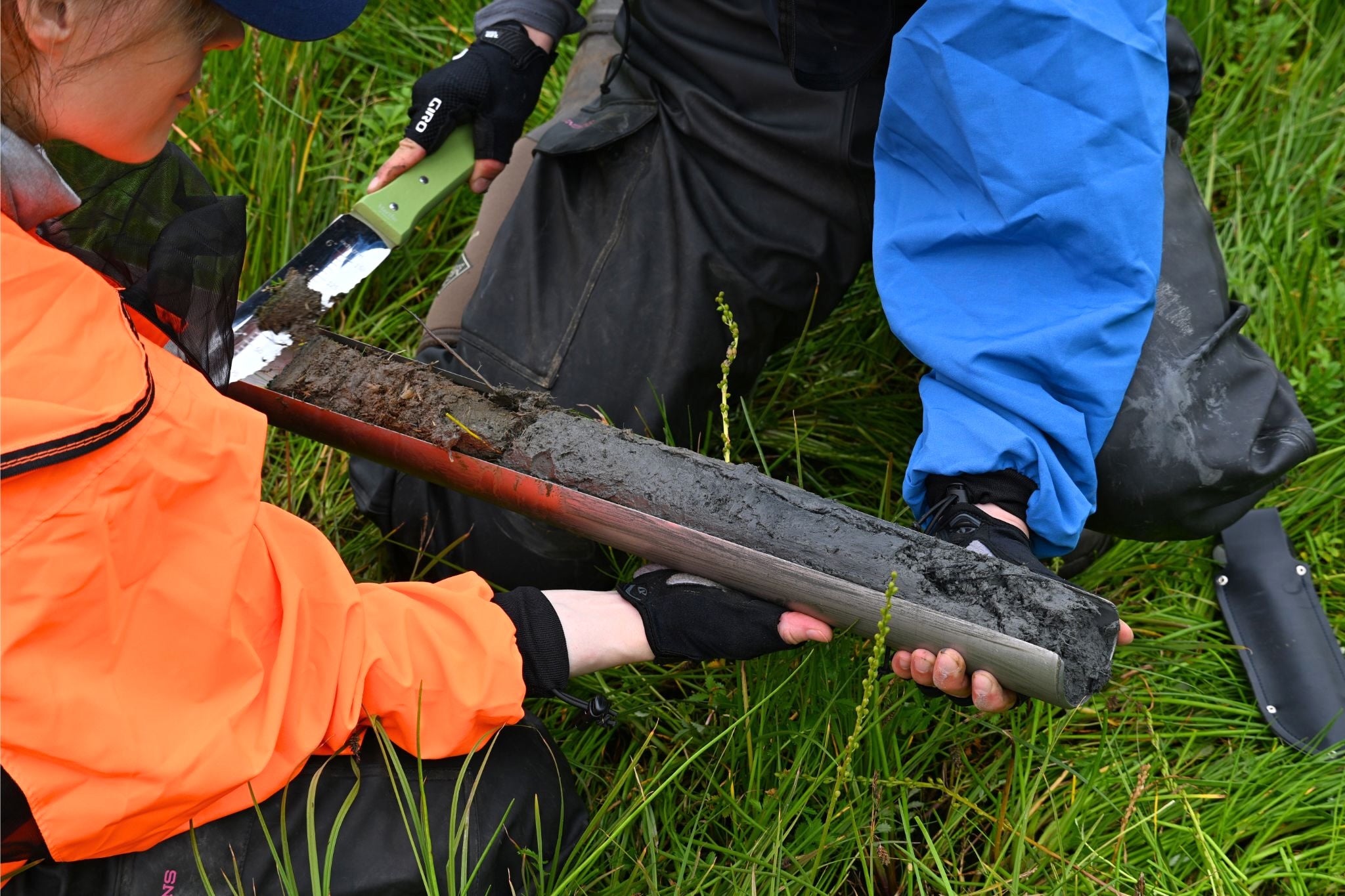
KINGSTON, R.I. – Dec. 4, 2025 – Coastal wetlands, like salt marshes, keep pace with sea-level rise by accumulating sediment and burying organic carbon in their soils, an important natural process that also helps sequester carbon. Accurately measuring this stored carbon is essential for understanding marsh resilience and informing blue carbon strategies.
But a new study led by Erin Peck, an assistant professor at the University of Rhode Island’s Graduate School of Oceanography, and Serina Wittyngham, an assistant professor at the University of North Florida, identifies a fundamental limitation in a widely-used method for measuring organic carbon in flooded coastal sediments. This gap has implications for global estimates of carbon storage and marsh resilience.
Traditional blue carbon methods assume that all measured organic matter contributes to long-term carbon storage and sediment volume. The new study shows this isn’t always the case. Some organic matter is dissolved in sediment porewater, while other portions adhere loosely to sediment particles or are bound within the internal structure of clay minerals. These forms of organic matter may not contribute to sediment volume, accretion, or marsh resilience.
By examining more than 23,000 tidal marsh sediment samples across multiple marsh systems, Peck, Wittyngham, and their collaborators demonstrated that this overlooked fraction of “volumeless” organic matter can lead to overestimates of both carbon storage and marsh elevation gains. Recognizing this nuance allows scientists to refine their estimates of carbon sequestration and resilience, ensuring that restoration planning, carbon accounting, and predictive modeling are based on the most accurate information possible.
The researchers’ findings were published recently in a peer-reviewed article in the journal Limnology and Oceanography Letters.
“This discovery came out of a simple question,” said Peck. “Serina and I were working on a project, trying to convert different components of a sediment core from mass to volume, and became frustrated that we couldn’t get the math to work out. Eventually, we realized that maybe we were missing something obvious—that not all our masses contribute to volume.”
“We started this ‘thought experiment’ by reflecting on sugar dissolved in water: you can dissolve a large mass of sugar without changing the volume of the water,” Wittyngham said. “This same concept applies to dissolved organic matter in sediments.”
Interdisciplinary collaboration
Peck, a geologist, and Wittyngham, an ecologist, emphasized the value of cross-disciplinary collaboration while conducting their research, noting that working together helped them move beyond the standard methods typically used in their individual fields.
“While writing about our research, we reviewed our calculations with modelers, biogeochemists, and a range of other researchers,” said Wittyngham. “This issue could affect anyone working with blue carbon across ecosystems, and we wanted to make sure we fully understood its implications.”
Refining blue carbon science
The researchers hope their findings will serve as a starting point for broader collaboration within the blue carbon community. They aim to develop correction factors to adjust previous measurements for volumeless organic matter, addressing this methodological limitation while preserving the value of data already collected.
Peck and Wittyngham emphasized the importance of working with the global scientific community to refine these methods while keeping data accessible. “We’re excited to collaborate with colleagues worldwide to improve blue carbon measurements and ensure the method remains open and usable for everyone,” Peck said.
By identifying and addressing this methodological gap, the study offers a constructive pathway to strengthen blue carbon science, improve coastal management decisions, and enhance predictions of marsh resilience in the face of sea level rise.
This story was written by Mackensie duPont Crowley, digital communications coordinator in URI’s Graduate School of Oceanography.