Freeport not counting on deals for growth, CEO says
Says more government incentives needed to boost US copper output
Grasberg expected to hit 90% capacity by mid-2026, back fully by end of 2027
NEW YORK, Dec 4 (Reuters) – Copper producer Freeport-McMoRan (FCX.N), opens new tab would pursue an acquisition if “the stars and the moon” aligned, but is not counting on deals to grow and is focused on developing existing assets, its CEO said on Thursday.
As an M&A frenzy envelops the mining industry, Freeport’s stance stands apart as global demand for the key electrification metal pushes rivals BHP (BHP.AX), opens new tab, Anglo American (AAL.L), opens new tab, and others to scramble for deals.
Sign up here.
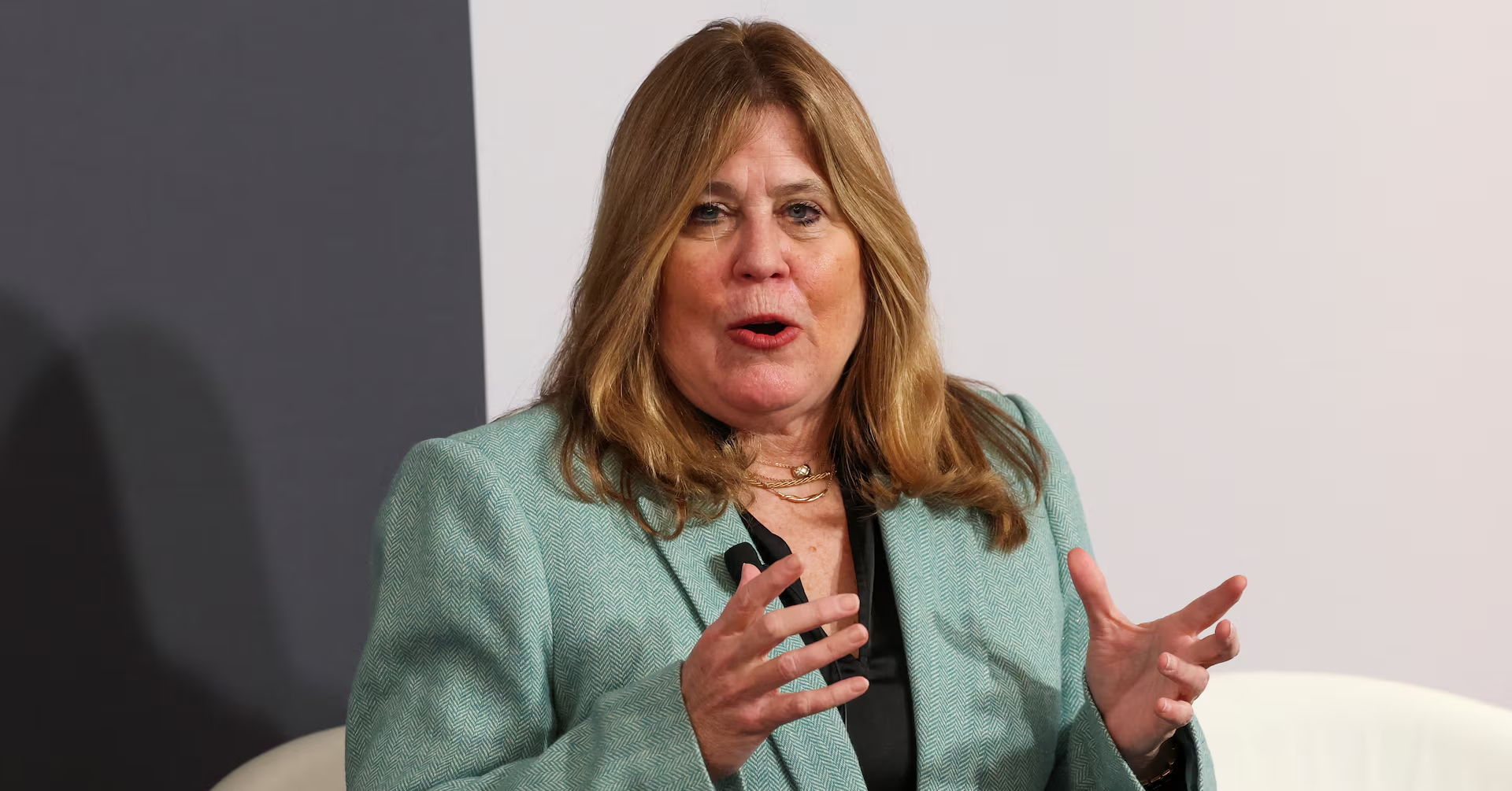
“You never say never about M&A, because we keep relationships around the industry … but we’re not counting on that,” Kathleen Quirk told the Reuters NEXT conference in New York. “The stars and the moon and everything would need to align.”
FREEPORT EYES NEW TECHNOLOGY
The world’s largest publicly traded copper company produced 1.26 billion pounds (571,530 metric tons) of copper in the U.S. last year and 4.1 billion pounds (1.86 million metric tons) globally.
By the end of the decade, Freeport aims to be producing 800 million pounds annually of copper outside of traditional mines with novel leaching technology in the U.S. That is roughly the size of a new mine’s output, yet at lower cost and with fewer regulatory issues.
“In the next five years in our U.S. business, we have the opportunity to grow by up to 50% through internal organic growth,” said Quirk, who became CEO of the Phoenix-based company last year after previously serving as finance chief. “We have the opportunity … to essentially build a new mine without spending a huge amount of capital.”
Freeport, which operates mines across the Americas and in Indonesia, would be interested only in buying a rival copper company or mine that could have synergies with its existing assets and technology, Quirk said.
Copper is used in construction, transportation, electronics, and many other industries. The U.S. imports roughly half of its copper needs each year and has only two active copper smelters, one of which Freeport owns.
SEEKING MORE INCENTIVES FROM WASHINGTON
Quirk called on the U.S. government to do more to protect the domestic copper industry from competitive global threats.
President Donald Trump in July imposed a 50% tariff on copper pipes, tubes, and other semi-finished products, but left out copper input materials such as ores, concentrates, and cathodes that Freeport produces.
The move was essentially a boost for Chile and Peru, two of the world’s largest copper miners and major suppliers, yet for Freeport, the final levy missed market expectations.
“If the U.S. wants to be self-sufficient in copper, some kind of incentive would help,” said Quirk, adding that permitting reform is one of the company’s other requests from Washington.
“We’re not going and asking Washington for handouts, but we are spending a lot of time with the administration to educate them on what we do.”
GRASBERG MINE FULLY ONLINE IN 2027
After a fatal accident in September at Freeport’s Grasberg copper and gold mine in Indonesia forced operations to halt, production should be 90% restored next year and fully back online by 2027, Quirk said.
The disaster was caused by mud that breached a previously undetected hole in the mine’s retired open pit and rushed into a zone where a two-person electrical crew and a five-person boring crew were working. Mud reached that area in minutes.
Quirk went to Indonesia after the disaster to meet with the miners’ families and recovery workers.
“Our team has taken it very hard, but we’ve unified together, and we’re committed to coming out stronger and safer in the future,” Quirk said.
View the live broadcast of the Reuters NEXT World Stage here and read full coverage here.
Reporting by Ernest Scheyder and Shariq Khan
Editing by Rod Nickel
Our Standards: The Thomson Reuters Trust Principles., opens new tab
Purchase Licensing Rights
Ernest Scheyder is a senior correspondent covering critical minerals and the global energy transition, as well as the author of “The War Below: Lithium, Copper, and the Global Battle to Power our Lives,” which was longlisted for the 2024 National Book Award and was named the American Energy Society’s Energy Book of the Year. He previously wrote about the U.S. shale revolution – drawing on a two-year stint based in oil-rich North Dakota – as well as politics and the environment. A native of Maine, Scheyder is a graduate of the University of Maine – where he was named a distinguished alumnus in 2021 – and Columbia Journalism School.
Shariq is a New York-based energy reporter and has led coverage of the destruction caused in the oil patch by the coronavirus pandemic, the industry’s rebuilding efforts, and the upheaval of trade routes from Russia’s invasion of Ukraine, among other major developments.