Chris ClementsScotland social affairs correspondent
 BBC
BBCPublic money will be used to plug gaps in a pension scheme run by an iconic bakery firm that collapsed in 2023.
Former workers at Morton’s Rolls Limited – well-known in the west of Scotland for its crispy morning rolls – had complained that their employer missed payments to the scheme in the run-up to its liquidation.
This was despite deductions being made from their salaries for their pension. BBC Scotland News has seen evidence of gaps in payments to the scheme of up to a year.
A spokesperson for the UK Insolvency Service tells the BBC that National Insurance funds will now be used to pay for the missing contributions.
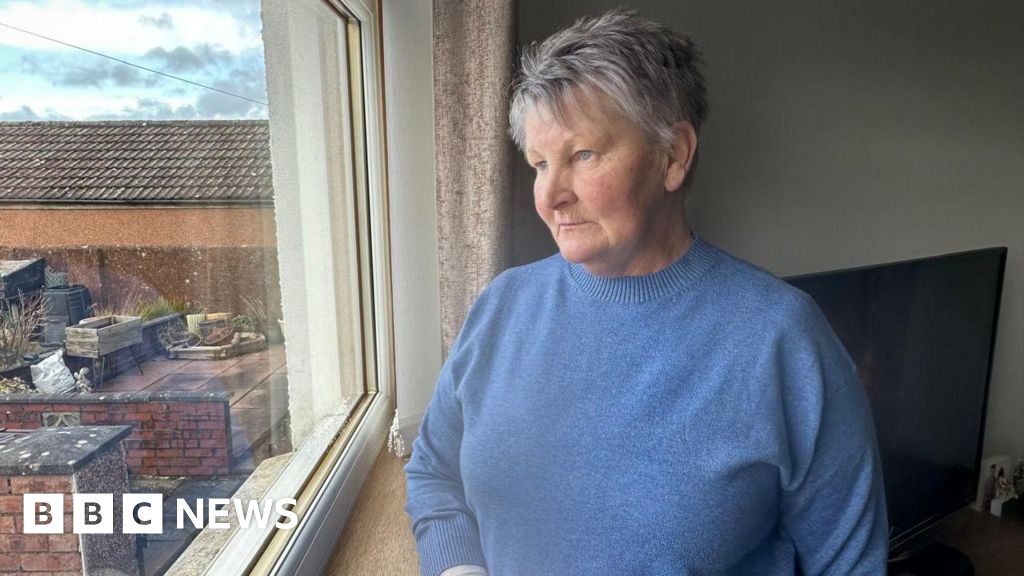
Nancy Dunnachie, 65, the widow of a former Morton’s Rolls employee tells BBC Scotland: “He kept going on about how they were a ‘shower of rogues’.”
She is talking about her late husband’s former employer as she sifts through a pile of letters from his pension company.
Each letter bears the same heading – ‘payment due to your pension plan’ – and they span a period from 2020 to 2023.
The letters from Standard Life inform William Dunnachie, a former driver for the Glasgow bakery company, that a “payment expected from your employer for [date] was not received for the latest date for payment”.

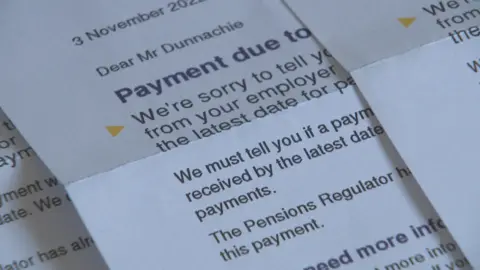
Payments had been missed by Morton’s in various months across the three-year period.
Ms Dunnachie says she has lost count of how many similar letters she has.
She then shows us the payslips from the same period as the letters. They show clear deductions by his employer from William Dunnachie’s earnings for his pension fund.
“He kept getting all these letters in to say that the pension hadn’t been paid,” she says. “But it had been coming off his wages. I think he had asked two or three folk about it, and obviously the boys at work had been talking about it too.
“They [the company] were taking the money off his wages and they weren’t paying it… So where is that money?”
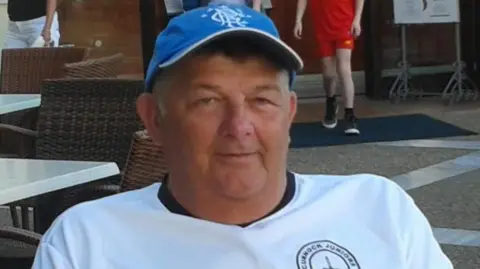
Wullie – to those that knew him – died of a heart attack last October while waiting for redundancy money. He was 66.
At her home in Cumnock, Ayrshire, Ms Dunnachie shows the BBC a redundancy cheque for more than £13,000. It finally arrived last month after a two-year legal battle over who would cover the costs.
She says it is money she can’t yet access due to it being in her husband’s name.
And she still wants answers about his pension deductions made by Morton’s Rolls Limited.

The BBC spoke to a number of former Morton’s employees who complained of missing pension payments – money they claim the collapsed company had deducted from their salary but had failed to pass on to Standard Life’s pension scheme.
One worker sent us emails showing how he had been complaining about the issue as early as 2019.
Another is Alan Love, 64, a former driver who served 32 years at Morton’s.
He showed the BBC a statement provided by Standard Life that showed numerous gaps in payments made by Morton’s Rolls Limited. This includes a gap between December 2021 and January 2023.
When asked where his pension payments had gone, he says. “It gets taken off my wages every week, so you tell me.
“For the first couple of years we paid into that scheme, there was never any problem.
“And then, all of a sudden, you’re behind. And then you’re going further behind.
“And then you’re playing catch-up, and then mega catch-up.
“Then the place goes bust and you are two years light on your pension… That isn’t right.”
Alan Love tells the BBC he had contacted the Pensions Regulator (TPR) – a UK body that protects workplace pensions – about the issue before the company went bust.
“It’s not about blowing the lid on anything,” he says. “It’s about getting those payments back, how do I get them back?
“I told them, if this place goes into liquidation, I’ll be playing catch-up.
“And as God is my judge, the only time I didn’t pay into the pension was the week before we went into liquidation.”
A TPR spokesperson said: “We do not comment on individual pension schemes or employers unless appropriate to do so.”
 Family handout
William Dunnachie had also worked for Morton’s for 32 years. He was let go in March 2023.
The Drumchapel-based company – well-known across the west of Scotland for its crispy morning rolls – had been suffering financial difficulties before its eventual collapse, with 230 workers being made redundant.
Less than a month later, 110 workers were recalled to work after Morton’s assets were taken over by a new company, Phoenix Volt Limited. A former director of the collapsed company now works for the new company.
Because the former company is in liquidation, there followed a two-year court dispute as 98 workers fought for payouts from the UK government’s Redundancy Payments Service (RPS).
Normally, workers could claim a redundancy payment, but the government argued they were not entitled and said jobs were protected as they had been transferred to the new owner.
Last week, an employment tribunal ruled that workers were entitled to payments as the company was already in liquidation at the time the business was transferred.
The RPS will now pay those funds from the National Insurance Fund.
Paul Kissen, of Thompsons Solicitors, represented the claim.
He estimates his clients could share about £500,000 in redundancy payments.
“There was a level of legitimacy to the government’s challenge because it had to be determined through a complex tribunal process to establish that it was liable,” he says.
“But I think the impact of having to wait so long is unsatisfactory. In my view, if there was a way to expedite this process if there are so many people, that would be the best outcome.”
He is now looking to secure compensation – a “protective award” for Morton’s Rolls failing to consult its employees before redundancy.
Mr Kissen said total payments for his clients could reach £1m – all paid for from the National Insurance Fund.
“Some of these people worked at the company for over 30 years. As a result of the sudden dismissal, they were without any financial means for a long period of time,” he adds.
“Many people managed to secure benefits, many of them didn’t. Some people took very unwell and one of my clients sadly passed away.”
He also told the BBC that some of his clients – William Dunnachie, Alan Love and others – had complained of missing pensions payments.
‘Established process’
A spokesperson for Standard Life tells the BBC there is an “established process” when employer pension contributions are late.
“This was triggered in the case with Morton’s Rolls Limited prior to its insolvency,” he says.
“Employers have until the 21st of the following month to pay outstanding contributions, after which the pension provider initiates a 90-day process to chase contributions.
“If payments are still outstanding at this point, the provider is obliged to inform the Pension Regulator who has a number of enforcement powers to try and pursue contributions with the employer.
“At this point, the pension provider also issues letters to members to inform them about the outstanding contributions.”
In 2023, FRP advisory Trading was appointed administrator of Morton’s Rolls Limited.
The administrator told the BBC that a fresh application was being made to the RPS to cover unpaid pension contributions.
Under the scheme, employees can reclaim contributions deducted from their pay, but not paid into their pension, for the 12 months before the employer became insolvent.
An Insolvency Service spokesperson said: “The Insolvency Service has reviewed the ruling and has decided not to appeal the decision, and the Redundancy Payments Service is currently making payments, including pension payments, to affected employees.”