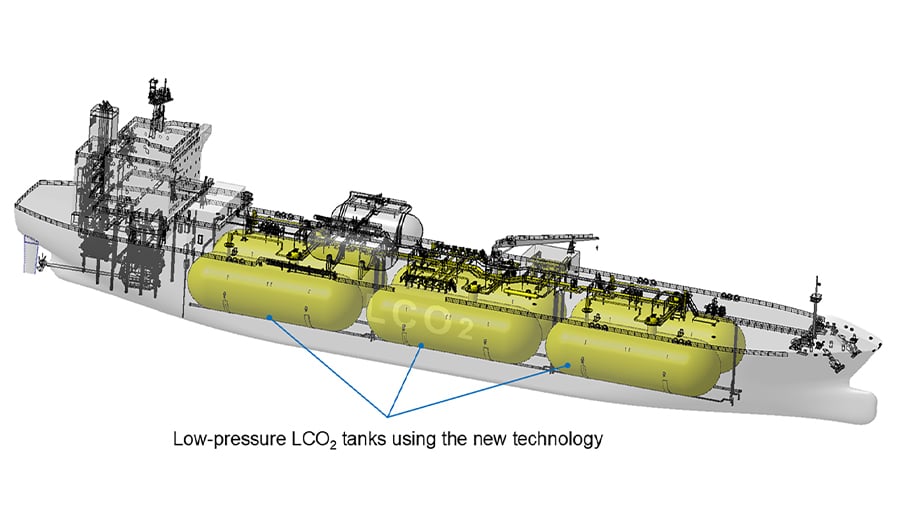
Illustration of a Ship with Low-pressure LCO2 Tanks
As part of Mitsubishi Shipbuilding’s cross-industry initiatives to standardize large LCO2 carriers, both companies are collaborating to develop the steel for large LCO2 tanks and establish a PWHT-exempt manufacturing process based on ECA to achieve both economic viability and productivity.
When an economical high-strength carbon-manganese steel is used in large LCO2 tank manufacturing, PWHT is generally required for tank welds as per IGC code(Note4). However, heat-treatment furnaces capable of annealing large LCO2 tanks are extremely limited, and this manufacturing process has become a significant obstacle to tank enlargement and a stable supply.
To address this issue, Mitsubishi Shipbuilding evaluated the integrity of tank welds through an ECA based on the steel plate properties developed by Nippon Steel. The results of ECA demonstrated the validity of manufacturing process without PWHT and received GDA.
Nippon Steel developed the steel that conforms to NK standard of KF460(Note5) —with high strength, excellent low-temperature toughness, and economic viability—to enable the PWHT-exemption technology for large low-pressure LCO2 tanks developed by Mitsubishi Shipbuilding.
The acquisition of this GDA represents a remarkable breakthrough achieved by the technical cooperation between the two companies, and it will contribute greatly to reducing LCO2 transportation costs by ensuring the safety of low-pressure LCO2 tanks while delivering both economic viability and productivity. Mitsubishi Shipbuilding and Nippon Steel will build on this joint success and work with supply-chain partners involved in LCO2 tank manufacturing to commercialize the developed steel and low-pressure LCO2 tanks.
MHI Group is currently pursuing strategic measures to strengthen its business for the energy transition. In conjunction with this initiative, Mitsubishi Shipbuilding is making efforts to contribute to the advancement of the maritime industries in Japan and around the world by utilizing its shipbuilding-based marine engineering technologies in addition to conventional shipbuilding. The development of this low-pressure LCO2 tank technology is one example of these efforts. Collaboration with Nippon Steel also demonstrates MHI Group’s commitment to partnerships. Moving forward, Mitsubishi Shipbuilding will continue to build strategic global partnerships both to incorporate external expertise and actively advance the development of a CCUS value chain. Through these efforts, the company aims to provide its technologies, products and services to ever more customers.
Nippon Steel has set out the Nippon Steel Carbon Neutral Vision 2050 to support the aim of realizing a carbon neutral society in 2050. In addition to reducing CO2 emissions in its own manufacturing processes, by delivering advanced products and solution technologies under the NSCarbolex™ Solution(Note6) brand, it also aims to contribute to the reduction of CO2 emissions in society. The developed steel among this joint development project with Mitsubishi Shipbuilding corresponds to the Thermo-Mechanical Control Process (TMCP) steel of NSCarbolex Solution, enhances the economic performance of entire CCUS value chains, and makes a significant contribution to their realization. CO2 reduction is an urgent issue across all industries, and Nippon Steel will continue to advance products and solution technologies to support its customers’ decarbonization and competitiveness, contributing to the realization of a carbon neutral society.
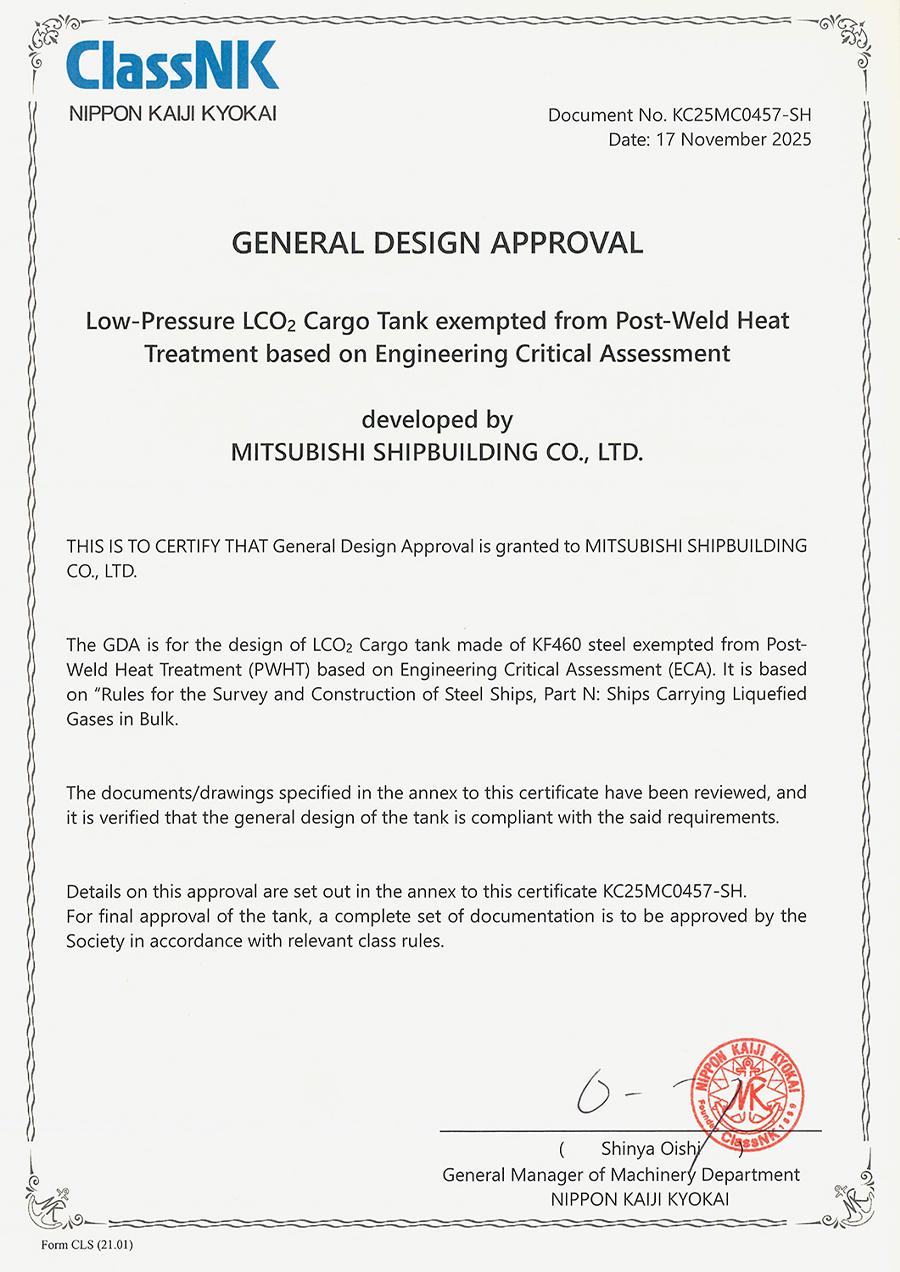
GDA Certification
- 1In post-weld heat treatment (PWHT), welded structural materials are reheated to a specified temperature and held at that temperature for a defined period. This process aims to relieve residual stress generated during welding and improve the quality of welding joints. PWHT is generally performed in a dedicated furnace. When the products are of large size, furnace size may cause bottlenecks in the manufacturing process.
- 2Engineering Critical Assessment (ECA) is an evaluation method that uses assumed micro initial defects in the welds and the estimated stress history together with material and welding properties, to confirm that no major failures will occur in the welds during the product’s service life.
- 3General Design Approval (GDA) indicates that a certification body has reviewed design documents equivalent to a product’s final documents and confirmed that the subject equipment meets technical requirements and relevant safety standards. In this case, the review was conducted based on the IGC Code and ClassNK classification rules applicable to ships transporting liquefied gases in bulk.
- 4IGC Code (The International Code for the Construction and Equipment of Ships Carrying Liquefied Gases in Bulk) is an international regulation stipulating conditions to ensure the safety of vessels that transport liquefied gases (LCO2, LNG, etc.) in bulk.
- 5KF460 steel is a carbon-manganese steel with excellent low-temperature properties, as specified under ClassNK classification rules for ships. According to the rules, these high-tensile strength rolled steel plates must have a yield strength of at least 460N/mm2 and a tensile strength of at least 540N/mm2.
- 6NSCarbolex Solution is a Nippon Steel brand encompassing advanced products and solution technologies that contribute to the reduction of CO2 emissions in society. For an overview of NSCarbolex Solution, see the following website:
https://www.nipponsteel.com/en/product/nscarbolex/solution/