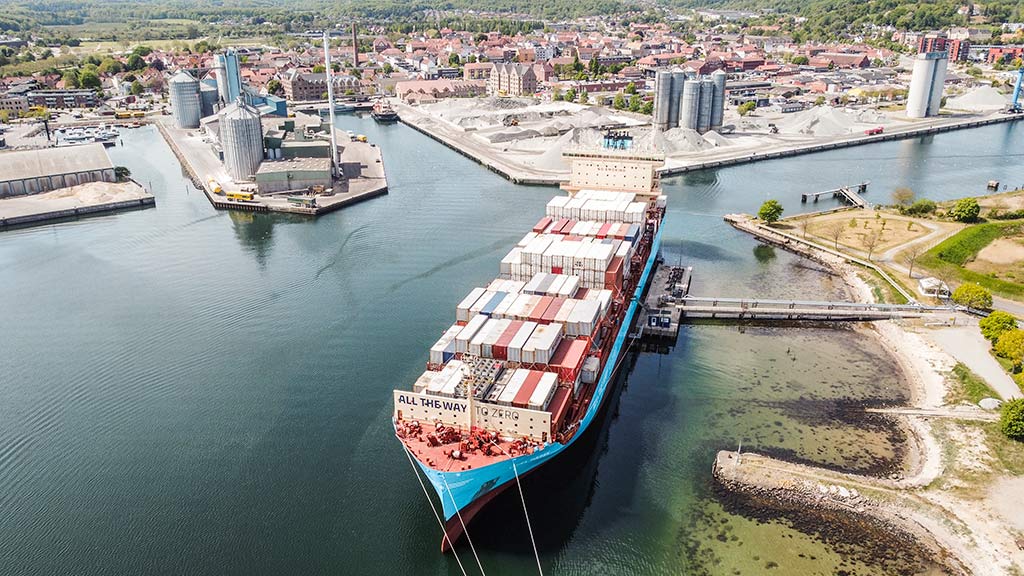
- Maersk to trial 50/50 ethanol-methanol blend on the vessel Laura Mærsk
- Initial E10 test confirmed safe integration and strong performance
- Ethanol offers another scalable, lower emission fuel option for decarbonisation
Copenhagen, Denmark – Maersk continues to explore options to diversify its low-emission fuel portfolio by testing ethanol in a dual-fuel methanol engine. Building on a successful initial trial, the company will now blend 50% ethanol with 50% methanol in a test onboard the vessel Laura Mærsk.
The first trial, conducted in October and November, involved a 10% ethanol / 90% e-methanol blend and confirmed that ethanol can be safely and effectively integrated into the fuel mix. The test underscores the potential to create greater optionality for Maersk’s dual-fuel methanol fleet, essentially enabling dual fuel alcohol vessels.
At Maersk, we believe multiple fuel pathways are essential for the shipping industry to meet its climate ambitions. That means consciously exploring different options and technologies.
Laura Mærsk, the world’s first dual-fuel container vessel operating on methanol, was designed for methanol as the alternative fuel. Because ethanol and methanol are both alcohols, they share similar properties. The initial trial tested whether an E10 blend would ignite and burn as efficiently as pure methanol while maintaining comparable lubricity and corrosiveness.
The results confirm that ethanol can be blended with methanol without compromising engine performance, paving the way for higher ethanol blends. Beyond the upcoming E50 test, Maersk plans to conduct a trial using 100% ethanol.
Ethanol has a proven track record with an established market and existing infrastructure and offers an additional pathway for decarbonisation. By gradually increasing ethanol content, we gain valuable insights into engine performance and combustion impacts, informing fuel sourcing potential.
About ethanol:
- The ethanol applied for the tests is so-called anhydrous ethanol, the same type of ethanol currently applied for blending into gasoline in several countries around the globe.
- The US is the largest ethanol producer in the world, followed by Brazil. The two comprise 80% of the World market.
- Collaboration with stakeholders and partners like engine manufacturers is key to supporting the exploration of ethanol as a fuel for dual fuel vessels.
- As there already is a strong ethanol market, it offers optionality towards delivering on Maersk’s climate targets.
- Ethanol is produced from biomass such as corn or sugar cane.
- It is important to ensure that the specific type of ethanol used does not directly or indirectly contribute to land conversion and deforestation and does not compete with food and feed.
- Maersk is in the process of assessing the potential role of selecting first-generation, crop-based fuels such as ethanol in our transitional fuel mix. This review is being conducted under robust sustainability criteria covering lifecycle greenhouse gas emissions, traceability, certification standards, and responsible sourcing practices.
To future-proof its fleet, Maersk in 2021 decided to exclusively order vessels with dual fuel capabilities. By 2025, 19 dual fuel vessels will be operating in the Maersk fleet. The current low-emission fuel portfolio includes bio- and e-methanol, biodiesel, and from 2027, liquefied biomethane, and LNG as the fossil alternative, will be added with the arrival of time-chartered dual fuel LNG vessels.
See this video below explaining our first test, the 10% ethanol trial: