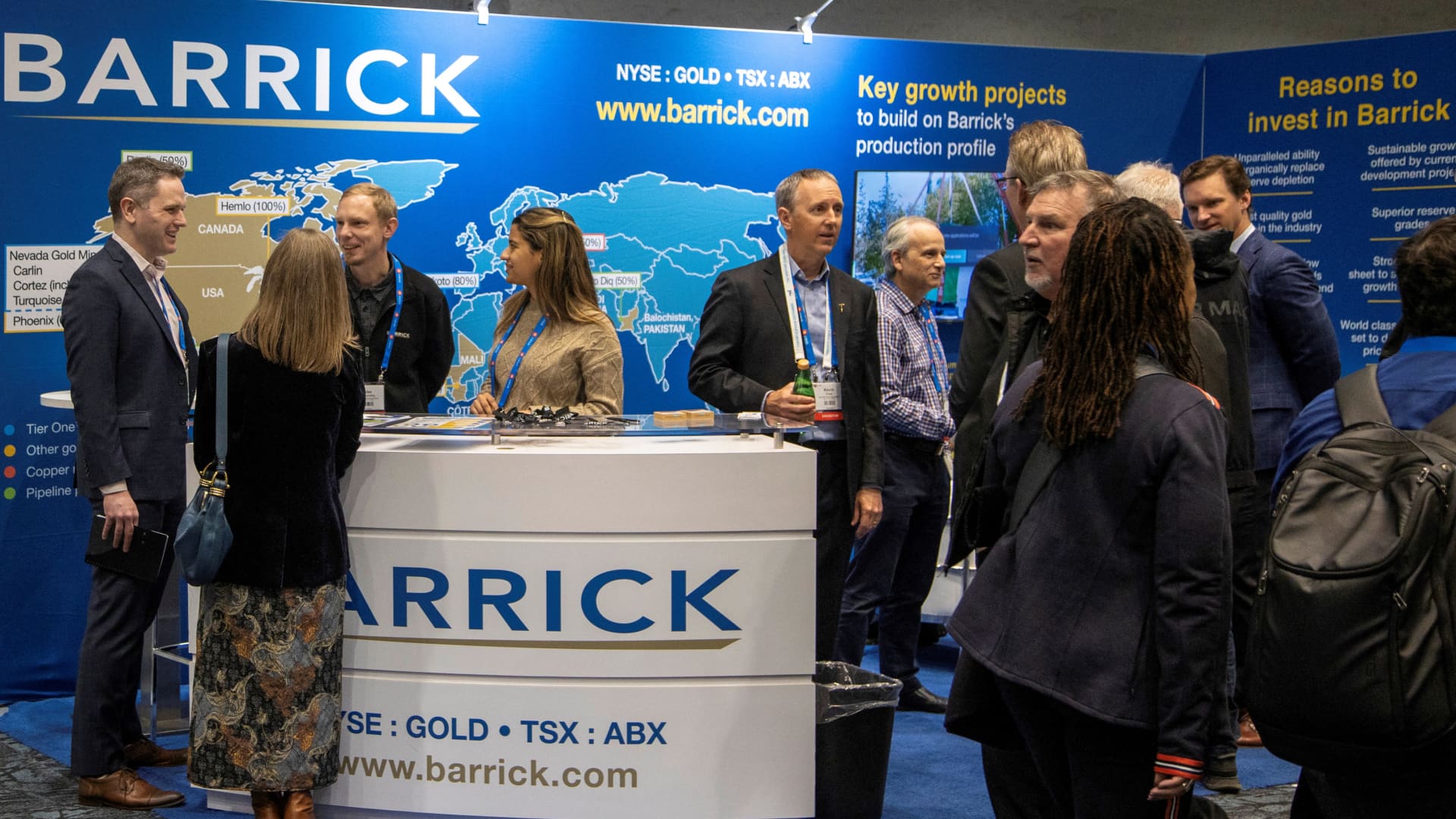
Attendees speak with representatives at the Barrick booth, at the Prospectors and Developers Association of Canada (PDAC) annual mining conference in Toronto, Ontario, Canada March 3, 2025.
Carlos Osorio | Reuters
Company: Barrick Mining (B)
Business: Barrick Mining, formerly Barrick Gold Corporation, is a gold and copper producer, which is engaged in the production and sale of gold and copper, as well as related activities, such as exploration and mine development. It has ownership interests in producing gold mines in Argentina, Canada, Cote d’Ivoire, the Democratic Republic of Congo, the Dominican Republic, Papua New Guinea, Tanzania and the United States. Its copper mines are in Zambia, Chile and Saudi Arabia. Its operations include Nevada Gold Mines, Bulyanhulu, Hemlo, Jabal Sayid, Kibali, Loulo-Gounkoto, Lumwana, North Mara, Porgera, Pueblo Viejo, Tongon, Veladero and Zaldivar. Its Bulyanhulu operation is located in northwest Tanzania, over 55 kilometers south of Lake Victoria and 150 km southwest of the city of Mwanza. The Jabal Sayid copper operation is located 350 km northeast of Jeddah in the Kingdom of Saudi Arabia. The Lumwana copper mine is a conventional open pit operation.
Stock Market Value: $69.16 billion ($40.38 per share)
Barrick Mining shares year to date
Activist: Elliott Investment Management
Ownership: n/a
Average Cost: n/a
Activist Commentary: Elliott is a multistrategy investment firm that manages about $76.1 billion in assets (as of June 30, 2025) and is one of the oldest firms of its type under continuous management. Known for its extensive due diligence and resources, Elliott regularly follows companies for years before making an investment. Elliott is the most active of activist investors, engaging with companies across industries and multiple geographies.
What’s happening
On Nov. 18, Elliott announced a position in Barrick Mining and expressed its interest in seeing a potential separation of North American assets from its mines in riskier regions across Asia and Africa. Most recently, on Dec. 1, Barrick announced that the board has authorized the company to explore a potential separation of the North American assets.
Behind the scenes
Barrick Mining is a Toronto-based global mining company focused predominantly on gold, operating 14 gold mines, as well as three additional cooper mines. The core of this business is its North America Gold assets, which consists of some of the highest quality deposits in the world, specifically Nevada Gold Mines, a joint venture with Newmont in which Barrick owns 61.5% and serves as its operator. The company also operates gold mines in Africa, the Middle East, Latin America, and Asia. Its copper portfolio is centered around Africa and the Middle East, including Reko Diq, a new copper development project in Pakistan.
With the recent bull market for gold, Barrick’s stock has more than doubled over the past six months. Despite this, Barrick continues to trade at 0.9 times its price to net asset value ratio, a significant discount to North American peers, who trade well above 1x, with best-in-class peers like Agnico Eagle trading at approximately 1.5x.
Investors buy gold companies primarily for gold price exposure, and from there prefer the companies with the best management teams that operate the companies most efficiently to best isolate the value of the commodity. Barrick has not been a top operator amongst its peers and, as a result, they abruptly parted ways with their CEO in September and replaced him with Mark Hill, the former COO, as interim CEO.
An interim CEO creates two very valuable opportunities for an activist in a company like Barrick. First and most importantly, they get to have a voice in who the new CEO will be regardless of whether they settle with the company for a board seat or just remain an outspoken shareholder. While they may not always be in the room when the discussions are had or the decision is made, we know of no CEO who would take a job at a company with an activist like Elliott engaging unless they knew that Elliott approved of the hiring.
Second, when a company has an interim CEO, it is an advantageous time to explore strategic alternatives, and a breakup of this company has always been the elephant in the room.
Barrick’s North American operations have been sullied by the company’s exposure to higher-risk regions and separating the two would go a long way to close the valuation gap between Barrick and Agnico Eagle.
The value proposition for a breakup is clear and even something management has discussed. In a presentation released in May, management demonstrated that applying a peer-like multiple to Barrick’s North American assets could unlock as much as 49% of unrealized value. Since then, the price of gold has appreciated by over 70% but the company’s stock has appreciated by more than 100%, so much of that gain has been realized but there is still some value to be realized from a breakup.
Elliott has a history of taking board seats at companies not for activist’s sake, but only when they feel that the director they are putting on the board could genuinely add value for shareholders. In this case, the breakup of the company is something that is being seriously considered by the board, and Elliott, just by its existence, is likely to have at least negative approval power over the new CEO.
Moreover, Elliott does not act impetuously in its activism. They have likely had a position in Barrick for many months at this point and have already received a great return from the company’s 100% appreciation in the past six months. We would not expect them to escalate their activism here unless either the board goes down a path they didn’t expect and don’t agree with, or it is at the company’s invitation to join the board to assist with the tasks ahead.
Ken Squire is the founder and president of 13D Monitor, an institutional research service on shareholder activism, and the founder and portfolio manager of the 13D Activist Fund, a mutual fund that invests in a portfolio of activist investments.