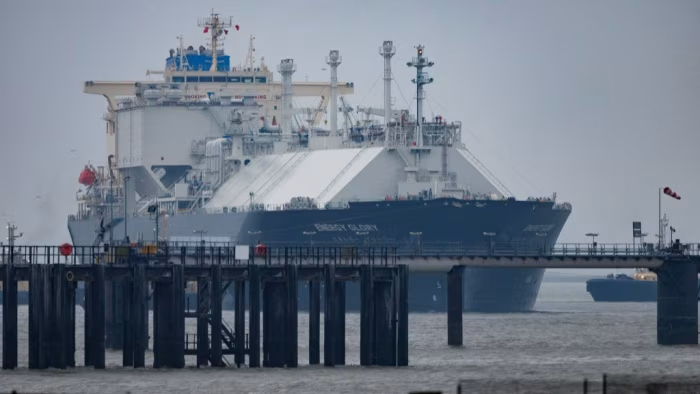
US natural gas prices are soaring as the country ships record amounts of the fuel overseas, contributing to an affordability crisis that is causing political problems for Donald Trump.
Wholesale prices have jumped more than 70 per cent in the past 12 months, with the US benchmark Henry Hub price settling at $5.29 on Friday, its highest level since December 21 2022 during the energy crisis sparked by Russia’s full-scale invasion of Ukraine.
The price surge is contributing to a deepening sense of runaway costs in the US, and flies in the face of Trump’s claims to have driven down energy prices during his first year back in office.
It comes alongside frigid temperatures across the US, pushing up demand for power generation to heat homes and businesses.
Trump has prioritised boosting LNG exports overseas and gas production at home to fuel the AI boom, as part of a strategy to unleash “US energy dominance”.
But he faces growing pushback from consumers and industry concerned that rising power prices are worsening a “cost of living crisis” and denting competitiveness.
“As North America exports more natural gas, it imports higher and more volatile gas prices as a result,” said Clark Williams-Derry, analyst at the Institute for Energy Economics and Financial Analysis, a think-tank backed by environmental foundations.
“This is great news for the gas industry, which has seen a bump in revenues. But it’s not so great if you’re a US consumer who relies on gas for heating or power,” he said.
Analysts say it may also reflect a structural shift in gas pricing, as an increasing share of production is diverted to booming LNG exports and an anticipated rise in demand from energy-hungry artificial intelligence data centres.
“During the coldest days of winter, LNG exports and local consumers are competing for the same supply molecules. In extreme weather scenarios, there may not be enough gas supply to satisfy both,” said Eric McGuire, analyst at Wood Mackenzie, an energy consultancy.
Industrial Energy Consumers of America, a group representing large energy-consuming manufacturers, said US policymakers should prioritise domestic customers over LNG exports.
“As export volumes grow, price and reliability risks increase for US consumers and directly impact manufacturing competitiveness,” said Paul Cicio, chief executive of the Industrial Energy Consumers of America.
“We do not have an alternative. We are stuck at the end of a pipeline.”
A Yahoo/YouGov poll published last week found that by a two-to-one margin, respondents believed Trump had done more to raise prices (49 per cent) than lower them (24%). This week, the president described cost-of-living concerns as a “con job by the Democrats”.
During last year’s election campaign Trump promised to cut energy prices in half during his first 12 months in office — a message that resonated with voters stung by high inflation and energy costs during the Biden administration.
But since his election the cost of electricity and gas piped into homes has continued to climb, with rates increasing by 5.1 per cent and 11.7 per cent respectively in September, compared to a year earlier, data published by the US Bureau of Labor Statistics shows.
The average price of natural gas paid by electric power plants this year will increase by 37 per cent and the price paid by industrial sector customers will rise by 21 per cent compared to the 2024 averages, according to the Energy Information Administration, the US government’s statistical arm.
Residential and commercial consumers are expected to pay 4 per cent more this year on average, compared to last year.
In September the US exported a record 9.41mn metric tonnes of LNG, up nearly 20 per cent in the same month a year earlier, according to the EIA.
US LNG helped supply Europe during the worst energy crisis in decades, as the continent tried to wean itself off Russian energy after Moscow ordered the full-scale invasion of Ukraine, with the primary destination for US cargoes including Spain, France, the UK and the Netherlands.
The LNG industry and gas producers argue surging LNG exports are not to blame for rising retail prices, as there is no shortage of gas to drill in the US. Instead, they blame a political failure to enable the construction of new pipelines and gas storage facilities, to supply key markets.
“It’s not AI, it’s not LNG exports. It’s very simple. It’s because political force has overwhelmed market forces and political force has shown up in the form of pipeline and energy infrastructure blockages,” said Toby Rice, chief executive of EQT, the largest gas producer in the US.
A lack of infrastructure is causing markets in the US to become disconnected, according to EQT, which expects to sell gas for approximately $4 per million British thermal units this winter in Appalachia while Boston and parts of New England will pay a much higher rate of close to $14 per mmbtu for natural gas, owing to very limited pipeline capacity to the city.
“This isn’t just the most expensive natural gas in the country, it’s the most expensive natural gas in the world,” said Rice.
But analysts say booming LNG supply, growing demand from data centres and rising cost of extracting gas from some US basins, such as the Haynesville, would maintain pressure on natural gas prices.
“Between now and 2030, LNG export capacity in the US Gulf Coast will double what it is currently and that will definitely have an impact on price,” said Mathieu Utting, analyst at Rystad.