Unlock the Editor’s Digest for free
Roula Khalaf, Editor of the FT, selects her favourite stories in this weekly newsletter.
Ben & Jerry’s co-founder Ben Cohen has clashed with the boss of Unilever’s ice cream spin-off after being told to “hand over to a new generation”, escalating a feud over the direction of the activist brand.
The row threatens to overshadow the demerger of the Magnum Ice Cream Company from its FTSE 100 parent as its shares start trading in Amsterdam on Monday.
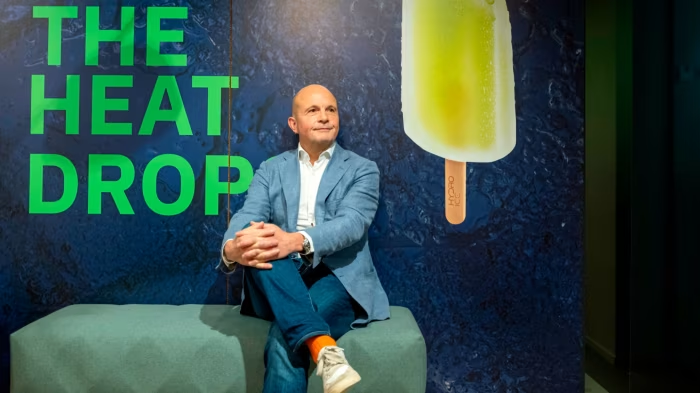
Peter ter Kulve, Magnum’s chief executive, said that Cohen and Jerry Greenfield were in their seventies and “at a certain moment they need to hand over to a new generation”.
Their “commitment to the brand, to the causes, has been immense, but at a certain moment you need to hand it over . . . we need to move on”, he told the Financial Times in comments that also pertained to trustees of Ben & Jerry’s charitable arm, Jeff Furman and Liz Bankowski.
Cohen and Greenfield have become increasingly vocal about their dissatisfaction with the direction of the brand they launched almost 50 years ago and sold to Unilever for $326mn in 2000.
That deal put in place an independent board to protect the brand’s social mission and integrity. It also allowed Unilever to choose the chief executive, but only a minority of directors.
The co-founders have accused Unilever, and now Magnum — the ice cream business being spun off by the consumer goods giant — of impeding its activism. Greenfield quit Unilever in protest in September.
Cohen said: “Unlike Magnum, I don’t think there is an age limit on campaigning for social justice and peace. This is another attempt to silence the social mission that we are all too familiar with, as Unilever attempts to wash their hands of Ben & Jerry’s through this IPO. But Ben & Jerry’s social mission has always been inseparable from the brand itself, and it is legally protected.”
Greenfield, Furman and Bankowski did not respond to requests for comment.
Shares in the maker of Magnum, Carte D’Or, Cornetto and Solero will start trading on Monday in Amsterdam following the demerger from Unilever. Secondary listings in New York and London will take place later in the week.
Magnum will be the world’s largest ice cream company, with more than a fifth of the global market and annual revenues of €8bn. It is expected to perform better as a standalone company than as part of Unilever, which will retain a 19.9 per cent stake.

Magnum will inherit the campaigning Cohen, its most vocal employee, who has called on the parent to “free” the Chunky Monkey and Cookie Dough maker, and tried to raise funds to buy back Ben & Jerry’s.
Magnum also inherits a long-running legal spat with the Ben & Jerry’s board over its powers to define the company’s direction.
The board has accused Unilever of blocking its call for a ceasefire in Gaza, preventing it from supporting Palestinian refugees, and ousting David Stever as chief executive of Ben & Jerry’s earlier this year for failing to comply with Unilever’s attempts to silence the brand.
As the disputes drag on, Ter Kulve is cracking down on governance at the board and the brand’s charitable arm, the Ben & Jerry’s Foundation, which was funded by Unilever, and now Magnum.
Magnum said last month following an external investigation that Anuradha Mittal, chair of the brand’s independent board, “no longer meets the criteria” to serve but did not say why. People familiar with the matter said the investigation had uncovered conflicts of interest, again without disclosing what they were.
Counsel for the Ben & Jerry’s board said that Unilever’s “phantom allegations” were part of a campaign against Mittal due to her “efforts to protect the independence of Ben & Jerry’s under the merger agreement”.
The audit of the charity, meanwhile, uncovered “material deficiencies” in financial controls, governance and compliance, including conflicts of interest.
Ter Kulve said: “A significant amount of money, €5mn to €6mn a year goes to the foundation. I can’t continue to fund [the foundation] unless we basically have complied with the conclusions of the audit, and we’re working on that.”
Underlining his ambition for Ben & Jerry’s to break from the past, ter Kulve said he planned to expand the brand beyond its traditional tubs into sticks and ice cream sandwiches next year to capitalise on growing health awareness and consumer preference for smaller portion sizes.
“That was the big opportunity when you take a brand like Ben and Jerry’s . . . they were stuck in the pint [tub] for a very long time.”
Unilever announced it would spin off its ice cream division last year as part of a plan to slim down the sprawling multinational through lay-offs and divestments. Ter Kulve has set a medium-term organic sales growth target of 3 per cent, which is considered ambitious by analysts.
Barclays forecast a potential share price range of €20.78 to €21.46, based on an estimated equity value of €10.2bn to €10.5bn.