In December 2015, the Paris Agreement was adopted. It aims to limit the global average temperature increase to well below 2°C above pre-industrial levels, and to increase parties’ ability to adapt to the adverse impacts of climate change and make financial flows consistent with a pathway toward low GHG emissions and climate resilient development. Each party shall communicate, at five-year intervals, successively more ambitious NDCs.
At COP29 in Baku last year, a new collective quantified goal (NCQG) on climate finance, to at least USD 300 billion per year by 2035, was reached, calling on all actors to work together to scale up financing to developing countries for climate action from all public and private sources.
Meanwhile, it is expected that the next round of NDCs must deliver on the promise to ramp up renewables and transition away from fossil fuels. At the Bonn June Climate meetings in preparation of annual COP, the closing statement includes a renewed call for fossil fuel phase out, concerns about limited progress on technology and the need for a clear roadmap to the USD 1.3 trillion in climate finance to deliver concrete milestones. It also puts the most vulnerable at the center and supports a tripling of adaptation finance.
Expectations from COP30 in Belem are very high, including synthesis reports on NDCs and biennial transparency reports. While concerns about climate change are on the rise and negotiations will continue for many years to come, it is important to remind ourselves that climate change is not just about CO2; it is about overconsumption and irresponsible production, irresponsible extraction and use of material. If actions at individual level are important, it is through collective action for a common good, based on the principles of SCP and circular economy, that the fight against climate impacts and building the path towards sustainability can be achieved.
Guided by science and economy, policy makers can bridge the gap between what is possible and what is needed by knowingly advancing policies that will be well received by most, embracing pragmatism to build trust before handling the most serious and complicated issues, starting with what is possible, creating momentum and helping catalyze new technologies, new economics, and new politics, making accelerated change possible.
Webinar Session:
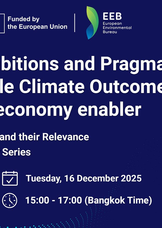
The EU SWITCH-Asia Policy Support Component and the European Environmental Bureau, are convening the webinar, Between Ambitions and Pragmatism for actionable climate outcomes: the circular economy enabler.
The objectives of the webinar are:
- To assess the key conclusions, decisions and directions from UNFCCC COP30 with special reference to integration of circular economy principles into climate mitigation and adaptation strategies.
- To explore how the circular economy-climate linkages could support the operationalization of the COP30 outcomes and their potential impacts to de-risk and attract public and private finance, thereby transforming markets and value chains towards low-carbon and climate-resilient economies.
- To discuss the policies, partnerships, and support mechanisms required to empower businesses, particularly SMEs, as central actors in implementing circular, low-carbon, and resilient solutions at scale.
- To discuss and derive concrete policy guidance and actionable strategies from the COP30 stocktake, focusing on how to effectively implement the material-CE-climate nexus for accelerated on-the-ground results.