China’s hydrogen industry is poised for major growth as the country intensifies the development of infrastructure and promotes end-use applications as a low-carbon fuel. In its current form, however, the industry is still heavily reliant on fossil fuels, and the green hydrogen segment is still in its infancy. These realities present both exciting opportunities for early investments and intrinsic early-mover risks, as infrastructure and value chains remain immature and future demand growth is uncertain. Foreign investors can seek to capitalize on the country’s bet on the emerging fuel source by selecting strategic and limited entry points and exploring the scope of possibilities.
China is doubling down on its bet on hydrogen as a potentially revolutionary clean energy source. Viewed as a means of diversifying the country’s energy mix and bolstering energy security, the clean-burning fuel may also prove key to decarbonizing hard-to-abate sectors such as transportation, steel, and chemicals. But as in the rest of the world, current production and utilization of hydrogen remain closely tied to the petrochemicals and coal industries. Most hydrogen is currently produced from fossil fuels, and its use is still concentrated in refinery, petrochemicals, and other energy-intensive industrial processes.
China’s green hydrogen industry is still in its infancy, both in terms of large-scale production and diversified end-use applications. Due to its significant potential as a low-carbon energy source, the sector nonetheless enjoys strong government attention and support. It has been outlined as one of six “future industries” (along with nuclear fusion energy) of focus for the 15th Five-Year Plan period (2026 to 2030). This creates meaningful potential for future technological development, expanded adoption, and access to government incentives as the sector grows.
Against this backdrop, opportunities for foreign investment emerge across multiple segments of the hydrogen value chain. Potential entry points range from production technologies and equipment to storage and transport solutions, to downstream applications in transportation, industrial heating, and chemical processing. These openings reflect both the scale of China’s future hydrogen ambitions and the ongoing need for advanced technologies, high-quality equipment, and operational expertise as the industry evolves.
Start exploring
Overview of China’s hydrogen industry
Hydrogen production
China is the world’s leading producer of hydrogen. In 2024, total hydrogen output grew 3.5 percent year-on-year to 36.5 million metric tons, according to the National Energy Administration (NEA), accounting for over a third of global production.
As is the case worldwide, China’s hydrogen production is primarily based on the coal and petrochemical industries. The majority of hydrogen in China is the so-called “black” or “brown” hydrogen, which comes from coal, a high-emitting source most commonly produced through the process of gasification. According to the NEA, around 56 percent of China’s total hydrogen production came from coal and 21 percent from natural gas. A further 21 percent was produced as an industry by-product (usually from the petrochemical industry). Only around 1 percent was produced through electrolysis, the process of using electricity to split water into oxygen and hydrogen, which, if produced using renewable energy sources, is the cleanest form of hydrogen.
This proportion aligns with global production trends. According to the International Energy Agency (IEA), less than 1 percent of global hydrogen production in 2024 came from low-emissions sources.
Hydrogen production in China is primarily concentrated in the north and northwest, with the provinces of Shandong, Inner Mongolia, Shaanxi, Ningxia, and Shanxi together accounting for 45 percent of total output in 2024.
Hydrogen utilization
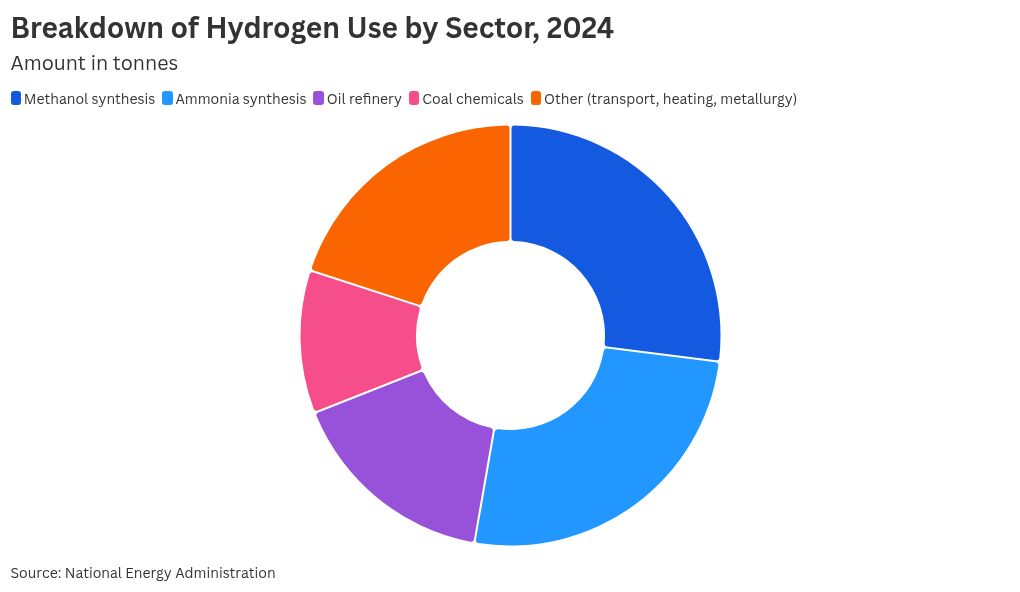
According to NEA data, in 2024, over half of China’s hydrogen – a combined 53 percent – was used in the methanol and ammonia synthesis industries, while the refinery industry consumed 16 percent and the coal chemical industry 11 percent. The remaining 20 percent was utilized in industries such as transportation, heating, and metallurgy.
As with production, hydrogen consumption is mainly concentrated in traditional heavy industrial provinces such as Shandong, Inner Mongolia, Shaanxi, Ningxia, and Shanxi.
Green hydrogen projects
While green hydrogen accounts for just a small proportion of China’s overall hydrogen production, the country is expanding output capacity, in particular in areas with rich renewable energy resources.
According to the NEA, there were over 600 planned renewable energy hydrogen electrolysis projects at the end of 2024, of which 94 had been completed, and a further 83 were under construction. The current output of the completed green hydrogen projects at the end of 2024 was 125,000 tonnes per year. Northern and northwestern China account for around 45 percent and 44 percent of this capacity, respectively, driven by these regions’ strong traditional industrial bases and rich renewable resources.
Find Business Support

2024 alone saw the completion of 35 new green hydrogen products with a combined output capacity of 48,000 tonnes per year. This was an increase of 62 percent in newly added capacity from the previous year. The main downstream uses of this green hydrogen were transport, oil refinery, and ammonia and methanol synthesis, as well as metallurgy, heating, power generation, energy storage, and scientific research.
China’s total green hydrogen capacity may see yet another increase in 2025, with the government actively funding a number of green hydrogen demonstration projects. In April 2025, the National Development and Reform Commission (NDRC) included nine green hydrogen projects in a list of advanced green and low-carbon technology demonstration projects, which will receive government investment. The projects, which cover the production, storage, and transmission of green hydrogen, among other processes, are primarily located in Inner Mongolia, Ningxia, Jiangsu, Tianjin, and Xinjiang.
According to a recent report from the Centre for Research on Energy and Clean Air (CREA), the combined capacity of the electrolyzers of these nine projects is 5.9GW – seven times the capacity of the green hydrogen projects included on the 2024 list.
Transportation and fuel cell vehicles
As in the rest of the world, China’s hydrogen fuel cell vehicle (FCV) industry is still in its infancy. According to data from the China Association of Automobile Manufacturers (CAAM) cited by the media, between 2015 and 2024, a total of 24,042 FCVs had been produced in China and 23,501 sold. In 2024, only 5,548 FCVs were manufactured, a year-on-year decline of 10.4 percent. FCV sales were similarly low, with just 5,405 sold, falling 12.6 percent from 2023.
The industry appears to have fared no better in 2025; CAAM data shows that in the first six months of the year, only 1,364 hydrogen FCVs were produced, a drop of 47.2 percent year-on-year, and only 1,373 were sold, down 46.8 percent year-on-year.
As the data shows, the industry has not taken off as quickly as hoped. A key hydrogen development plan released by the National Development and Reform Commission (NDRC) in 2022 targeted for China to have a fleet of around 50,000 hydrogen FCVs by 2025 – a figure it appears unlikely to reach. The slow uptake is due in part to the limited production and supportive infrastructure, such as refueling stations, which hamper widespread production and adoption. According to the NEA, there were around 540 hydrogen refueling stations at the end of 2024.
The NEA nonetheless notes key technological breakthroughs in the deployment of hydrogen and hydrogen-derived fuels for transport in recent years. These include a long-haul hydrogen-powered logistics trial on the Beijing–Shanghai expressway, the rollout of a 2,400-kW hydrogen-powered train, and the first flight of a prototype light hydrogen-combustion aircraft. Progress has also extended to maritime applications, with the methanol-fueled vessel Guoneng Yangtze 01 entering commercial operations, a 5,500-horsepower ammonia-fueled tugboat completing marine ammonia bunkering, and a large methanol-powered container ship carrying out ship-to-ship refueling.
Policy landscape
In 2022, the NDRC released the Medium- and Long-Term Development Plan for the Hydrogen Energy Industry (2021-2035) (the “2021 to 2030 Development Plan), which sets targets and provides policy guidance for the industry’s development.
Find Business Support
This plan called hydrogen energy “an important component of the future national energy system” and a “crucial conveyor for achieving the green and low-carbon transition in energy end uses”, underscoring how the government views the technology as an important tool for both national energy security and decarbonization.
Over the past few years, the Chinese government has elevated the hydrogen industry as one of the “future industries” with significant potential for expansion and application. The 14th Five-Year Plan (the national development plan for the period from 2021 to 2025) called for the government to “organize and implement future industry incubation and acceleration programs, and plan and deploy a number of future industries”, which included hydrogen energy and energy storage.
The sector was also mentioned in the proposals for the 15th Five-Year Plan, released at the end of October 2025, which acts as the blueprint for the finalized plan, which will be implemented in 2026. It specifically calls for “proactively planning for future industries, exploring a variety of technological routes, typical application scenarios, feasible business models, and market regulatory rules to promote […] hydrogen energy”, among other emerging sectors, and to “innovate regulatory methods, develop venture capital, and establish mechanisms for increasing investment and sharing risks in [these] future industries”.
Key development targets
The 2021 to 2030 Development Plan sets a series of five-, 10-, and 15-year goals for the development of hydrogen production and adoption. However, it only sets numerical targets for 2025, namely:
- Have a fleet of around 50,000 fuel cell vehicles in operation and deploy and construct “a batch” of hydrogen refueling stations.
- Increase renewable energy hydrogen production to 100,000 to 200,000 tonnes/year, reducing carbon dioxide emissions by 1 to 2 million tonnes/year.
By 2030, China will strive to have formed “a relatively complete hydrogen energy industry technology innovation system and clean energy hydrogen production and supply system, with a rational and orderly industrial layout. Renewable energy hydrogen production will be widely applied, strongly supporting the achievement of the [2030] carbon peak target”.
By 2035, “a hydrogen energy industry system will be formed”, supporting a diversified hydrogen energy application ecosystem that covers transportation, energy storage, and industry. Additionally, the proportion of hydrogen from renewable energy sources in final energy consumption will have “increased significantly” and will play “an important supporting role in the green transformation and development of energy”.
Development and adoption of green hydrogen
At the end of 2024, the Ministry of Industry and Information Technology (MIIT) released the Implementation Plan for Accelerating the Application of Clean and Low-Carbon Hydrogen in Industrial Sectors (the “Green Hydrogen Implementation Plan”), which builds on the 2021 to 2030 Development Plan to set more granular targets and policy outlines for the production and utilization of green hydrogen.
The Green Hydrogen Implementation Plan’s core aim is to achieve significant progress in “supporting equipment and promoting technologies for clean and low-carbon hydrogen applications in the industrial sector” by the year 2027. It highlights key industries for application, including metallurgy, synthetic ammonia, synthetic methanol, and oil refinery. It also calls for deploying demonstration applications in fields such as industrial green microgrids, shipping, aviation, and rail transportation, and to create commercial application models for hydrogen energy in transportation, power generation, and energy storage.
Opportunities for foreign investors in China’s hydrogen industry
For foreign investors, China’s hydrogen sector offers a combination of challenges and opportunities. While it is a nascent industry with considerable room for growth, many viable applications and benefits of the technology have already been proven across multiple fields. The sector also has strong policy backing and an expectation of rising demand as technologies mature and costs decline. At the same time, early movers face clear risks, from underdeveloped infrastructure and evolving standards to potential setbacks associated with the commercialization of emerging technologies.
Despite these challenges, the outlook of China’s hydrogen industry is compelling, and the Chinese government continues to spotlight a number of hydrogen-related segments as priority areas for development. Additionally, the 2022 edition of the Catalogue of Encouraged Industries for Foreign Investment (the “2022 FI Encouraged Catalogue”) includes several fields related to hydrogen energy, including FCVs, equipment manufacturing, and technology R&D.
Equipment manufacturing and technology development
Equipment manufacturing remains a strong area of opportunity for foreign investors, particularly as China works to build out the full hydrogen value chain. The 2022 FI Encouraged Catalogue includes green hydrogen production technologies, such as hydrogen from chemical by-products, biological hydrogen production, and renewable-energy-based electrolysis, as well as hydrogen storage, transportation, and liquefaction. This reflects broad openness to foreign firms engaged in the core technologies required to produce and handle hydrogen at scale.
Foreign companies with advanced manufacturing expertise and proprietary technologies can find demand across multiple equipment categories. These include electrolyzers, membrane and catalyst materials, compressors, high-pressure storage systems, liquid hydrogen equipment, and purification and transport systems.
In addition, opportunities exist in upstream technology development. As China seeks to expand green hydrogen production and improve the performance of production and storage systems, companies offering innovations in electrolysis efficiency, materials science, and modular system design are well-positioned to collaborate with local partners or establish localized manufacturing. For foreign investors, this segment offers a pathway to participate in China’s emerging hydrogen ecosystem while contributing high-value technologies and capabilities.
Hydrogen FCVs
One tangible opportunity for foreign investors in the hydrogen industry is the development of hydrogen FCVs. Although the industry has faced setbacks in recent years, continuous policy support means there is still a strong possibility for the market’s future growth.
China has identified hydrogen-powered transportation as a strategic growth area, offering both policy support and a clear roadmap for industry development. The 2022 FI Encouraged Catalogue explicitly includes several activities related to FCVs. These include the design and R&D of hydrogen fuel cell power systems, the construction and operation of hydrogen refueling stations, and the development, manufacturing, and operation of new energy storage equipment, including hydrogen storage.
Find Business Support
Policy directives outlined in the Green Hydrogen Implementation Plan further reinforce these opportunities. The plan emphasizes technological innovation in fuel cells and hydrogen storage, encouraging the development of high-power, efficient, and long-life fuel cells, high-efficiency hydrogen or ammonia internal combustion engines, and high-pressure, high-density onboard hydrogen storage systems.
Demonstration projects are also being encouraged to integrate renewable hydrogen and high-quality industrial by-product hydrogen, supporting distributed hydrogen production and refueling stations. Simultaneously, the scale-up of FCV use in industrial clusters, such as industrial parks, logistics hubs, ports, and mines, is a priority, creating opportunities for foreign companies to supply vehicles, refueling infrastructure, fleet management systems, and operational expertise. The government also supports the creation of “district-to-district” hydrogen energy logistics corridors and city clusters for fuel cell vehicle demonstrations, while initiatives such as “Hydrogen for All” promote applications across highways, ports, industrial zones, and commercial equipment, further opening avenues for technology deployment and commercialization.
Investors should nonetheless be aware of the risks associated with entering an immature industry. China’s hydrogen FCV industry has stagnated, despite government support for pilot projects. The sector continues to suffer from high costs for fuel cells and refueling stations, the limited number and inconvenient locations of refueling stations, and the high price of hydrogen due to limited supply.
For this reason, foreign investors should approach the market with caution, prioritizing cost reduction strategies, such as utilizing lower-cost black or brown hydrogen in the short term and focusing initially on applications that may be easier to commercialize, such as trucks and freight transport, rather than passenger vehicles. Investors may also look at the construction and operation of hydrogen fueling stations, as well as R&D and manufacturing of hydrogen FCV components such as hydrogen circulation pumps, hydrogen ejectors, 70MPa hydrogen cylinders, and vehicle-mounted hydrogen concentration sensors, all of which are listed in the 2022 FI Encouraged Catalog.
At the same time, policy incentives will remain critical to industry growth, making it essential for investors to closely monitor evolving government support and align market entry or expansion plans accordingly.
Clean and low-carbon hydrogen alternatives
China is placing strong emphasis on replacing fossil-fuel-based hydrogen with cleaner alternatives across its industrial system, creating a range of opportunities for foreign technology providers and project developers.
Related Reading

The Green Hydrogen Implementation Plan promotes several areas for development in this field. First, major energy- and materials-intensive sectors, such as refining, petrochemicals, coal chemicals, non-ferrous metals, semiconductors, and pharmaceuticals, are being encouraged to substitute conventional fossil-derived hydrogen with clean or low-carbon hydrogen. This shift is expected to generate demand for advanced electrolysis technologies, hydrogen purification systems, and equipment that can be integrated into existing production lines.
Second, authorities are prioritizing the development of low-cost renewable-energy-based hydrogen production. This includes advancing “solar + storage” solutions, promoting integrated “hydrogen production + hydrogen use” projects in regions rich in wind and solar resources, and supporting off-grid or weak-grid hydrogen production models. These initiatives open space for foreign firms with expertise in renewable integration, energy storage, and high-efficiency power electronics.
The plan also highlights frontier areas such as coupling industrial waste heat with high-temperature electrolysis and leveraging offshore wind for hydrogen production. In addition, China is encouraging the scaled-up purification of industrial by-product hydrogen and the installation of carbon capture, utilization, and storage (CCUS) systems at fossil-based hydrogen facilities, creating further opportunities for specialized equipment and engineering services.
A promising but uncertain future
China’s hydrogen industry presents a complex but promising landscape for foreign investors. On the demand side, hydrogen’s potential role in decarbonizing hard-to-abate sectors positions it as a strategic future energy source with significant long-term growth prospects. This potential is further reinforced by strong government backing, with hydrogen repeatedly identified as a priority emerging industry and a focus of national development planning. These factors create a potentially favorable environment for foreign participation across multiple segments of the value chain.
At the same time, the industry’s immaturity poses inherent risks. Production, infrastructure, and end-use applications are still developing, and recent years have shown that market growth can be slower and more uneven than expected. For this reason, investors should adopt a cautious and selective approach, targeting segments where early commercial opportunities exist, limiting exposure in areas facing high uncertainty, and aligning closely with evolving policy incentives.
About Us
China Briefing is one of five regional Asia Briefing publications. It is supported by Dezan Shira & Associates, a pan-Asia, multi-disciplinary professional services firm that assists foreign investors throughout Asia, including through offices in Beijing, Tianjin, Dalian, Qingdao, Shanghai, Hangzhou, Ningbo, Suzhou, Guangzhou, Haikou, Zhongshan, Shenzhen, and Hong Kong in China. Dezan Shira & Associates also maintains offices or has alliance partners assisting foreign investors in Vietnam, Indonesia, Singapore, India, Malaysia, Mongolia, Dubai (UAE), Japan, South Korea, Nepal, The Philippines, Sri Lanka, Thailand, Italy, Germany, Bangladesh, Australia, United States, and United Kingdom and Ireland.
For a complimentary subscription to China Briefing’s content products, please click here. For support with establishing a business in China or for assistance in analyzing and entering markets, please contact the firm at china@dezshira.com or visit our website at www.dezshira.com.