Unlock the Editor’s Digest for free
Roula Khalaf, Editor of the FT, selects her favourite stories in this weekly newsletter.
A top Bank of England policymaker has warned against rapid interest rate cuts despite anti-inflation measures in the Budget, as splits persist within the bank’s key committee ahead of a vote next week.
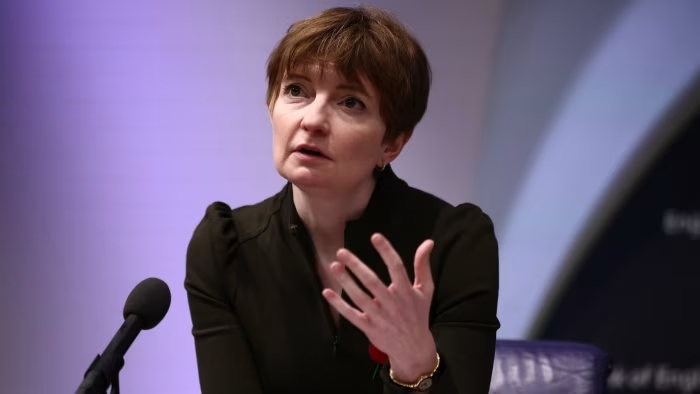
Clare Lombardelli, a BoE deputy governor, stressed the “upside risks” to inflation as she argued for a cautious approach to further rate reductions as the bank gets closer to a more neutral level of interest rates.
This came despite BoE analysis that shows measures in Rachel Reeves’ Budget aimed at easing the cost of living could trim as much as 0.5 percentage points from inflation next year.
“We have been on this path for some time; my view is as you approach your turning point off that path, and you don’t know where it is, you might slow down a bit,” Lombardelli said. “I worry more about the upside risks to inflation.”
Her words on Tuesday came in a meeting of the Treasury select committee ahead of the BoE’s rate-setting meeting next week. Markets are expecting the bank to trim another quarter point from rates at the meeting, but the hearing suggested members of the Monetary Policy Committee remain heavily divided.
Lombardelli was one of five MPC members who voted against a rate reduction in a narrow decision to hold rates at 4 per cent at the BoE’s November meeting. Among those who sided with her in the vote was external MPC member Catherine Mann, who questions whether inflation will decelerate as rapidly as the BoE’s central forecast implies.
“I have been sceptical that headline CPI inflation will decelerate so quickly and sustainably to the 2 per cent target by mid-2027 as outlined in the November Monetary Policy Report,” Mann said in a written report to MPs on Tuesday.
“However, my concerns for sticky inflation, particularly of services, would be assuaged if the employment outlook deteriorates faster than projected.”
By contrast, BoE deputy governor Dave Ramsden called for a quarter-point rate reduction at the November meeting. In his written report to the Treasury committee, Ramsden struck a dovish tone on the rates outlook.
Absent unforeseen shocks, he said, “I think we can have increasing confidence that the currently restrictive level of Bank Rate will support the disinflation process, and bring headline inflation below 3 per cent by spring 2026 and back towards the 2 per cent target by 2027.”
Swati Dhingra, another external MPC member, said that given the slowdown in the labour market, she did not see why higher inflation expectations would translate into a resurgence of inflation. “I don’t see a particular need to be so restrictive at this point,” she said.
Lombardelli said rate-setters needed to be “open-minded” about the impact of Budget measures aimed at easing household utility bills as well as other costs, including rail fares. These should reduce headline inflation by between 0.4 and 0.5 percentage points in the second quarter of next year, she argued.
But she said other Budget measures pointed to slightly looser policy in the near term.
The BoE needed to be careful about rate reductions as it got closer to the end of its rate-cutting cycle. “I am very worried that we are seeing more pressure on resources in the economy, and that obviously leads to price rises,” she added.
“I am also perhaps less convinced than others about how restrictive monetary policy is at the moment.”
A key factor in next week’s BoE meeting is the stance of governor Andrew Bailey, who was not testifying at the Treasury committee hearing on Tuesday. He has emerged as the key swing voter in next week’s meeting.
In the November MPC meeting, Bailey left the door open to a move as soon as next week, saying “upside risks to inflation have become less pressing since August, and I see further policy easing to come if disinflation becomes more clearly established in the period ahead”.