Unlock the Editor’s Digest for free
Roula Khalaf, Editor of the FT, selects her favourite stories in this weekly newsletter.
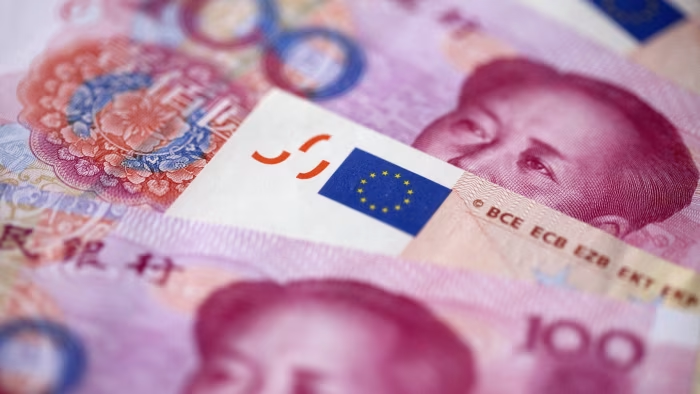
Beijing is keeping the renminbi heavily undervalued against the euro, European companies have warned, giving Chinese exporters an advantage and raising the risk of increased trade retaliation.
The warning from the EU Chamber of Commerce in China comes just days after data indicating the country’s annual goods trade surplus will exceed $1tn for the first time.
In a report released on Wednesday, the chamber said the renminbi had weakened to a 10-year low against the euro this year, even though China’s huge trade income should be driving an appreciation of its currency.
Economists say China’s real effective exchange rate — its weighted average against a broader basket of currencies — has depreciated 18 per cent from its peak in March 2022 during the Covid-19 pandemic. Prices in China have fallen during that time due to weak domestic demand and industrial oversupply.
“An undervalued renminbi is a subsidy for exports,” said Jens Eskelund, president of the EU chamber. He said this realisation would make it “easier” for China’s trading partners to take retaliatory actions, such as anti-dumping investigations and the imposition of tariffs.
“I think there needs to be a discussion about the real exchange rate . . . on its impact for both the Chinese economy and for China’s trade partners,” Eskelund said.
The People’s Bank of China closely controls the renminbi exchange rate, but Beijing says it abides by market principles and denies manipulating the currency for political purposes.
China has repeatedly reported large trade surpluses with the rest of the world since the pandemic, relying on export growth to offset a weak domestic economy suffering from a property slump.
Instead of a large-scale effort to boost domestic demand, Beijing has prioritised industry, particularly high-tech sectors, as it competes with the US for economic supremacy.
While China’s economies of scale and efficiency are credited with driving the increase in its global export market share, economists say the depreciation of its exchange rate has also played a strong role.
“China’s extraordinary competitiveness can be neatly summarised by movements in its real effective exchange rate,” said HSBC in a report.
Brad Setser, a senior fellow at the Council on Foreign Relations, and Mark Sobel, US chair of think-tank OMFIF, called on China to let the renminbi appreciate in a paper last month, saying this would reduce geopolitically sensitive trade surpluses and boost domestic demand by increasing consumers’ spending power.
Jürgen Matthes, analyst at the German Economic Institute in Cologne (IW), also argued in a July report that the euro had appreciated in real terms based on producer prices by more than 40 per cent against the renminbi in the euro area between early 2020 and spring 2025.
Matthes said Europe’s rising trade deficit should have led to higher net demand for the renminbi. “Thus, the yuan should have appreciated if it was floating freely,” he wrote.
China portrays itself as a pillar of global trade in the face of US President Donald Trump’s tariff war.
“I believe that only through open co-operation can we create a larger space for incremental growth,” China’s second-ranked leader, Premier Li Qiang, told a Beijing gathering of officials from international agencies on Tuesday that included IMF managing director Kristalina Georgieva.
The EU chamber report came amid a flurry of surveys by other chambers in Beijing that show foreign companies are still finding it hard to do business in China.
But reports by the German and UK chambers showed some were finding a niche partnering with Chinese companies investing abroad.
In the case of UK companies, conditions were improving for the legal profession after British firms were licensed to open more joint law operations with Chinese counterparts.
Harry Bell, policy and advocacy manager at the British Chamber of Commerce in China, said the joint ventures had contributed to soaring optimism in the legal services sector. The better sentiment was also due to firms’ “ability to help and support Chinese companies going global”, he said.