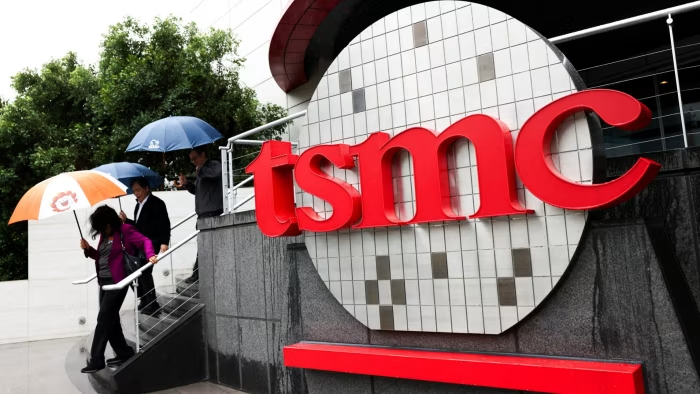
Taiwan has begun trade secrets investigations in its critical chipmaking sector under newly broadened national security laws, but the probes have raised eyebrows for who they are targeting: not companies from China but from the island nation’s closest allies.
Last week, prosecutors charged the local subsidiary of Japanese chip equipment maker Tokyo Electron with failing to prevent alleged theft of trade secrets from Taiwan Semiconductor Manufacturing Company.
A week earlier, prosecutors raided two homes of former TSMC executive Lo Wei-jen, who joined Intel after he left the Taiwanese company in July, as part of a probe into whether the 75-year-old was sharing “national core critical technology” with his new employer.
The probe came after TSMC sued Lo for violating his non-compete agreement, saying it was highly probable he “uses, leaks, discloses, delivers or transfers TSMC’s trade secrets and confidential information to Intel”.
Legal and industry experts in Taiwan said they were glad to finally see investigators getting serious about protecting a technology that had made Taiwan indispensable to the global economy. TSMC is the world’s largest chipmaker and dominates the market for cutting-edge semiconductors.
But, unexpectedly, the first trade secrets cases under national security laws are not implicating companies from China — long seen as the main culprit in technology theft and the biggest threat to Taiwan’s security — but Tokyo Electron, a supplier, and Intel, a customer and rival. Both companies are from countries viewed as Taiwan’s closest partners.
The cases have emerged amid concern in Taipei over the reliability of its main security backer given US President Donald Trump’s desire to make a “deal” with China, as well as his remarks about Taiwan “stealing” America’s chip business and allegedly freeriding on defence support.
An executive at a Taiwanese chip company in the US likened the investigations to a “man bites dog” scenario, saying the probes went against both the narrative that Beijing was poaching Taiwanese talent and Trump’s position that Taiwan had stolen the US’s technological leadership.
A US executive at a fund invested in semiconductor companies warned that Taipei’s more aggressive protection of its economic security could create risks for its geopolitical security by offending the US.
“This is not a good look for Taiwan right now,” said the executive. “Do they really think they can afford to go after US efforts to revive its chip manufacturing industry?”
Under pressure from the Trump administration, TSMC raised its US investment commitment by $100bn to $165bn in March. But Washington has made clear this is not enough. Trump administration officials have said they want 50 per cent of chip manufacturing to happen onshore, far more than TSMC’s expanded capacity can deliver.
In August, Washington agreed to take a 10 per cent stake in Intel as it aimed to resurrect the struggling company as a national champion of semiconductor manufacturing.
Neither TSMC nor the prosecution has targeted Intel directly or suggested its involvement in alleged technology theft. Prosecutors are only investigating Lo and have not brought charges against him. But observers suggested Washington could apply political leverage on any Taiwanese legal case.
“Taiwan has very limited options to refuse US requests and pressure” because it was pursuing a trade deal to lower Washington’s 20 per cent tariff on Taiwanese exports, said James Chen, a professor at Tamkang University in Taipei. It is also seeking US support for President Lai Ching-te’s tough approach towards China.
Provisions introduced in 2022 made the unauthorised transfer of “national core critical technology” to a foreign entity a national security offence for the first time, with a clear focus on China, to which Taiwan has been losing chip engineers for years.
In one of the most prominent controversies, Liang Mong-song, a former TSMC research and development executive, joined Semiconductor Manufacturing International Company, China’s largest chipmaker, in 2017 and is now its co-chief executive. He and the many TSMC engineers who followed him are credited with helping SMIC narrow its technology gap with the Taiwanese chipmaker.
The national security law amendments have raised the risk of such moves and stipulate much higher fines for leaking trade secrets to China than to allies such as Japan and the US.
But experts said the law still fell short. Tsai Ing-wen, Lai’s predecessor, initially aimed for a government role in initiating trade secrets cases through broad national security powers. The law adopted by parliament only allows prosecutors to move when a Taiwanese company makes a complaint, mirroring the US Economic Espionage Act and similar laws in Japan.
Investigators are now under pressure to build solid cases. In the instance of Tokyo Electron’s subsidiary, prosecutors have charged former TSMC staff with technology theft, but the indictment of the company only lists a failure to prevent such behaviour, not an accusation of theft itself.
“They have established the precedent that companies are responsible for building strong internal compliance mechanisms to protect against trade secrets theft,” said Jeremy Chang, chief executive of the Research Institute for Democracy, Society and Emerging Technology under Taiwan’s technology ministry.
“That could become a key task for everyone in the semiconductor supply chain,” he said, especially as more countries try to onshore chip manufacturing.
The former TSMC staff who have been charged declined to comment.
Tokyo Electron said the indictment of its subsidiary did not allege it had directed or encouraged its employee to improperly obtain TSMC technology. The company added that it had measures in place to prevent such behaviour and would strengthen its compliance systems.
Lo declined to comment. Intel stressed its commitment to internal controls that prohibit the use of third-party technology and said it had no reason to believe there was merit to the allegations involving Lo.
Observers cautioned that as Taipei worries about securing continued support from Washington, politics might play into prosecutors’ decisions.
“The government might have some thoughts of intervening or using leverage, but they cannot directly intervene in the judicial system,” said Chen. “This is a very politicised and sensitive issue.”