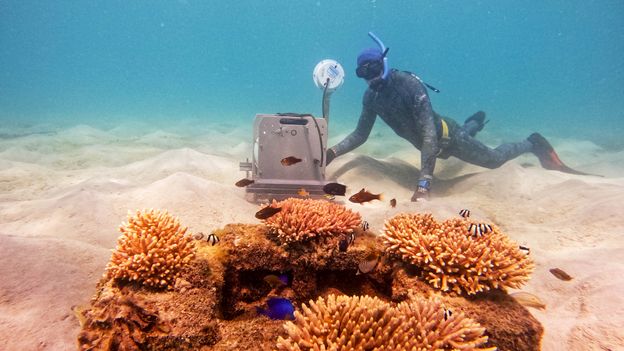
Plus, degraded and poorly managed ocean ecosystems have altered the marine biophony. With the loss of kelp forests and coral reefs, melting glaciers, overfishing and underwater mining, essential habitats for sea life are stripped away – reducing the abundance of noise-producing animals.
 AIMS/ Daneil Estcourt
According to Simpson, the sounds of today’s ocean are very different from those of preindustrial times. “The ocean soundscape used to be made up of the biophony – the animal sounds – and the geophony – the sounds of the Earth, rain, wind and currents. But now it’s the anthrophony as well, for example the sound of motorboats on coral reefs.”
Anthropogenic ocean noise – for example, from vessels or construction – can mask animal noises, preventing them from communicating with one another, just as it would above the surface. “It’s like being in a bar,” explains Parsons. “If there’s no one else in the bar, you can probably hear your friend. But if the bar is full of people, the distance over which you can hear each other is a lot smaller,” he says.
It’s not just the frequency or intensity of the noise, it’s also the unpredictability of the sound’s source that can be disruptive. “If we live in a city, we’re not surprised by traffic noise, but if you live in the ocean and a boat suddenly drives over the top of you, you wouldn’t be expecting it,” says Simpson.