Imagine setting out to hike a vast mountain range. Your goal is clear: reach the summit. But without a map, you risk taking wrong turns and missing the best route. The same principle applies to corporate sustainability.
SAP’s goal is equally clear: enhancing our sustainability impact to help the world run better and improve people’s lives. The question is how do we navigate this complex terrain without losing our way?
The challenge: from sustainability metrics to actionable insights
Corporate sustainability reporting has evolved significantly in recent years. However, many organizations still face the fundamental challenge of translating complex environmental and social data into insights that drive strategic change.
Sustainability metrics such as “0.15 micrograms of fine dust per cubic meter” or “five liters of water consumed” are scientifically accurate but difficult to interpret, especially for decision-makers without deep sustainability expertise. Just as hikers need a reliable navigation system, businesses need a common language to translate diverse sustainability indicators into comparable, actionable insights.
This is where impact measurement and valuation (IMV) comes into play.
The approach: how IMV translates complexity into business-relevant insights
SAP’s IMV approach encompasses three steps.
Step one: A language everyone understands—translating societal impacts into monetary units
The IMV framework quantifies the costs and benefits of corporate activities to society and the environment. It builds on environmental, social, and governance (ESG) data that many companies already report and translates these into a single monetary metric, for example, Euros or U.S. dollars.
This is like moving from vague trail descriptions to precise GPS coordinates that everyone can understand. When sustainability indicators are expressed in a common unit, companies can clearly see where they stand, evaluate trade-offs between different sustainability dimensions, and compare them alongside financial impacts.
As a tangible example, the environmental impact of greenhouse gas (GHG) emissions can be monetized by multiplying a company’s reported emissions by the social cost of carbon, $244 per metric ton of CO₂e in 2025. This converts abstract data into a clear, actionable signal, allowing companies to compare impacts across different ESG and financial indicators. With this clarity, businesses can focus on the most impactful sustainability initiatives—those that deliver the greatest contribution to GHG reduction goals while evaluating both financial and sustainability return on investment.
Step two: Determining relative position—comparing performance to peers
Once you know your exact position, you need a reference point to understand how well you’re performing. It’s like trail runners who want not only to reach the summit, but also to understand their performance along the way. Your GPS shows you where you are, but to improve, you need to compare your data against other runners.
Impact benchmarks complement IMV by providing reference values that show how a company’s sustainability performance compares to industry peers. These benchmarks act like performance markers, helping businesses identify where they are ahead, behind, or on par—guiding decisions to improve toward maximum positive impact.
Step three: Identifying hotspots—focusing on maximum impact
The global sustainability agenda demands urgent, focused action. IMV and impact benchmarks together provide data-driven insights that pinpoint where a business has the greatest leverage to amplify positive and reduce negative impacts.
For example, in SAP’s human rights risk assessment and double materiality analysis, these insights helped narrow down the most material sustainability topics, critical value chain stages, and high-risk countries or industries. This approach uncovers opportunities where improved sustainability performance drives long-term competitive advantage and highlights risks such as supply chain vulnerabilities and regulatory exposure.
Navigating together: collaboration for sustainable impact
SAP has adopted this methodology as a founding member of the Value Balancing Alliance (VBA), a nonprofit coalition of multinational companies dedicated to establishing a globally accepted sustainability management accounting and steering system. In collaboration with the WifOR institute, a scientific research organization specializing in impact valuation, SAP has analyzed its societal impacts (step one), applied industry benchmarks to contextualize performance (step two), and integrated these insights into core reporting and steering processes (step three).
This collaborative approach ensures that the data guiding SAP’s sustainability strategy is independent, credible, and scientifically validated, enhancing both internal decision-making and transparency for investors and external stakeholders.
“Impact measurement and valuation provides the scientific foundation for sustainability steering, allowing organizations like SAP to understand their impacts holistically and prioritize decisions based on statistical evidence.”
Dr. Richard Scholz, Head of Impact Analysis at WifOR
The results: what SAP’s analysis reveals and how it drives strategic decision-making
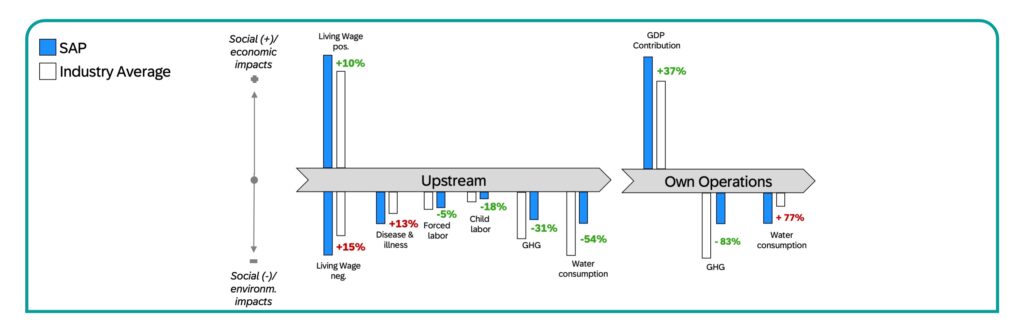
The graphic below illustrates SAP’s sustainability performance compared to industry benchmarks, the result of step two. The analysis covers SAP’s entire supply chain from direct suppliers to sub-suppliers as well as SAP’s own operations. A methodology for quantifying downstream impacts, such as the effects of software in use, is currently under development.
The analysis identifies both positive and negative impacts. Areas where SAP shows a higher negative impact than the industry average are highlighted in red, indicating priority areas for mitigation. In contrast, smaller negative or larger positive impacts indicate stronger ESG performance.
Key findings
- Social performance: Supply chain data reveal mixed results regarding living wages. While most supply chain workers earn above living wage thresholds, reflecting positive impacts, the analysis also identified risk hotspots, enabling SAP to take targeted action. In response, the Human Rights team at SAP partnered with procurement, suppliers, and multi-stakeholder initiatives to develop and implement risk mitigation strategies. IMV data allowed these efforts to focus on the countries, industries, and vendors with the highest risk, ensuring that improvements are driven where they matter most.
- Environmental performance: GHG emissions results reflect strong progress toward SAP’s net-zero goal, with positive results across both direct operations and upstream activities. While water consumption is not considered material for SAP at the group level, we address identified local hotspots through local environmental management programs, including site-specific water management measures to ensure responsible resource use.
Leading by example
As a global technology company supporting the majority of the world’s business transactions, next to enabling our customers on their positive impact journey through our solutions, we want to lead by example.
Our corporate sustainability approach creates positive economic, social, and environmental impact while respecting planetary boundaries and human rights.
To achieve these goals, SAP relies on tools such as IMV that help us assess and prioritize the measures with the greatest leverage—maximizing positive impacts and minimizing negative ones.
“Sustainable transformation is only possible when we base our decisions on reliable data. With IMV, we make sustainability measurable, comparable, and actionable. This enables us to create transparency, set clear priorities, and take responsibility. By focusing on areas where we can achieve the greatest positive business and sustainability impact, we ensure that our actions are both meaningful and effective.”
Matthias Medert, Global Head of Sustainability at SAP
The journey ahead
The climb toward impact-based decision-making continues. Just as hikers rely on navigation tools to traverse challenging terrain, we use IMV as our guide to ensure every step brings us closer to our sustainability goals.
Looking ahead, we aim to expand the methodology, contribute to cross-industry standardization, and foster multi-stakeholder collaboration to accelerate the adoption of impact-based decision-making across global value chains. Through SAP cloud solutions for sustainable enterprises, we support our customers in their own impact management journeys.
Our climb is guided by more than metrics; it’s driven by purpose. Clear insights from IMV keep us on the right path toward a future where sustainability and business success go hand in hand.
Iris Konrad is a senior sustainability specialist at SAP.