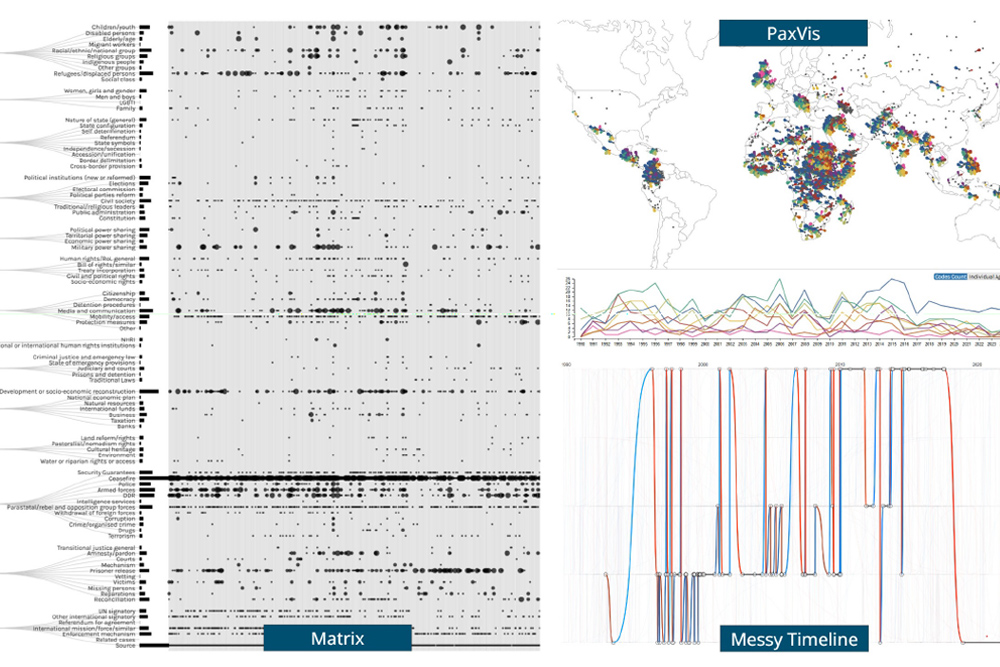
PeaceRep had a strong presence at the IEEE VIS 2025 conference in Vienna – the world’s leading conference for scientific visualisation, data visualisation, and visual analytics. Organised by the Institute of Electrical and Electronics Engineers (IEEE), the conference brings together experts in the field from around the world. This year, all three submissions involving PeaceRep were accepted, highlighting the consortium’s growing contribution to visualisation research at the intersection of peace, conflict, and data.
PeaceRep’s accepted work included:
- A poster and accompanying short paper showcasing PeaceTech visualisation research
- A dedicated workshop on visualising peace and conflict resolution
- A full research paper, co-authored by PeaceRep visualisation researchers, and which received a Best Paper Honorable Mention
Poster Exhibition: Visualising Peace and Conflict
[Download the poster and the accompanying paper]
Created collaboratively by current and former PeaceTech researchers at PeaceRep [Tomas Vancisin, Jinrui Wang, Niamh Henry, Sarah Schöttler, Lucy Havens, Tobias Kauer, Sanja Badanjak, Christine Bell, and Benjamin Bach], the poster highlighted PeaceRep’s three key approaches to supporting peace mediation through visualisation technology:
- Analysis
- Communication
- Tracking
Featuring nine visualisations, the poster presented an emerging area of research that combines peace and conflict resolution with data visualisation as a way to address humanitarian and societal issues from new perspectives.
The poster drew significant attention throughout the conference. Some attendees were curious how peace and conflict can be represented visually, and what data makes this possible. Others were impressed by PeaceRep’s range of PeaceTech visualisations, and connected the exhibits to their own experiences, emphasising the potential for these tools to engage broader public audiences.
Workshop: Bringing Peace and Conflict to VIS4DH
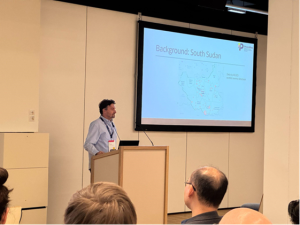
Two out of seven days at the IEEE VIS conference are dedicated to workshops, including the long-running Visualisation for Digital Humanities (VIS4DH) workshop, now in its ninth year. VIS4DH focuses specifically on the intersection between the humanities and visualisation, and how these two areas of research can be advanced by combining research approaches.
This year, PeaceRep Research Associate Tomas Vancisin served as a co-organiser of VIS4DH and successfully advocated for Peace and Conflict to be the main theme, allowing for this (still relatively new) type of research to have unprecedented visibility within in the global visualisation community.
The VIS4DH team invited Jan Pospisil (Coventry University) to be the keynote speaker in recognition of his expertise and direct experience of gathering data in conflict settings through PeaceRep’s Perceptions of Peace in South Sudan surveys. The keynote attracted a diverse audience from across the VIS and Digital Humanities community, offering a rare insight into data collection and analysis in complex conflict environments.
Award-Winning Paper: Transparency Through Visualisation Badges
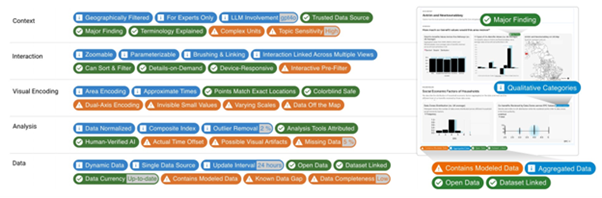
PeaceRep researchers also contributed to the paper The Visualization Badges: Communicating Design and Provenance through Graphical Labels Alongside Visualizations, authored by Valentin Edelsbrunner, Jinrui Wang (PeaceRep), Alexis Pister, Tomas Vancisin (PeaceRep), Sian Phillips, Min Chen, and Benjamin Bach (PeaceRep).
The paper introduces a new way to make data visualisations clearer and more honest: graphical badges. These badges act like small visual cues placed alongside a chart to communicate important context. They can flag a major finding, indicate when an axis has been truncated, or warn viewers about potential visual artifacts. In doing so, they help visualisation creators explain their analytical and design choices, while also helping readers better interpret what they see.
The framework behind these badges grew out of a series of co-design workshops involving PeaceRep researchers, which shaped both the concept and its practical use. PeaceRep’s “Messy Timeline” visualisation was highlighted as an example for discussion, with PeaceRep researchers providing critical assessments of open data principles and uncertainty communication. This example became an important case study for the visualisation badges, and is featured on the badge website.
The project resulted in:
- a catalogue of 132 visualisation badges, including different design options
- multiple categorisation schemes
- real-world visualisation examples
- a set of clear guidelines for implementation
This paper was awarded a “Best Paper Honorable Mention,” placing it among the top 5% of all submissions at the conference.
Citations
Edelsbrunner, V., Wang, J., Pister, A., Vancisin, T., Phillips, S., Chen, M., & Bach, B. (2026). Visualization Badges: Communicating Design and Provenance through Graphical Labels Alongside Visualizations. IEEE Transactions on Visualization and Computer Graphics.
Explore PeaceRep’s suite of data visualisation and PeaceTech tools →