Agriculture is an industry with slim margins and farmers are always looking for ways to cut costs. That’s why in many parts of the U.S., drones are now doing the job of tractors, planters, and planes.
For decades, essential agriculture services were provided by crop dusters: small, low-flying aircrafts that applied pesticide or fungicide over fields.
But of course, that requires a pilot and a plane — both of which started to become hard to come by a few years ago.
“More and more farmers were demanding fungicide on corn than what pilots could apply,” said Taylor Moreland in central Missouri.
Moreland started his own business, Agri Spray Drones, to give farmers another option.
His company sells drones and trains farmers to use them to apply products, plant seeds and check on crops. All with a remote control.
It can be a lot easier than hiring a pilot in a crop duster. But Moreland said using drones does take practice.
“You have to learn a whole new concept, because it’s the first piece of ag equipment that flies, is battery powered and is autonomous,” he said.
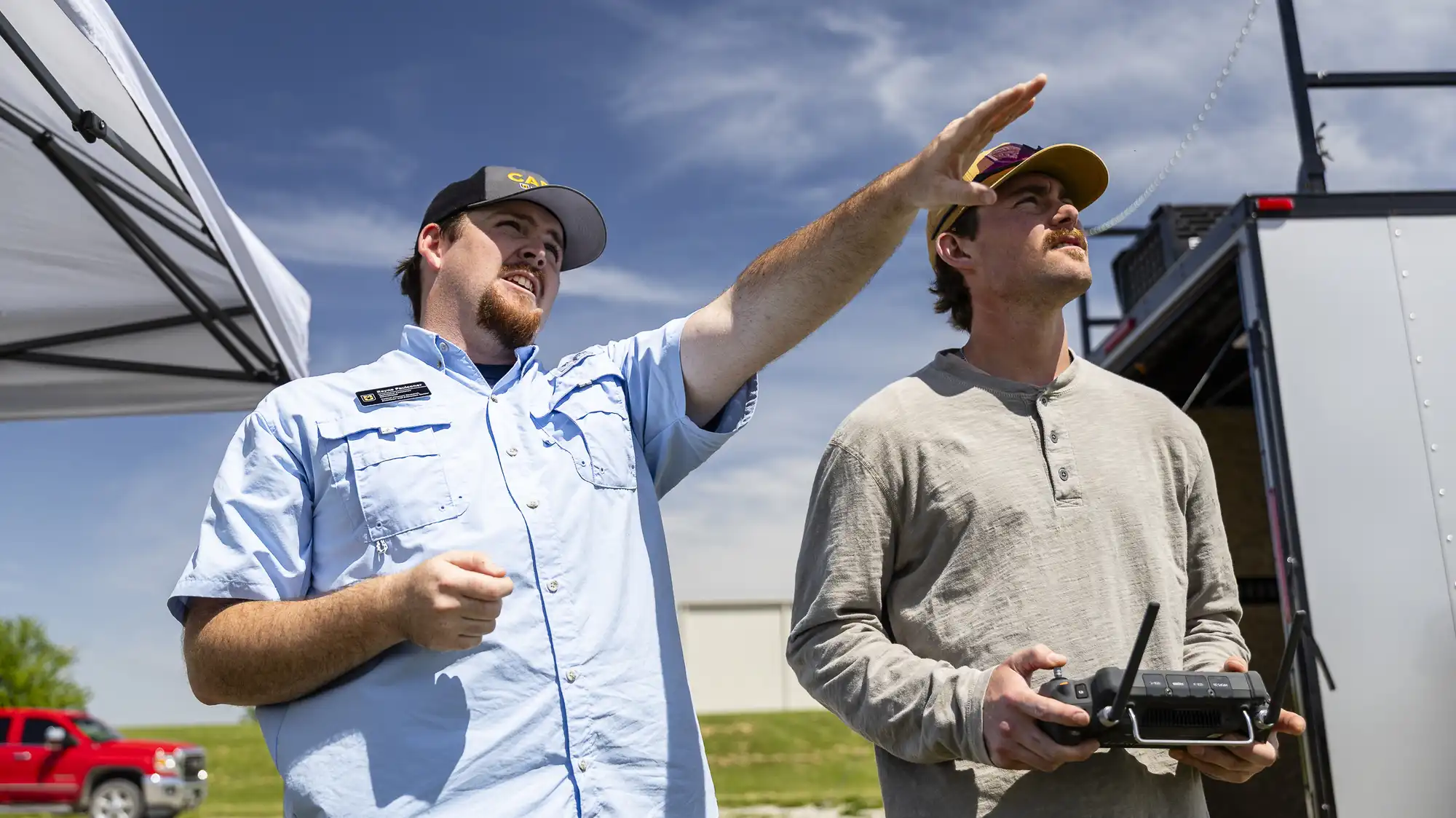
A group of students learned how to fly ag drones on a Saturday morning at the fairgrounds in Montgomery City, Missouri.
As a field specialist for the University of Missouri Extension, Caleb O’Neal travels the state demonstrating how to use two different types of agriculture drones.
Small imaging drones can hover over fields and capture pictures and video. So, if a field is too wet to get a tractor out, a farmer can still scout their crops.
Larger drones can carry tanks to apply herbicide, pesticide or fertilizer — and they’re precise, dousing only the plants that need it. Unlike a crop duster’s all or nothing approach.
Rusty Lee helps O’Neal teach “drone school.” He’s also a farmer who uses drones to precisely target chemical products on his fields of corn and soybeans — and that means using less chemicals overall.
“We’ve cut cost, we’ve reduced inputs, we’ve reduced environmental impact through using technology,” he said.
Drones can be a tool to help farmers be more sustainable — both environmentally and economically.
“You don’t last in the farming business without being able to evolve and incorporate and utilize new technology,” Lee said.
Drones are just the latest new technology for an industry that’s always changing.
This story first appeared on KBIA.