
Introduction
Good afternoon and thank you for the opportunity to speak at this conference. The theme – banking
and financial stability – is a topic of deep interest to the RBA given our longstanding mandate to
contribute to financial stability. And I would like to say thank you to all of you, for your work in this
important area and contributing to our understanding of the issues.
Today Im going to explore two broad questions relating to financial stability.
First, why does financial stability matter and what is the RBAs responsibility in relation to it?
Second, how does the RBA deliver on its financial stability responsibility?
Along the way, Ill highlight some of our ongoing work in this space and the issues that are on our
mind. To summarise, our overall assessment is that in this period of elevated global uncertainty, the
Australian financial system is well positioned to weather most shocks. However, we cannot be complacent.
The nature of risks is changing and so there is ongoing work for regulators and industry to remain
prepared in this evolving environment.
Why does financial stability matter and what is the RBAs role?
Financial stability is important because of the role that the financial system plays in the everyday life
of Australians.
The financial system is made up of a range of financial institutions. It includes banks, insurers,
superannuation funds and non-bank lenders. It also includes financial markets, where financial assets
such as shares, bonds and foreign exchange are bought and sold. And it includes market infrastructure,
such as the payments system and other systems that support the trading of financial assets.
It is important that all these elements of the financial system are working well because together they
provide the financial services that Australians depend on in their everyday life. More concretely, a
well-functioning financial system enables households and businesses to:
- save, borrow and invest – so that they can prepare for retirement, buy their first home, or
purchase equipment to expand their businesses - make payments – so they can move money efficiently and securely, such as when theyre
tapping their card to pay for groceries, or making payments for their bills online - insure against and manage risk – so they can protect themselves against unexpected costs, such
as damage to or loss of property, or unexpected medical bills.
In other words, the financial system is vital in helping Australians get on in life and plan for the
future. This means that if the financial system overall is not functioning well, it is costly for
everyone.
- For example, if banks are unwilling or unable to lend money, businesses might not get the working
capital they need to run their operations, households might reduce spending further than otherwise,
it can become more challenging to purchase a home and economic activity can suffer. Indeed, financial
crises lead to economic hardship for many with long-lasting consequences for economic growth. - Another example is disruptions to payments systems, which can prevent salaries and pensions from
being paid, households from buying the things they need and transactions in financial markets from
settling, causing widespread difficulties.
Maintaining financial stability is about ensuring we have a financial system that is strong, operationally
resilient and prepared for adverse conditions, so we can avoid these types of disruptions and their
broader costs. This doesnt mean reducing risk to the point that we compromise innovation,
competition and efficiency. But it does mean ensuring resilience alongside these other features. Indeed,
innovation and competition can lead to better ways to achieve resilience. We need a financial system that
can support the economy by reliably providing the financial services that households and businesses
depend on, both in good times and bad. A stable financial system promotes saving and investment,
supporting lower funding costs, productive investment and thus longer term growth. So financial stability
is a necessary underpinning to support the economic prosperity and welfare of Australians – which
is the RBAs overarching legislative objective.
Given the alignment between financial stability and the RBAs other functions and objectives, the RBA
– like other central banks – has long had a mandate to contribute to financial stability.
This is a role that has evolved and changed over time. Initially it spanned all the way from liquidity
provision to banking supervision. But in the late 1990s, this changed following the Financial System
Inquiry (Wallis Review). Responsibility for banking supervision was transferred
to a new separate agency – the Australian Prudential Regulation Authority (APRA), which was set up
to bring the prudential functions of the RBA and Insurance and Superannuation Commission together into a
dedicated agency. So unlike in some other countries, in Australia, the RBA, as the central bank, is
not responsible for prudential supervision of these entities – that is APRAs
job.
Although the Australian Governments response to the Wallis Review meant that supervision of these
individual financial institutions was transferred to APRA, the RBA still retained a general (albeit
non-legislated) responsibility to safeguard stability of the financial system as a whole. This reflects
that the RBA, as the central bank, is well positioned to both assess financial system stability –
given the breadth of our system-wide responsibilities – and to support financial system stability
– given our balance sheet capacity to provide liquidity. We also cannot achieve our monetary policy
objectives without financial stability. Relatedly, following the Wallis Review the RBA also gained
enhanced powers to regulate the payments system to ensure it is secure, stable and efficient. The
RBAs responsibility to promote the stability of the Australian financial system was recognised by
the Government at that time, and in subsequent agreements between the RBA and
Treasury.
More recently, following the independent Review of the RBA in 2023, the RBAs financial stability
role was enshrined in legislation – making contributing to financial stability a core
part of the RBAs legislative functions. The Review highlighted the importance of this for
reinforcing accountabilities and strengthening the foundation of cooperation arrangements with other
agencies that share a mandate for promoting financial stability.
How does the RBA deliver on its financial stability responsibility?
So how does the RBA deliver on this high-level responsibility to contribute to the stability of the
Australian financial system? The answer is in a number of ways, and in conjunction with other agencies.
In Australia, delivering on financial stability is a team effort. Responsibilities are shared across
several agencies, each with complementary mandates and policy tools (Figure 1).
As the central bank, the RBA has a range of responsibilities which Ill cover in more detail shortly.
As Ive already mentioned, APRA is the prudential regulation authority, responsible for regulating
and supervising banks, insurers and superannuation funds, so that Australians financial interests
are protected and the financial system is stable, competitive and efficient. This includes responsibility
for macroprudential policy and bank resolution.
The Australian Securities and Investments Commission (ASIC) and the Treasury also have important financial
stability roles. ASIC is responsible for market integrity and consumer protection across the financial
services sector, and regulates clearing and settlement facilities (complementing the RBAs
supervision of those same facilities from a financial stability perspective). And the Treasury has an
important role in advising the government on financial stability, including the financial regulatory
framework. Treasury also has important policy tools that can help alleviate the economic impacts of
financial crises.
These institutional arrangements and mix of responsibilities make cross-agency collaboration essential in
Australias financial regulatory framework. And this is where the Council of Financial Regulators
(CFR) comes in.
The role of the CFR
The CFR plays a crucial role in bringing together the RBA, APRA, ASIC and Treasury to coordinate and
collaborate on financial stability issues. Its ultimate aim is to promote the stability of the Australian
financial system and support effective and efficient regulation.
The CFR agencies work together to promote financial stability in three key ways:
- We analyse vulnerabilities in the financial system that could amplify shocks, and work together to
understand their potential impacts and coordinate policy and other actions to address them. - We support coordination of financial regulation, so that it is effective, efficient and promotes
competition in the financial sector. - We maintain crisis readiness so the CFR agencies are as ready as can be to work together to respond
to support financial stability in the event of future shocks.
Earlier this month, the CFR published its first annual update on its initiatives to address risks and
vulnerabilities in the financial system – covering progress over 2025 and focus areas for the year
ahead. These focus areas for 2026 are geopolitical vulnerabilities, operational vulnerabilities, systemic
liquidity risk and high household leverage. Given the international environment of elevated
uncertainty and geopolitical tensions, strengthening crisis readiness is a common theme running through
much of this work.
While the CFR does not have formal regulatory or decision-making powers separate from those of its
individual members, it has a strong track record of effective collaboration – including in response
to the COVID-19 pandemic and the global financial crisis. The RBA Review in
2023 highlighted the importance of reinforcing cooperation arrangements among the CFR agencies for
promoting financial stability. Consistent with this, the CFR Charter and Memorandums of Understanding
between the agencies were updated earlier this year to clarify roles and responsibilities, and how
agencies work together to promote financial stability.
Having talked about the CFR and its agencies, let me now turn to the specifics of the RBAs role and
how exactly we fulfil our financial stability responsibilities.
The RBAs contribution to financial stability
The RBA contributes to financial stability in several distinct ways. Some contributions aim to be
preventative – focused on promoting resilience and mitigating vulnerabilities, so that
the financial system can withstand a wide range of adverse conditions. Others are curative
– designed to contain disruptions and restore confidence during periods of financial stress.
Weve recently set out the RBAs framework for contributing to financial stability on our
website as part of our broader commitment to enhance transparency and public understanding of the work we
do.
Ill now step through the elements of this framework (see below).
Monetary policy
Arguably the most fundamental way the RBA supports financial stability is by setting monetary policy to
achieve low and stable inflation and full employment. To see why, lets consider the alternative.
For example, unemployment is the most common reason why households are unable to repay debt owed to
banks, which can lead to loan losses for banks. High inflation can also trigger financial difficulties
for households and businesses by leading to higher interest rates and lower real incomes, in turn
affecting their ability to service loans. If a sufficiently large number of borrowers were to fall into
negative equity and default on their loans, lenders could face widespread losses as a result. If these
losses were large enough, this could lead to lenders sharply restricting the supply of credit to even
very sound borrowers. This could disrupt economic activity and add to unemployment. And if households and
businesses become concerned that their deposits at banks might not be safe, financial system stability
and economic activity will be disrupted further still. So by setting monetary policy to achieve our
objectives of low inflation and full employment, the RBA has a key role to play in helping create the
economic conditions that support stability in the financial system.
Likewise, a stable financial system supports us to achieve low inflation and full employment.
Well-functioning financial markets and institutions are essential for the transmission of monetary
policy, and history has shown that episodes of financial instability can have lasting impacts on the
economy and employment.
Working with the CFR agencies
As Ive already discussed, the RBA also works closely with the other CFR agencies to support
financial stability. As part of this, the RBA advises the other CFR agencies on the outlook for financial
stability, including if monetary policy might affect – or be affected by – financial
stability concerns.
As noted earlier, monetary policy and financial stability objectives are generally complementary, and
indeed necessary for each other in the longer term. However, there can be times when monetary policy
actions needed to deliver price stability and full employment may not align perfectly with financial
stability goals. For example, an extended period of accommodative monetary policy required to lift
employment and inflation to their appropriate levels could potentially contribute to the build-up of
leverage and imprudent risk-taking in parts of the financial system. A tightening in monetary policy to
control inflation at a later point could then expose these vulnerabilities.
As part of managing these interactions, the Monetary Policy Board has committed to ensuring the CFR is
informed when there are material interactions between financial stability and monetary policy. This is
important to support coordination of policies to address financial stability risks across the CFR,
including the use of APRAs macroprudential policy tools. In this context, the RBA and APRA have
recognised that APRAs macroprudential policy, as a financial stability tool, is better placed in
most circumstances to address the build-up of certain systemic vulnerabilities than monetary policy.
The RBA now provides financial stability advice to the CFR and APRA on a regular basis, and at least
annually to accompany APRAs update to the CFR on macroprudential policy, most recently at the
September 2025 CFR meeting. In that context, the RBA noted that housing credit
growth has picked up, driven by strong growth in lending to investors, as borrowers have responded to
lower interest rates. However, lending standards have remained sound and riskier forms of lending –
such as high-loan-to-valuation-ratio (LVR) loans, high-debt-to-income (DTI) loans and interest-only loans
– have edged up only slightly (Graph 1).
Graph 1

Looking forward, however, vulnerabilities could build if households begin to take on excessive debt. One
way this could play out is if there was a sharp rise of investor activity from already elevated levels
that results in rapid and unsustainable increases in housing prices, leverage and/or an easing in lending
standards as other borrowers try to keep up.
The CFR has been discussing the importance of taking pro-active steps to prevent vulnerabilities building
in the financial system over time. In this context, the CFR supported APRAs recent decision to
activate a new macroprudential policy tool – limits on high DTI lending – to pre-emptively
contain the build-up of housing-related vulnerabilities in the financial system. These limits
are not currently binding but would become so if high DTI lending were to pick up materially from here.
Managing monetary policy and financial stability interactions
Of course, macroprudential policy and other financial stability tools are not always going to be the
answer, or at least not the whole answer. There may be circumstances where they cannot fully address
financial stability concerns, either because of the nature of the financial vulnerability or because the
relevant financial stability tools are not available or used. Where that has implications for the
achievement of the RBAs inflation and employment objectives, the Monetary Policy Board has
flexibility in its framework to account for those concerns.
This could include circumstances where financial system vulnerabilities are assessed to be accumulating
over time, resulting in a trade-off between the RBAs ability to meet its monetary policy objectives
at different time horizons. For example, holding interest rates low might, in certain circumstances, be
needed to ensure the RBA achieves its inflation and employment objectives in the short-to-medium term,
but in doing so result in an accumulation of vulnerabilities that pose a risk to longer term inflation
and employment outcomes. As I mentioned earlier, macroprudential tools are often most appropriate in such
circumstances. But if that proved unworkable or ineffective, the Monetary Policy Board might need to
consider setting monetary policy so as to return inflation to target over a slightly longer timeframe
than it otherwise would if there were no financial stability concerns. The Boards actual decision
would, of course, depend on the specifics of the situation and their assessment of the risks. But as
highlighted in the RBA Review, transparency about decision-making is important. In any circumstance where
financial stability considerations have had a bearing on the monetary policy decision, the Monetary
Policy Board will clearly communicate how its decisions remained consistent with achieving its monetary
policy objectives. That includes explaining:
- how and why it might use the flexibility in its monetary policy framework to take account of
financial stability considerations relevant to the outlook for inflation and employment - how it had assessed any trade-offs in its ability to achieve its monetary policy objectives in the
short vs medium term - why financial stability policies may not be sufficient to fully address the financial stability
concerns.
To be clear, none of these considerations are bearing on monetary policy at the moment. Given the
resilience in the Australian financial system, the Monetary Policy Board recently observed that there are
no immediate implications for monetary policy arising from domestic financial stability
considerations.
Communicating regular financial stability assessments
Each of the contributions to financial stability I have mentioned so far are underpinned by the RBAs
ongoing monitoring and assessment of financial stability. Our own research and analysis is complemented
by insights from others in Australia and abroad, importantly including liaison with Australian financial
institutions, businesses and community services organisations, as well as the other CFR agencies.
We publish a comprehensive financial stability assessment twice yearly in the RBAs Financial
Stability Review. This includes where we see potential risks to financial stability and
vulnerabilities in the financial system, given the prevailing domestic and international environment. To
make this assessment, we also consider the resilience of households, businesses, banks and non-bank
financial institutions in the face of potential shocks.
By making sure there is good information about where the risks and vulnerabilities lie in our financial
system, we can support good decision-making by individuals, businesses and policy-makers to address and
manage these threats, and to limit excessive risk-taking. This is another way the RBA contributes to
financial stability.
The RBA published its most recent Financial Stability Review in October (see below). A key
takeaway was that the heightened risk in the international environment means a systemic risk is most
likely to come from abroad. However, our judgement is that Australian households, businesses and banks
are well placed to weather most shocks. This is thanks to ongoing strength in the labour market, prudent
lending standards and high levels of bank capital and liquidity.
Financial Stability Review, October 2025
The Australian financial system is well placed to withstand most shocks but continued effort is needed to stay prepared for emerging challenges
However, this is certainly not an environment we want to become complacent in. There are two key issues
here we called out in the Review.
First, it is important that lending standards remain sound so that the good level of financial resilience
among households and businesses is not undermined over time. APRAs pre-emptive introduction of high
DTI lending limits will help in this regard.
Second, it is important that financial institutions continue to build their resilience to geopolitical and
operational risks. These threats are intensifying, and we are alert to the prospect that financial and
operational stress events occur at the same time. We got some sense of the potential challenges here in
April this year, when cyber-attacks on the Australian superannuation sector coincided with stressed
conditions in financial markets. There is, accordingly, a big program of work underway across the CFR
agencies, government and industry to strengthen resilience both of individual institutions and the
financial system as a whole.
So the upshot of all that is while the Australian financial system is starting from a good place, there is
work to do to keep up with the evolving environment.
Crisis management, liquidity provision and financial market intervention
Having discussed the things the RBA does to support financial stability in advance, let me now turn to
what we stand ready to do in the event a shock does occur. This includes our responsibilities in crisis
management (in coordination with the CFR) and through our role as the ultimate provider of liquidity to
the financial system.
The RBA works with the CFR agencies to maintain crisis management readiness and ensure effective responses
to a range of potential or actual instances of financial instability. These may include material stresses
in financial institutions, disruptions in financial markets, interruptions to the smooth functioning of
financial market infrastructure, or major operational disruptions affecting the provision of financial
services.
Each CFR agency has a range of responsibilities that collectively contribute to the CFRs crisis
management arrangements. Fortunately, Australia has not had to contend with the
failure of a key financial institution for many years. But to remain prepared, the CFR conducts regular
crisis exercises and simulations – including joint exercises with the New Zealand financial
authorities (through the Trans-Tasman Council on Banking Supervision). And we have, of course, had real
life practice at responding to various shocks to the financial system, such as the COVID-19 pandemic, all of which our financial system has managed to weather.
In a crisis situation the RBA has a number of responsibilities. First, the RBA has lead responsibility
among the CFR agencies for monitoring systemic risk (including in financial markets, clearing and
settlement systems, and the payments system).
The RBA is also responsible for adjusting the supply of liquidity to institutions or markets as
appropriate.
In exceptionally rare circumstances, this could include providing liquidity assistance to a bank or
clearing and settlement facility that is solvent but facing acute liquidity pressures. To provide
such exceptional liquidity assistance, the Monetary Policy Board would need to be satisfied
that to do so was needed to contribute to the stability of the Australian financial system, in line with
its legislative responsibilities.
In rare instances of market-wide liquidity stress, the RBA may also determine it is appropriate to provide
liquidity support to eligible counterparties more broadly. This is the approach the RBA adopted in
response to the disruptions following the outbreak of the pandemic in March 2020, when we adjusted the
size and frequency of our repurchase operations and broadened the range of accepted collateral to support
financial stability.
I should also note here that the RBAs provision of liquidity in normal times is also an important
contributor to maintaining financial stability. This occurs through the RBAs standard liquidity
facilities as part of implementing monetary policy and ensuring banks have enough cash (or liquidity) to
meet their day-to-day obligations.
As well as ensuring adequate liquidity is provided to the financial system, in rare circumstances the RBA
may also intervene in the markets for foreign exchange or bonds issued by Australian governments to
address dysfunction in these markets where that dysfunction threatens broader financial stability. We can do
this by temporarily buying and selling certain assets when markets are displaying signs of substantial
illiquidity or there are very sharp changes in prices that do not appear to be explained by economic news
or other market forces.
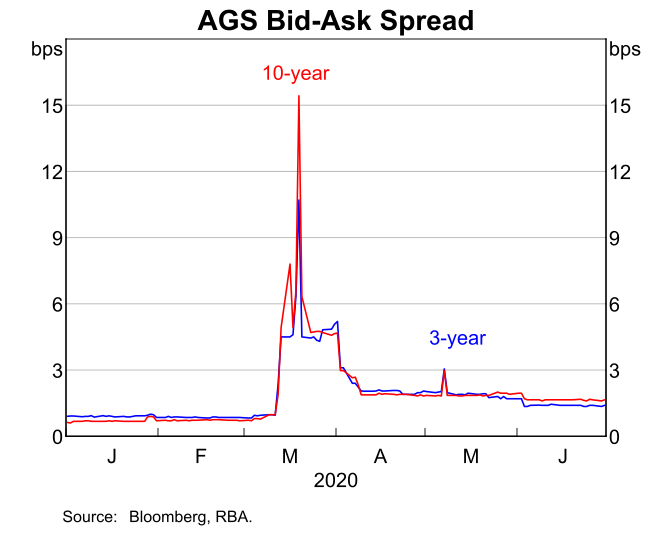
For example, during the period of exceptional instability at the onset of the pandemic, the RBA purchased
Australian Government bonds and semi-government securities for this purpose. This helped restore market
functioning, bringing bid-offer spreads back down to more normal levels (Graph 2). Effective
functioning of the government bond market is important for financial stability because it is a key market
that provides the pricing benchmark for many financial assets.
Graph 2
Finally, the RBA, in coordination with ASIC, is also responsible for the supervisory response to financial
stress at clearing and settlement facilities and for the resolution of these facilities if required. This
broadly mirrors the recovery and resolution role that APRA has for banks, insurers and superannuation
funds.
Broader contributions to financial stability
While that gives you a flavour of how the RBA contributes to financial stability, the list is not
exhaustive. The RBA engages with the CFR on a wide range of financial stability topics beyond those
relevant to monetary and macroprudential policy. We are an active participant in international forums
that support global and regional financial stability and promote effective standards and cooperation. And we play
an important role in regulating and supervising the payments system – to ensure it is safe,
competitive and efficient – and in managing Australias high-value payment system (the Reserve
Bank Information and Transfer System or RITS).
Conclusion
In conclusion, financial stability matters. It ensures the financial system can reliably provide the
financial services that Australians depend on through good times and bad. This is a critical foundation
for Australias economic prosperity and welfare.
The RBA has long had a financial stability role, and we welcome that this now has a clear statutory basis
following recent amendments to the Reserve Bank Act 1959. Delivering on this mandate
involves a range of activities. The RBA contributes through its monetary policy, liquidity provision,
payments system and financial market infrastructure oversight and public communication of where risks may
lie or vulnerabilities may be building.
Equally important is our work with others. Collaboration across Australias financial regulators has
always been central to maintaining financial stability. Through the CFR we have a strong track record of
effective cooperation. Recent steps strengthen this collaboration further, by enhancing clarity of
individual agencies responsibilities, the CFRs collective objectives, and setting out clear
and specific commitments for how the agencies will work together to promote financial stability.
While the Australian financial system is well positioned to weather most shocks, working together
effectively is key to ensuring we remain prepared for any challenges ahead.
Thank you and I look forward to your questions.