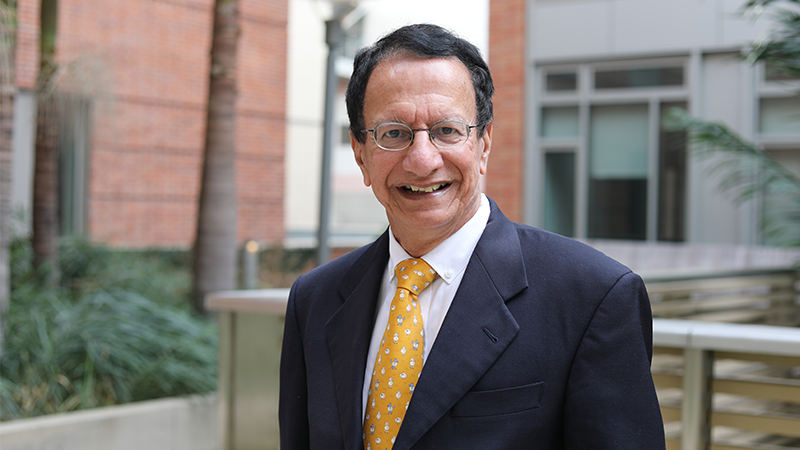
Chandrashekhar Joshi, a distinguished professor of electrical and computer engineering at the UCLA Samueli School of Engineering, has been appointed the inaugural holder of the Mukund Padmanabhan Term Chair in Excellence.
The endowed chair is one of two term chairs established in 2024, each funded with a $500,000 gift from double Bruin Mukund Padmanabhan M.S. ’89, Ph.D. ’92, and matched with an additional $1 million from the Samueli Foundation. The Mukund Padmanabhan Term Chair in Innovation is yet to be filled. Padmanabhan has previously endowed two other faculty chairs, established an undergraduate scholarship and three graduate fellowships, supported a semiconductor research lab in the Engineering VI building and other school initiatives.
“I am deeply grateful for Mukund Padmanabhan’s continued generosity toward advancing engineering education and research through his many years of support for his alma mater,” said Ah-Hyung “Alissa” Park, the Ronald and Valerie Sugar Dean of Engineering. “As the inaugural chairholder, Chan Joshi will continue to drive breakthroughs in plasma particle accelerators and compact light sources, helping make these powerful scientific instruments smaller, more accessible and more affordable.”
After earning both his master’s and doctoral degrees in electrical engineering from UCLA Samueli, Padmanabhan joined the IBM Thomas J. Watson Research Center in Yorktown Heights, New York, where he specialized in speech processing technologies, including managing the research and development of algorithms for speech recognition. An accomplished signal-processing engineer with more than 20 U.S. patents, he is now a partner and statistical researcher at Renaissance Technologies, a New York-based hedge fund. He has received UCLA Samueli’s Professional Achievement Award and the Distinguished Alumnus Award from the Indian Institute of Technology Kharagpur.
(UCLA Samueli)
Padmanabhan is the founder and president of the Guru Krupa Foundation, which supports educational access for students from financially disadvantaged families in the U.S. and India. A longtime supporter of UCLA Samueli, Padmanabhan also serves on the UCLA Samueli Dean’s Executive Board.
“I owe much of my professional success to the education I received at UCLA,” Padmanabhan said. “I hope this gift encourages other alumni to support this remarkable institution so it can continue to attract and retain top faculty.”
Known for his extraordinary creativity in experimental plasma physics during his four-decade career at UCLA, Joshi championed the groundbreaking development of plasma-based accelerators — a technology that uses ionized gas, or plasma, to rapidly accelerate electrons and positrons to extremely high speeds, thereby creating very high-energy particle beams in extremely small spaces. The high-energy particle accelerator is widely considered one of the most important scientific tools of the 20th century, and it is expected to help researchers tackle some of society’s most pressing challenges.
Building on his groundbreaking work in plasma physics in the 1980s, Joshi developed additional advances and trained new generations of scientists who now lead the field. He leads UCLA’s Plasma Accelerator Group, which studies how plasmas can be used in future high-energy accelerators.
Joshi has authored more than 600 scientific papers and received numerous national and international accolades for his achievements. Among the many awards he has won are the Gothenburg Lise Meitner Award from the Gothenburg Physics Centre in Sweden in 2018, the Marie Curie Award and Medal from the Institute of Electrical and Electronics Engineers in 2017, and the James Clerk Maxwell Prize from the American Physical Society in 2006. He was elected to the U.S. National Academy of Engineering in 2014 and named a foreign fellow of the Indian National Sciences Academy in 2025.
A dedicated teacher and mentor, Joshi has opened up crucial avenues of research for a new generation of scientists. At UCLA, he has been the advisor to 35 doctoral students, many of whom now lead their own research groups. He received the Engineering Educator of the Year Award from the Engineers’ Council in 2015. In 2016, he led the creation of the undergraduate Fast Track honors program in the Electrical and Computer Engineering Department.