Unlock the Editor’s Digest for free
Roula Khalaf, Editor of the FT, selects her favourite stories in this weekly newsletter.
Japan’s benchmark government bond yields hit their highest level since 1999 after the central bank pushed up short-term interest rates to address rising prices and wages.
The Bank of Japan raised its policy rate by 0.25 percentage points to “around 0.75 per cent”, a three-decade high, and signalled its readiness to continue monetary tightening if conditions are right.
The rate increase, a unanimous decision by the bank’s Policy Board, was the fourth under governor Kazuo Ueda, continuing a “normalisation” process he launched last year.
The rate is the highest since 1995 as Japan emerges from decades when it maintained an ultra-loose monetary policy to try to fight deflation.
Despite the prospect of further rate increases, the yen weakened against the dollar following the BoJ’s move.
Traders said the move reflected market concerns around Japan’s fiscal situation under Prime Minister Sanae Takaichi, who took office in October and has proposed expansive spending plans.
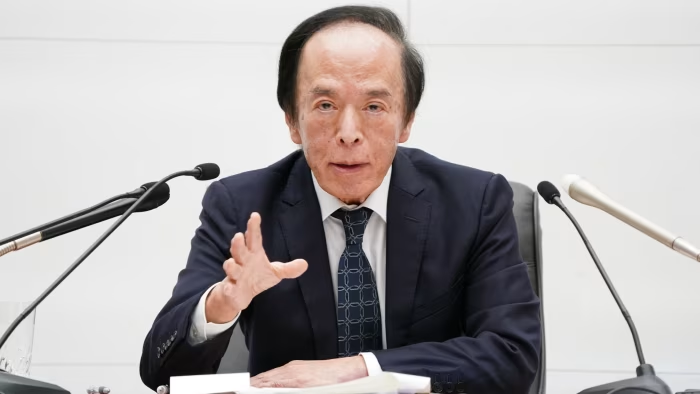
In a press conference Ueda said the new 0.75 per cent interest rate level was still “far from the bottom” of the central bank’s estimated range for the “neutral rate” — the level where monetary policy is neither expansionary nor contractionary.
“Our estimate on Japan’s neutral rate sits on a pretty wide range. It’s hard to set a pinpoint estimate . . . We’d like to look at how the economy and prices react to each change in short-term rate,” said Ueda.
Friday’s rate rise was widely anticipated after what traders said was unusually clear messaging ahead of the decision. A less telegraphed rate increase in July 2024 caused severe market ructions.
Hiroshi Shiraishi, senior economist at BNP Paribas in Tokyo, said Ueda had raised market expectations earlier in the month that he might be more explicit about BoJ estimates of the neutral rate. “In the event, he didn’t really say anything very new: he didn’t want to sound too hawkish and upset the government, or sound too dovish and cause the yen to fall . . . the market reaction is exactly as expected,” said Shiraishi.
The yield on the benchmark 10-year Japanese government bond climbed 0.05 percentage points, breaking through 2 per cent and reaching the highest level since 1999. Bond yields move inversely to prices.

Yields on JGBs had already risen to multiyear highs in recent weeks, driven by anticipation of the BoJ’s move and investor concerns that Japan’s fiscal position will be stretched by Takaichi’s spending plans.
The yen weakened to ¥156.77 against the dollar.
Andrew Pease, Asia-Pacific head of investments for Russell Investments, said the yen’s move was “a puzzle” but could suggest the market was potentially “worried about the fiscal dynamics in Japan”.
The market “is underestimating the potential for the Bank of Japan to tighten more aggressively next year”, Pease added.
Shoki Omori, chief desk strategist at Mizuho, said: “There was some disappointment in the market that the BoJ’s statement was not more hawkish, but the central bank does seem to have handled this very smoothly this time.”
He added that by remaining vague on the neutral rate, the BoJ appeared to have struck a balance to prevent markets from unduly front-running further rate increases. “It is therefore appropriate to characterise the current posture as hawkish in action and moderate in communication,” said Omori.
The BoJ statement noted that labour conditions in Japan, where the population is shrinking, continued to be tight, while corporate profits were expected to remain strong despite the impact of tariff policies.
The central bank said companies were “highly likely” to keep raising wages next year and that prices would continue to rise moderately.
Those conditions justified the adjustment of monetary policy, it said, a move that some economists judged to be at odds with Takaichi’s sweeping economic stimulus plans.
The BoJ observed that “real interest rates are expected to remain significantly negative after the change in the policy interest rate, and accommodative financial conditions will continue to firmly support economic activity”.
Headline consumer price inflation has been above the BoJ’s target level of 2 per cent for more than three years, driven by the yen’s weakness and Japan’s dependence on imports of food and energy. Official data on Friday showed consumer prices excluding fresh food rose 3 per cent in November from a year earlier.
Additional reporting by William Sandlund and data visualisation by Haohsiang Ko in Hong Kong