Listen to this article
Estimated 4 minutes
The audio version of this article is generated by AI-based technology. Mispronunciations can occur. We are working with our partners to continually review and improve the results.
A public health nutritionist at the Windsor-Essex County Health Unit is encouraging people who can afford to entertain this holiday season to invite people over for dinner who might otherwise miss out.
Food insecurity can cause social isolation, Karen Bellmore said.
And that leads to worsening physical and mental health.
“Many individuals who have full-time jobs who are minimum wage earners are still struggling with food insecurity,” Bellemore said.
“Usually people withdraw, and there’s a lot of shame and embarrassment with not being able to feed yourself. But this is really a system-level problem.”
Statistics Canada reported on Dec. 15 that grocery inflation in November had reached its highest point since the end of December: 4.7 per cent year over year.
People on social assistance struggling to pay for food
The health unit released its own annual food affordability report in late November, documenting the cost of 61 food items that are essential to helping people at different ages and stages of life meet their nutritional needs.
It found that a family of four would spend about $1,181.08 per month on those food items, while a single person would spend $413.18.
When combining those numbers with average rents in the region, it estimated that a family of four on Ontario Works would have just $546 leftover for additional expenses after paying for food and housing, while a single person would be in the hole by an estimated $420.
Those additional expenses include utilities, insurance, laundry, vehicle expenses, child care, school supplies and other essentials, including other groceries.

“Even in our nutritious food basket cost, we aren’t really looking at those extra hygiene items like toilet paper,” Bellmore said.
It doesn’t even track the cost of coffee.
Hunger tends to be hard to see, Bellmore said, because nobody gets evicted from their home or has their utilities cut off when they don’t feed themselves.
Food tends to be seen as a “flexible expense” that people will sacrifice in order to avoid losing those other essentials, she said.
“But it really isn’t,” she said, “because it harms our physical and mental health when we’re not able to nourish ourselves.”
One man who launched an annual community Christmas dinner four years ago says people have been struggling more with their mental health for the past several years, and the holiday season just makes things worse for some people.
Shared meal became annual community gathering
“Being around people helps that person out, even if it’s just sitting there talking to somebody for five minutes,” John Hanchar said.
Hanchar launched Not Alone for Christmas during his first year of recovery from addiction by bringing together six people from Narcotics Anonymous.
“I know what it’s like to be alone ’cause I’ve been there before, and I just thought, ‘You know, let’s just do it,” he said.
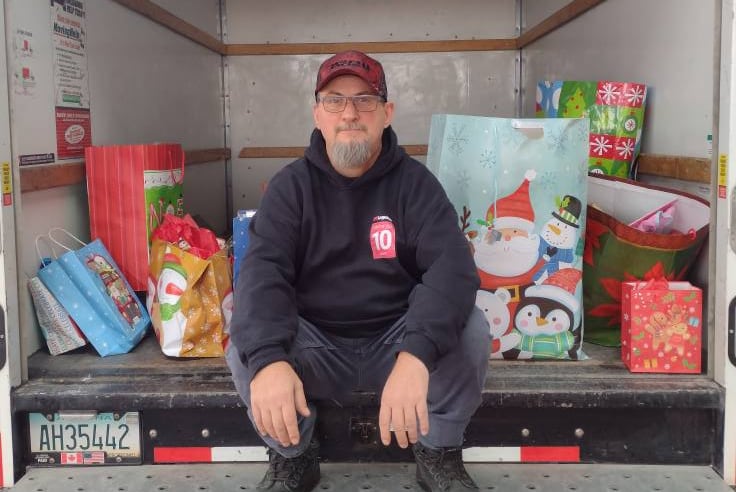
“The first one was just a simple thing. … I just went and bought … some food and some games and played cards, and we had some snacks.”
The following year he made posters for the event and got media coverage, and it blew up.
“People were telling me, like, no one does a Christmas dinner on Christmas Day,” he said.
Last year, he served 180 people, thanks to donations from people and businesses in the community.
The event is now listed in 211 Windsor’s Holiday Sharing Guide, and Hanchar said his phone has been ringing off the hook.
“What I get out of this is gratitude,” he said.
Everyone is welcome to the free event. And Hanchar tries to provide a present for everyone.
The event is alcohol free, and the leftover food and gifts are donated to other charities.
This year’s event takes place Christmas Day at Peace Lutheran Church. Doors open at 1 p.m., and dinner starts at 2:30.