
Spending tens of thousands of dollars annually on staff Christmas hampers and cash bonuses is something regional Victorian employer, Paul Butko, is only happy to splurge on.
It is a tradition the Wodonga family owned company, JC Butko Engineering, which has about 150 employees, has kept alive since 1976.
“We have got a great team and your business is only as good as your employees,” Mr Butko said.
“We are probably a medium-sized company, but we treat all of our employees like family and we feel it’s the right thing to do at Christmas and Easter [that] everyone gets a share in the success of the business.
“It is a significant cost, but our employees are definitely worth it.”
A row of Christmas hampers at Paul Butko’s company. (Supplied: Paul Butko)
Less festive bonus season forecast
Christmas bonuses are not legislated in Australia and are given at the employer’s discretion, and experts warn, with tough economic conditions lingering, many employees yearning for a holiday bonus may be disappointed.
“Bonuses have always been tied to business performance and the reality is that many employers have been navigating tighter margins, higher operating costs and ongoing economic uncertainty,” Victorian Chamber of Commerce and Industry chief executive Sally Curtain said.
“While some organisations may not be in a position to offer the same level of bonuses as in previous years, we know that many businesses are still working hard to recognise and retain their staff in ways that are sustainable.
“As conditions improve, we expect to see more businesses re-evaluating their incentive structures, but right now the priority is keeping businesses strong and people employed.”

Businesses and shoppers face uncertain economic times. (ABC News: Danielle Bonica)
Australia’s unique Christmas bonus
Australia’s strong wages and some unique benefits, like annual leave loading, mean the cash Christmas bonus has not always played a strong role in the country’s workplaces, according to the University of Melbourne’s Professor of Human Resource Management, Peter Gahan.
Annual leave loading is not a universal benefit but is included in many awards, and began in the late 1960s to 1970s, primarily in manufacturing, when many workers were dependent on regular overtime but lost this pay perk during periods of leave.
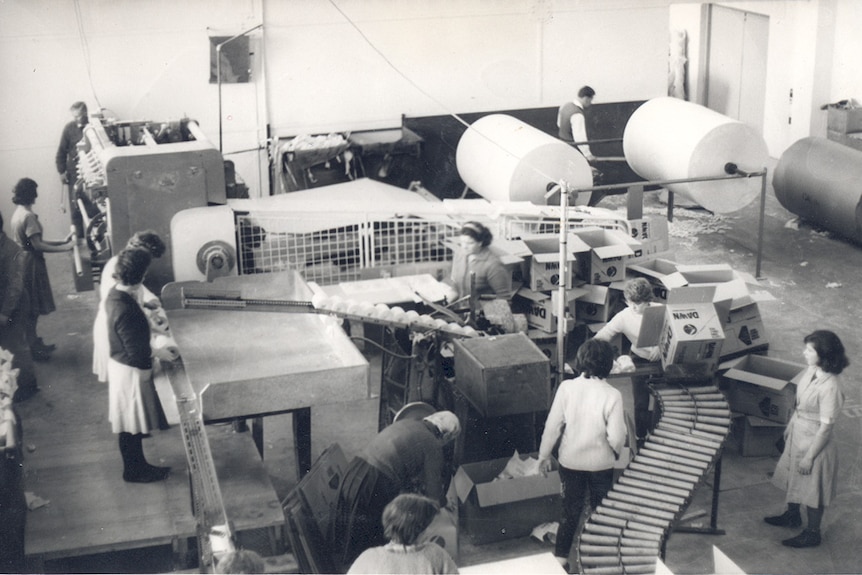
Annual leave loading was used primarily in the manufacturing industry. (Supplied: Kimberly Clark)
Professor Gahan said the cash Christmas bonus was more typical in North America and some parts of Europe, while the separate Christmas bonus for salaried employees is a more recent development in Australia.
“Traditionally, what we have had is a Christmas bonus in the form of that annual leave loading,” Professor Gahan said.
“Probably in more professional areas, we have seen Christmas bonuses come into play as a fixed amount that might be received for people who are salaried and perhaps not covered by awards.”

Some employers give festive gifts instead of cash bonuses. (ABC Wimmera: Andrew Kelso)
He warned bonuses were a double-edged sword for companies.
“The effect of having it tends to become an expectation and then if it’s removed because of conditions in the economy generally as a discretionary element, people will feel that a lot more strongly and suppose will feel less well disposed towards their employer, and feel like there’s some breach of their psychological contract of employment,” he said.
But for those who do receive a bonus at Christmas, Professor Gahan said morale also climbs, at least temporarily.
“In the US, literally the law is silent around many of these entitlements, so it becomes really at the largesse of the employer, so people perhaps feel more positively disposed to their employer because it’s seen as a gift from their employer when it does happen rather than something that’s required by law,” he said.