Pritti MistryBusiness reporter
 Lush
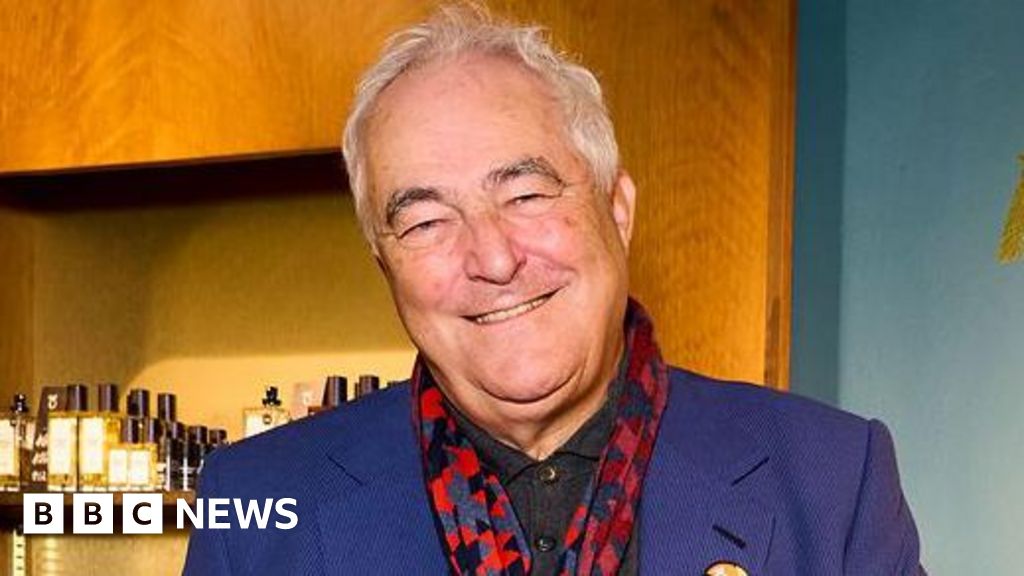
LushMost companies and bosses would squirm at the idea of being called “woke” and may even regard it as an insult. But not Mark Constantine.
Lush’s outspoken co-founder and chief executive wears it like a badge of honour and is not ashamed of turning it into a business philosophy.
The firm is renowned for putting activism at the heart of its bright bath bombs business, tackling a range of issues from trans rights to police accountability.
The 73-year-old is still steering the empire with the same principles that have defined its three decades on the High Street, which has seen it expand from a small Dorset store into a global brand with 869 outlets and an annual turnover of £690m.
Lush has taken some of the boldest stances in British retail including shutting down some of its social media accounts over concerns about the impact on young people, and more recently closing stores for a day to protest against starvation in Gaza.
“I like being woke,” admits Constantine.
A self-confessed “over-achiever and a nerd” who loves learning, he is up before the crack of dawn for his main passion – writing about birdsong – in between his meditation and Alexander technique, a therapy for good posture and movement.
But his message is crystal clear to those who openly resent his values: “You shouldn’t come in my shop.”
It’s a strong statement in an era when many businesses avoid political or cultural debates for fear of alienating customers and risking profits.
Ben & Jerry’s has long worn its social activism on its sleeve, which has caused tension with its parent company.
Where Lush has remained an independent firm, Constantine believes selling out means sacrificing the business’s values.
“If you’ve sold your business to someone else, I think you’re asking a lot for them to do everything you want. What should Ben and Jerry have done? They should never have sold.”
Ben & Jerry’s co-founder Ben Cohen maintains they were opposed to selling but as a publicly-traded company, says US regulations forced their hand and the brand’s social mission was written into the contract with the parent company.
“I have a huge appreciation for Lush, their values, and how they use their most powerful tool – their voice – to advocate for those values,” Cohen told the BBC, following Constantine’s Big Boss interview, adding, “I’m not ‘asking’ for anything.”
Speaking to the BBC’s Big Boss Interview podcast in the busy run-up to Christmas, Lush’s Constantine says preparing for the festive period is “very like war”.
“You have your troops, you have your supplies. Everything’s organised and ready. And then it’s just a question of when will the onslaught occur?”
He suggests that men may be more likely to be out buying last-minute presents, saying with a laugh the company sees a lot of men “who come in on Christmas Eve and tell us they’re regulars”.
But the key to attracting shoppers in the first place is by making retail “fun”, says Constantine.
Lush has turned shopping into more of an experience with offerings such as spa treatments and parties for customers.
And it’s experiences such as these that could help reverse the High Street’s declining prospects, he believes.
While some business leaders have suggested that a rise in employers’ National Insurance contributions and in the minimum wage could result in hiring freezes, Constantine views it differently.
“It’s good news for everyone and it’s good for the economy because you’ve got more money coming into the economy at the biggest point.
“The people who are getting these raises are at the bottom.
“I’m delighted to pay the extra money to get the staff up to a proper level, and I think we should celebrate that.”
However Lush’s pay record is not without blemish. In 2020, it admitted to underpaying its Australian workers more than $4m over nearly a decade. A company spokesperson told the BBC after the Big Boss interview: “We made mistakes, we found those mistakes and have paid the money we owed, and we are ensuring those errors cannot happen again.”
In the same year Lush faced claims of poor working conditions at its Australian factory. The spokesperson added: “Since these concerns were raised we swiftly developed an action plan to address the areas of concern.”

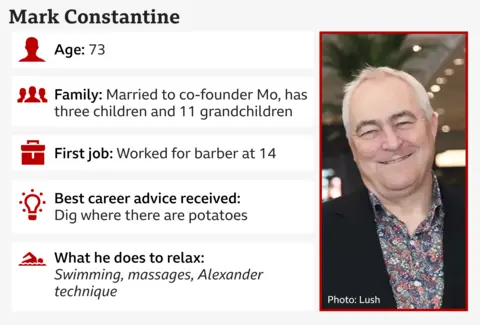
Lush is privately owned by all six co-founders – Constantine and his wife Mo, Rowena Bird, Helen Ambrosen, Liz Bennett and Paul Greeves – all of whom started the business in 1995 and have remained active since.
Two of Constantine’s three children also work for the company, which is particularly pleasing for a man who believes family is at the heart of a successful business and is key to longevity.
“Family businesses give better returns on investment at every level,” he says, claiming they last longer because they ride out the good times and the bad.
It’s a lesson he learned from the late Dame Anita Roddick, founder of The Body Shop where it all began for Constantine in 1977 – manufacturing and supplying products to Roddick’s stores.
However, he says the government does not understand “the strength of family businesses” after it announced that from April 2026 family business assets of more than £1m will face inheritance tax when passed on to relatives.
He believes this tax will force many owners to sell up, which is the “real worry on succession”.
A spokesperson for the Treasury said the government was “pro-business”, pointing out that it had capped corporation tax at 25% and was reforming business rates.
“Right now, 53% of Business Property Relief – worth £533m – goes to just 158 estates. Our reforms will channel that funding into vital public services,” the spokesperson said.
Nevertheless, Constantine remains bullish about the future of bricks-and-mortar shopping.
But he thinks modern retailing would benefit from a return to the old-fashioned values that once defined British retail, in particular innovation and kindness.
“I like to serve. I like the Jeeves kind of feeling,” he says with a grin.