
Released: 2025-12-23
Real GDP by industry
October 2025
-0.3%
(monthly change)
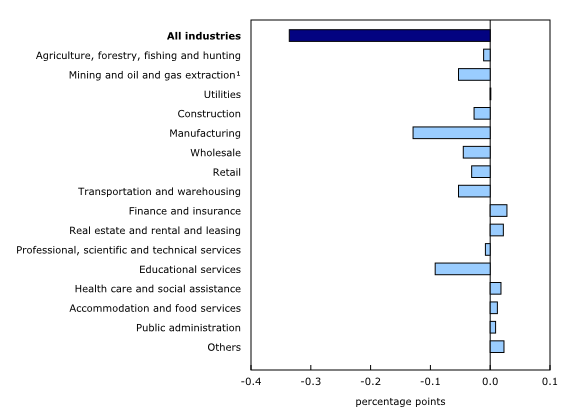
Real gross domestic product (GDP) decreased 0.3% in October, offsetting a 0.2% increase in September, driven by contractions in goods-producing and services-producing industries. Overall, 11 of 20 industrial sectors contracted in October.
Chart 1

Real gross domestic product declines in October
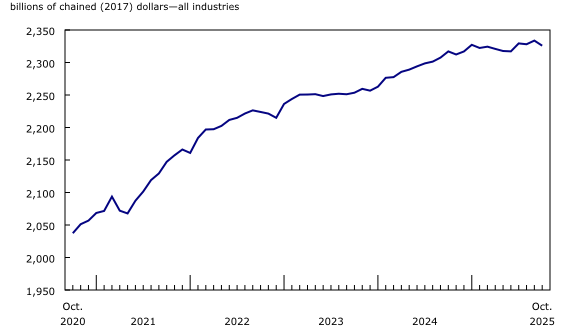
Goods-producing industries were down 0.7% in October, as most sectors comprising the grouping contracted, led by the manufacturing sector. Services-producing industries declined 0.2% in the month, impacted by a few labour stoppages that dampened the overall activity.
Manufacturing sector drives October’s decline after leading September’s growth
The manufacturing sector fell 1.5% in October, largely offsetting September’s expansion, as contractions in durable-goods and non-durable goods manufacturing industries weighed on growth.
Chart 2
Manufacturing sector contracts in October
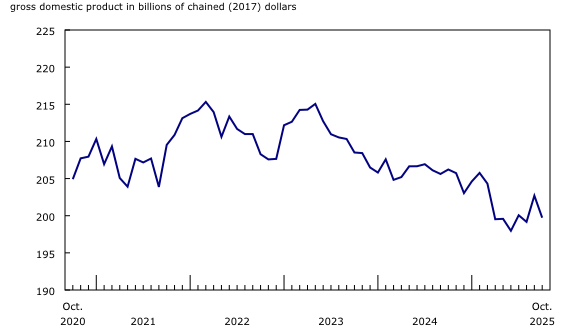
Durable-goods manufacturing industries contracted 2.3% in October, more than offsetting September’s 2.2% growth. Machinery manufacturing (-6.9%) contributed the most to the decline in October after driving the increase in the previous month. Wood product manufacturing (-7.3%) recorded its largest decline since April 2020, on widespread contractions across all industry groups. Sawmills and wood preservation (-9.0%) drove the decline in the subsector in October 2025, reflecting production slowdowns following the announcement from the US government of additional tariffs on Canadian lumber effective October 14.
Non-durable goods manufacturing industries decreased 0.4% in October. The chemical manufacturing subsector (-3.4%) was the largest contributor to the decline, with a 7.2% contraction in pharmaceutical and medicine manufacturing accounting for most of the subsector’s decrease. Meanwhile, petroleum and coal product manufacturing (+2.5%) partly offset some of the decline, on ongoing strengths in petroleum refineries (+2.7%) and petroleum and coal products manufacturing (except petroleum refineries) (+0.2%), as production continued to ramp up following maintenance and turnaround activities earlier in the year.
Province-wide teachers’ strike in Alberta weighs on the public sector
The public sector aggregate (comprising educational services, health care and social assistance, and public administration) contracted 0.3% in October.
Educational services fell 1.8% in October, driven by a contraction in elementary and secondary schools (-3.3%). This decline in elementary and secondary schools reflects a labour action by the members of the Alberta Teacher’s Association that took place from October 6 to October 29. This was the largest decline in the subsector since the public sector workers’ strike in Quebec caused back-to-back monthly decreases in November and December 2023.
Chart 3
The educational services sector falls in October
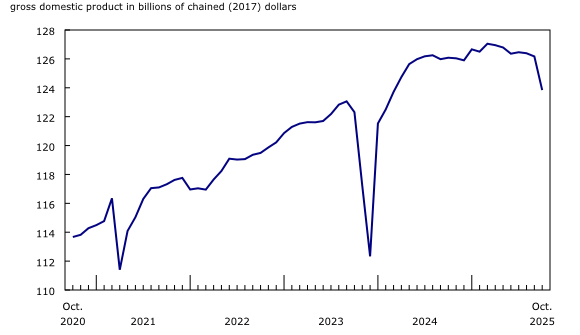
Meanwhile, growth in health care and social assistance (+0.2%) and public administration (+0.1%) tempered the decline in the public sector in October 2025.
Mining, quarrying, and oil and gas extraction sector down in October
The mining, quarrying, and oil and gas extraction sector contracted 0.6% in October, more than offsetting September’s expansion, as two of the three subsectors declined.
Following four consecutive monthly expansions, the oil and gas extraction subsector contracted in October (-1.2%). Oil sands extraction (-2.7%) contributed the most to the decline on account of lower crude bitumen extraction in October as several operators were performing maintenance at their facilities. Oil and gas extraction (except oil sands) (+0.2%) tempered the decline, reflecting increased extraction of crude petroleum in Alberta and Newfoundland and Labrador.
Support activities for mining, and oil and gas extraction (-2.4%) further added to the decline in October, driven by a 3.7% fall in support activities for oil and gas extraction, reflecting lower drilling and rigging services.
Mining and quarrying (except oil and gas) (+2.6%) tempered the decrease in the sector, with all industry groups growing in October. Non-metallic mineral mining and quarrying (+3.7%) led the growth, as potash mining (+4.5%) rebounded following a planned shutdown of a mine in September.
Transportation and warehousing sector down amid ongoing postal service workers’ strike
Transportation and warehousing decreased 1.1% in October, more than offsetting September’s growth, with the postal service leading the decline.
Chart 4
The postal service drops in October
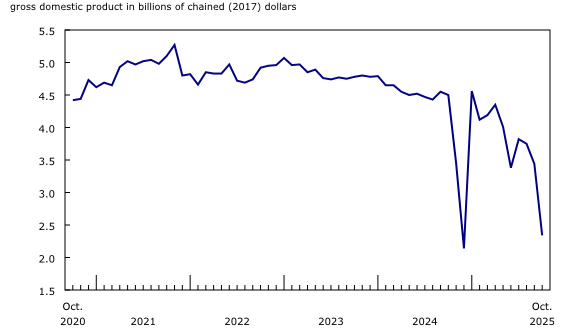
The postal service dropped 32.1% in October, reflecting disruptions in mail and parcel delivery activities as the nation-wide strike by members of the Canadian Union of Postal Workers (CUPW) launched on September 25, and shifted to rotating strikes on October 11. This was the steepest decline in the subsector since December 2024 (-38.1%), when the CUPW members last went on a nation-wide strike.
Wholesale trade sector down on widespread contractions
The wholesale trade sector contracted 0.9% in October, more than offsetting September’s expansion. This was the second decrease in the sector in the last three months.
Miscellaneous merchant wholesalers (-4.3%) and machinery, equipment and supplies merchant wholesalers (-1.6%) contributed the most to the decrease in the wholesale trade sector in October. Meanwhile, motor vehicle and motor vehicle parts and accessories merchant wholesalers (+1.8%) tempered the decline in the sector.
Retail trade down for the second consecutive month
The retail trade sector decreased 0.6%, down for the second month in a row, with most subsectors recording contractions in October.
The food and beverage retailers subsector fell 2.3% in October after recording back-to-back monthly increases in August and September. A labour action in British Columbia in October by members of the BC General Employees Union contributed to lower activity at beer, wine and liquor retailers, affecting the operations of both retailers and distribution centres. This was the lowest level of activity in the subsector since December 2022. Marking its third consecutive monthly decline, gasoline stations and fuel vendors (-1.0%) further added to the decrease in October 2025.
Meanwhile, growth at furniture, home furnishings, electronics and appliances retailers (+0.9%) and building material and garden equipment and supplies dealers (+0.2%) mitigated the sector’s decline in October, coinciding with the growth in national home resales and the higher activity at the offices of real estate agents and brokers and activities related to real estate (+0.9%).
Construction decreases for the first time in six months
The construction sector was down 0.4% in October, with most subsectors posting declines. Engineering and other construction activities (-0.7%) contributed the most to the decrease, recording its first contraction following five consecutive monthly increases. Residential building construction (-0.4%) continued to decline in October, down for the third month in a row, driven in October by decreased construction activity of new single-occupancy homes.
Meanwhile, non-residential building construction (+0.1%) tempered the decrease in October, reflecting rising institutional building construction activity.
Finance and insurance sector hits another record high in October
The finance and insurance sector posted its fifth consecutive monthly increase, rising 0.4% in October, and mitigating the overall GDP decline in October.
Other finance and insurance (+0.9%) drove the sector’s growth in October, reflecting increased activity in both equity and debt markets.
Chart 5
Main industrial sectors’ contribution to the percent change in gross domestic product in October
Advance estimate for real gross domestic product by industry for November 2025
Advance information indicates that real GDP by industry increased 0.1% in November. Increases in educational services, construction and transportation and warehousing were partially offset by decreases in mining, quarrying, and oil and gas extraction and manufacturing. Owing to its preliminary nature, this estimate will be updated on January 30, 2026, with the release of the official GDP by industry data for November 2025.
Sustainable development goals
On January 1, 2016, the world officially began implementing the 2030 Agenda for Sustainable Development—the United Nations’ transformative plan of action that addresses urgent global challenges over the following 15 years. The plan is based on 17 specific sustainable development goals.
The release on gross domestic product by industry is an example of how Statistics Canada supports monitoring the progress of global sustainable development goals. This release will be used to help measure the following goal:

Note to readers
General information
Monthly data on gross domestic product (GDP) by industry at basic prices are chained volume estimates with 2017 as the reference year. This means that the data for each industry and each aggregate are obtained from a chained volume index multiplied by the industry’s value added in 2017. The monthly data are benchmarked to annually chained Fisher volume indexes of GDP obtained from the constant-price supply and use tables (SUTs) up to the latest SUTs year (2022).
For the period starting in January 2023, data are derived by chaining a fixed-weight Laspeyres volume index to the prior period. The fixed weights are 2022 industry current price estimates.
Statistics Canada also produces expenditure-based GDP estimates at market prices, which are chained quarterly based on a Fisher volume index. Due to conceptual and statistical differences, GDP by industry and GDP by expenditure percent change estimates can diverge slightly.
All data in this release are seasonally adjusted. For information on seasonal adjustment, see Seasonally adjusted data – Frequently asked questions.
An advance estimate of industrial production for November 2025 is available upon request.
For more information on GDP, see the video “What is Gross Domestic Product (GDP)?.”
For more information on the impact of tariffs on key economic statistics, please consult: “How tariffs are conceptually reflected in key economic statistics.”
Revisions
With this release of monthly GDP by industry, revisions have been made back to January 2025.
Each month, newly available administrative and survey data from various industries in the economy are integrated, resulting in statistical revisions. Updated and revised administrative data (including taxation statistics), new information provided by respondents to industry surveys, and standard changes to seasonal adjustment calculations are incorporated with each release.
Notably, this monthly release incorporated updated information of Production of principal field crops released on December 4 which resulted in upward revisions for the crop production industry for the first nine months in 2025.
To satisfy the opposing goals for both timeliness and accuracy, Statistics Canada regularly updates (revises) its estimates of GDP. For more information about GDP revision cycles, please consult the “Revisions to Canada’s GDP” article in the Latest Developments in the Canadian Economic Accounts (13-605-X).
Real-time table
Real-time table 36-10-0491-01 will be updated on January 19, 2026.
Next release
Data on real GDP by industry for November 2025 will be released on January 30, 2026, including an advance estimate for the December 2025 reference month.
Products
The User Guide: Canadian System of Macroeconomic Accounts (13-606-G) is available.
The Methodological Guide: Canadian System of Macroeconomic Accounts (13-607-X) is also available.
The Economic accounts statistics portal, accessible from the Subjects module of the Statistics Canada website, features an up-to-date portrait of national and provincial economies and their structure.
Contact information
For more information, or to enquire about the concepts, methods or data quality of this release, contact us (toll-free 1-800-263-1136; 514-283-8300; infostats@statcan.gc.ca) or Media Relations (statcan.mediahotline-ligneinfomedias.statcan@statcan.gc.ca).