Unlock the Editor’s Digest for free
Roula Khalaf, Editor of the FT, selects her favourite stories in this weekly newsletter.
Global dealmaking topped $4tn this year for the first time since the boom of 2021, as a record number of megadeals lifted investment banking fees to their second-highest level ever.
A total of 68 deals worth at least $10bn each reshaped sectors from the media to industrials, as companies took advantage of buoyant markets, readily available financing and less stringent US regulation to attempt strategic transactions that would not have been possible in other conditions.
Worldwide mergers and acquisitions increased by almost 50 per cent from 2024 to $4.5tn, according to data from the London Stock Exchange Group. It is the second-highest total in more than 40 years of records, topped only by the 2021 pandemic frenzy of dealmaking.
“I haven’t seen large-scale M&A like this in a decade . . . These are deals which are really transforming industries,” said Tony Kim, co-president of investment bank Centerview Partners. “Scaled M&A requires a lot of important ingredients in the mix to succeed, and we seem to have all of those elements today.”
The rush of transactions helped drive investment banking fees to an estimated $135bn, the data show, a 9 per cent increase from last year. More than half of those came from the US, with $2.3tn of deals with American targets — the highest proportion since 1998.
“The current risk appetite is strong, with supportive financing and antitrust environments,” said Mark McMaster, global head of M&A at Lazard. “As a result, we’re seeing an ‘all systems are go’ dynamic when it comes to getting most deals done.”
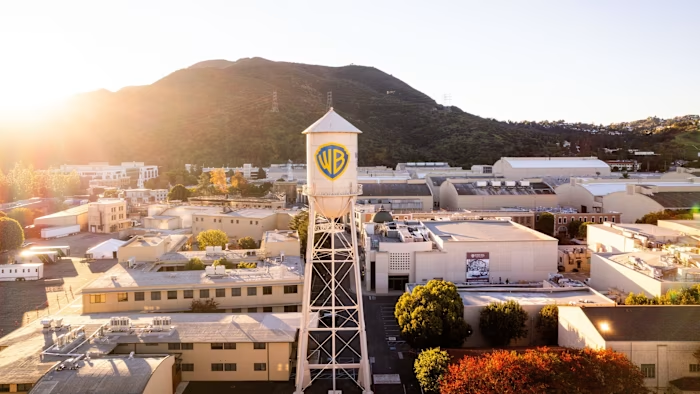
The two biggest deals of the year are the battle between Netflix and Paramount for Warner Bros Discovery, and the railroad megamerger between Union Pacific and Norfolk Southern to create a $250bn transcontinental juggernaut.
This mirrors 2021, the only year when dealmaking has topped 2025. Two of the largest deals then were WarnerMedia’s merger with its rival Discovery, and Canadian Pacific Railway’s $31bn acquisition of rival Kansas City Southern.
Top dealmakers said that the Trump administration’s push to loosen regulation had encouraged companies to explore tie-ups that they might otherwise have been hesitant to pursue.
“What we see with corporate clients is a willingness to take on regulatory risk for transactions that are strategic,” said Andrew Nussbaum, co-chair of the executive committee at law firm Wachtell, Lipton, Rosen & Katz. “They see a willingness of the regulators to engage in constructive dialogue.”
Although US dealmakers had anticipated a revival in activity under Donald Trump’s second presidency, sweeping “liberation day” tariffs announced in early April briefly halted early momentum.
However, dealmaking rebounded in the following weeks and ended the year with back-to-back quarters of more than $1tn in M&A for the first time in four years.
“Our momentum built post the recovery from liberation day and has just continued to build since then. There’s a lot of pent-up interest in M&A,” said Daniel Mendelow, US investment banking co-head at Evercore.
The rush of mega deals stands in contrast to a broader drop in smaller transactions, with the overall number of deals falling 7 per cent this year to the lowest levels since 2016.
Private equity dealmaking has lagged behind the wider recovery, with an increase of just over 25 per cent to $889bn. Buyout groups, also known as financial sponsors, still face challenges selling assets, although there were some flagship take-private deals involving the sector.
Among those, the largest was the $55bn deal for video game maker Electronic Arts led by Saudi Arabia’s Public Investment Fund, with backing from the private equity investor Silver Lake and Trump’s son-in-law Jared Kushner.
“The general narrative is that sponsors are not active, but there were some large take-private transactions,” said Anu Aiyengar, global head of advisory and M&A at JPMorgan Chase.
“Despite the equity markets hitting record highs, mispriced opportunities continue to exist and the scale of these opportunities are made possible with financing coming from a myriad of sources.”
The outlook for private equity was bolstered by an uptick in large initial public offerings, such as for the medical supply group Medline and the security services company Verisure, opening up an alternative path to offloading assets.
“Over the next couple of years there’s room for more activity, and we certainly feel the sponsor wave in particular is only just gaining momentum,” said Andre Kelleners, co-head of European investment banking at Goldman Sachs.