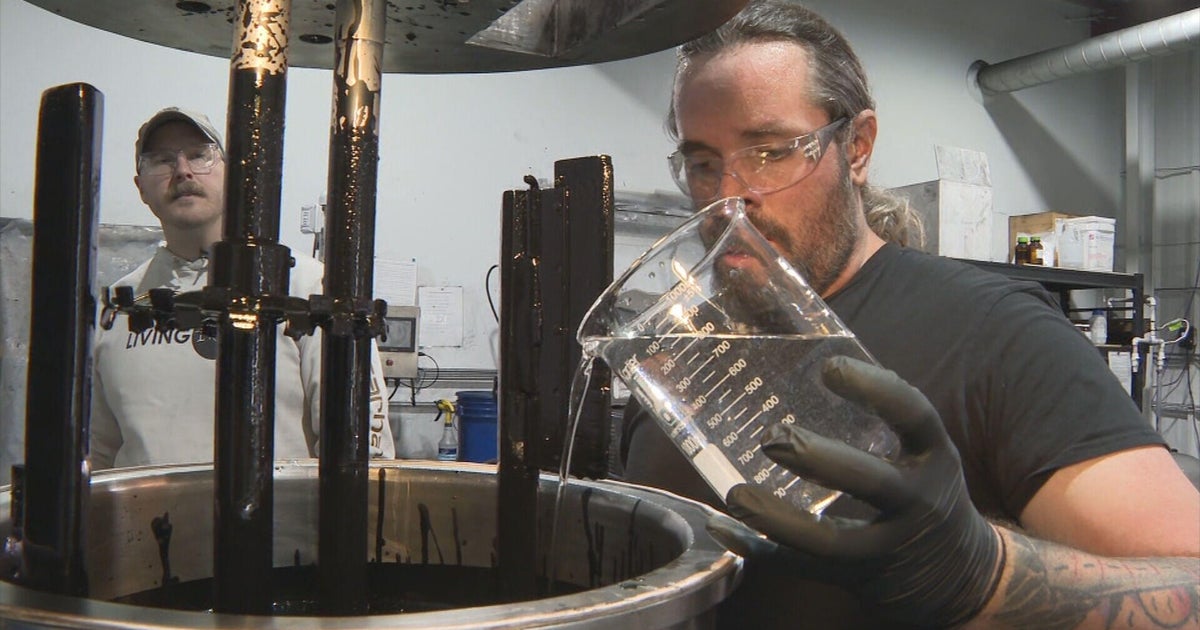
A Northern Colorado company, based in Berthoud, is helping major brands around the world produce more eco-friendly packaging and products. Living Ink Technologies, founded by Colorado State University graduates, is continuing to grow its operation in the region.
CBS
“Living Ink is a waste-to-value company. So, we take biomass waste, we do our thermal treatment, and we make an alternative to carbon black,” said Scott Fulbright, CEO and cofounder of the company.
Carbon black is found in most products and packaging that contain black ink. Fulbright said carbon black requires petroleum to create and is less eco-friendly than the alternative ink they are creating.
To create an alternative option, Living Ink has found a method to create black ink from waste created by other companies and humans, via biomass.
“Biomass like algae, like spent yeast from breweries and things like that,” Fulbright said.
Living Ink Technologies has partnered with companies like those that produce Budweiser beer. The company sends Living Ink their spent yeast, and then the team in Berthoud helps flip the product into a sustainable and reliable black ink.
CBS 
Living Ink’s product has already been used in major brands like Nike and Patagonia.
Currently, Fulbright admits that his product does come at a more expensive cost than carbon black ink. However, he said they are working on a trajectory that would make it more affordable and appealing to companies beyond their branding of being eco-friendly.
“We do think we can compete, and potentially undercut traditional carbon black, as we use these different waste streams in our process,” Fulbright said.
Fulbright said his team has moved around Colorado, but found home in Berthoud thanks to the talent pool in the region.
“We ended up in Berthoud because there is a great talent pool in Fort Collins, and there is a great talent pool in Denver and Loveland,” Fulbright said.
Fulbright said his company hopes to one day be able to work, in part, out of the Budweiser facility in Fort Collins. He said, by working directly in the facility, they could make a more cost-efficient way of flipping the company’s spent yeast and turning it into the ink on their packaging, all in-house.
CBS 
“So, we are working with their Fort Collins facility right now, and we are taking some of their spent grain and yeast from their process as our feedstock,” Fulbright said. “Ideally, making them more profitable and sustainable in their overall manufacturing cost.”