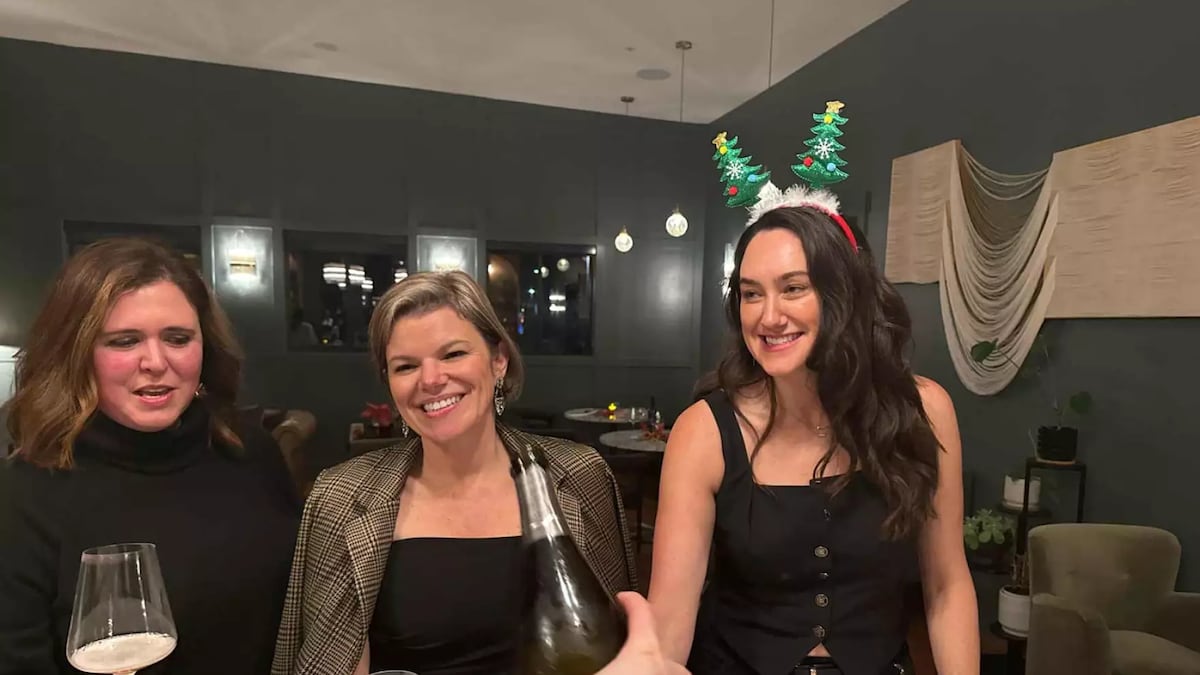
From the left Lauren Riker, Julie Parmer and Tracy Parmer enjoy a pour of French champagne at a club event at the Drayman House in Walla Walla, Wash., in an undated photo.
Anna King / NWPB
At Drayman House in Walla Walla, people pay to store their wine in lockers in a climate-perfect basement.
The membership-based storage facility also entertains guests in the poshly appointed upstairs with leather divans, velvet chairs and polished knotty-fir under clacking heels and shiny loafers.
On a warmer than usual December evening, people gathered here to swash several French “grower champagnes.” Silver buckets of ice hold several sparkling offerings — blancs and rosés — to choose from.
“Scoop that caviar up, ladies and gents,” cried out Island Nguyen-Ainsworth, co-owner of Saffron Mediterranean Kitchen.
She’s doling out house-made chicken nuggets loaded down with creme fraiche and caviar.
The Northwest is increasingly home to new and interesting sparkling wine options. The Washington State Wine Commission reports the sparkling industry is seeing sparks of growth, especially in the $16 to $20 a bottle price range.
Northwest fizz with styles
There are several types of fizz being made in the region: “farmer fizz,” forced carbonation wines, Pét-nat and traditional method sparkling wines.
- French grower champagne or Northwest farmer fizz are wines made by the people who grew the grapes. They are estate-grown. Although only wines produced in Champagne, France, can be called champagne.
- “Pét-nat” is short for Pétillant Naturel, meaning a wine that is only fermented once in the bottle, many times without using added yeast and sulfites. It’s topped with a metal crown cap instead of a cork. Oftentimes, it’s not riddled or disgorged, so it might have a bit of yeasty cloudiness to the wine.
- Then there’s traditional method sparkling. This is a wine fermented until it’s dry, then a bit of sugar and yeast are added before putting it in a bottle. This wine is opened briefly after it’s been in the bottle for a while and turned upside down. The neck of the bottle is frozen, and a frozen plug of the lees is ejected, leaving the clear wine. Then more wine tops it off and the bottle gets a cork.
Corey Braunel leans into his sparkling work at Dusted Valley winery in Walla Walla, Wash., in an undated photo.
Anna King / NWPB
Someone who’s making traditional method and labor-intense sparkling wine is Corey Braunel, of Dusted Valley winery.
Braunel said there is a lot that can go wrong in the years it takes to finish about 200 cases of traditional method sparkling wine made available to purchase each year.
To make traditional method, some parts of the process have been automated, like the riddling, or hand-shifting bottles so the yeast falls into the neck of the bottle.
“Here are all of our babies,” he said, touching a metal cage packed with unlabeled, shiny bottles laying on their sides. This winery uses machines to do the riddling, but there’s still a lot to do — from picking and crushing the grapes to disgorging the bottles. That’s when winemakers remove an ice plug from the bottles’ necks with the yeast, or lees, from each bottle.
“All this work is done by hand,” Braunel said. “This is really and truly a labor of love. All of this is a labor of love.”
High-quality bubbles
Over in Prosser, Washington, is Northwest winemaker Andrew Gerow. He is the co-owner of Tirriddis sparkling winery. He said consumers should look for high-quality bubbles.
“A finer bubble. So, a smaller bubble,” Gerow said. “Sometimes you’ll have a sparkling wine that when you put it into your mouth the wine turns to foam. Because the bubbles are so aggressive and they’re not comfortable in the solution.
“Or sometimes you will pour a glass of sparkling and there is a little bit of sediment in it, and that sediment, all those pieces of sediment are like little microscopic mentos and so the bubbles froth out. It’s not a sparkling wine if there are no bubbles in it. The importance for a high quality bubble is the fineness of the bubble. And how long it lasts in the glass. How long it lasts in the bottle when it’s been opened.”
“You would never see a sparkling malbec in France. They think I’m, like, nuts! But actually it’s turned out beautiful, so why not?”
— Gilles Nicault, winemaker
Another Walla Walla winemaker — Gilles Nicault of Long Shadows and Nine Hats — is from France. But he’s been in Washington making top wines for more than 30 vintages now. He said old world wines set the bar and are many times high quality, but they also follow rigid rules.
“When you buy champagne, you know what to expect to some extent,” Nicault said. “When you get some sparkling wine, it can be all kinds of things. Like the sparkling rosé I am making is malbec. French people are probably going crazy over it. You would never see a sparkling malbec in France. They think I’m, like, nuts! But actually it’s turned out beautiful, so why not?”
‘Wine that could go wrong’
Kaleigh Brook, an advanced sommelier — often shortened to som — said she’s in agreement. She also co-owns Tavern Ancestrale. Brook said there are some fresh, daring bubble bandits in the Northwest. People who are experimenting with different methods and varieties of winegrapes.
“It’s easy to make safe wine,” she said. “It’s not so easy to make wine that could go wrong.”
She also said she hunts out “honest wines.” While there are a lot of wineries struggling because sales are down, she said, small local producers are bottling interesting wines that are worth spending time with.
“Look for wineries that are being transparent about the way they grow their grapes, the way they make their wines and their story,” Brook said. “If you start asking for transparency and asking for honesty in wines, you’ll find honest wines. And in the end, you’ll drink better.”
Nuggets, friends and family
One thing is agreed; bubbles go great with nuggets, friends and family.
“‘Cause wine is about community, right?” said Brook. “It’s about sharing. It’s about bringing community together.”
“What I love is that it’s festive and bright and vibrant and always very enjoyable anywhere from brunch to dinner,” said Nicault.
Gerow smiled and said his favorite part of the sparkling wine making process is when someone opens his bottles in front of him, “You know, that’s why you make wine — is to share!”
And Braunel said any day is a sparkling day, “I like to joke around that I’m looking for more reasons to open bottles. Instead of more reasons to not open bottles if you know what I mean?”
Some Northwest wineries making sparkling:
Washington
Oregon
Is your Northwest favorite not on this list? Send an email to news@nwpb.org.
Anna King is a reporter with Northwest Public Broadcasting. This story comes to you from the Northwest News Network, a collaboration between public media organizations in Oregon and Washington.
It is part of OPB’s broader effort to ensure that everyone in our region has access to quality journalism that informs, entertains and enriches their lives. To learn more, visit our journalism partnerships page.