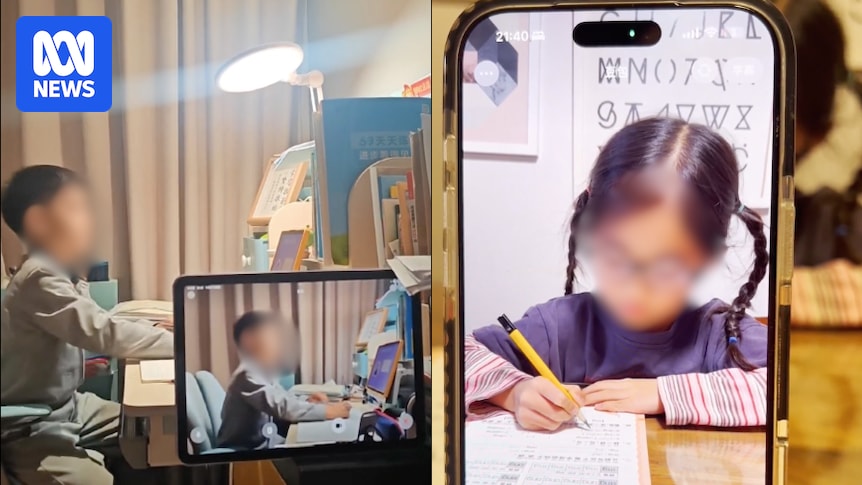
When she is busy, Lu Qijun places her phone on her son’s desk before he starts his homework.
The camera is on — and it stays on.
When Ms Lu’s son slouches, a calm voice on the phone reminds him to sit up. When he fidgets with his pen, the voice tells him to stop. And when his pace slows, the voice urges him to work faster.
Ms Lu, a television journalist in China’s southern province of Guangdong, is not in the room.
The voice belongs to Dola, a Chinese artificial intelligence chatbot developed by ByteDance, the company behind TikTok.
Ms Lu is one of about 172 million monthly users of the app, according to Chinese statistic platform QuestMobile.
In addition to homework monitoring, the app also acts like a tutor.
Ms Lu said AI could monitor her son doing homework when she was busy. (Supplied)
On social media, Ms Lu shares light-hearted videos of her son reacting to the chatbot’s instructions, attracting thousands of views from Chinese parents.
The appeal, she said, was not only convenience.
As China’s economic growth slows, many families are reassessing how much they can afford to spend on education.
Private tutoring, once common among China’s millions of urban middle-class households, has become harder to justify, even as many students continue to spend several hours a day on schoolwork and extracurricular classes.
“Dola can keep an eye on him for me,”
Ms Lu said.
“Parents are anxious about spending heavily, only to end up with a ‘rotten-tail kid,’” she said, referring to a popular Chinese meme used to describe jobless young adults despite years of investment in their education.
Dola is an AI app owned by TikTok’s parent company, ByteDance. (Reuters: Dado Ruvic/Illustration)
The app allows Ms Lu to upload parenting books and study materials she trusts so that it can tailor its guidance to her son’s needs.
Dola can also check her son’s homework, explain why his answers are incorrect, and generate similar questions based on his mistakes.
“It’s like having my own parenting bible,” she said.
“Now I can read a book or answer messages while he is doing his homework.”
AI used to sidestep conflict
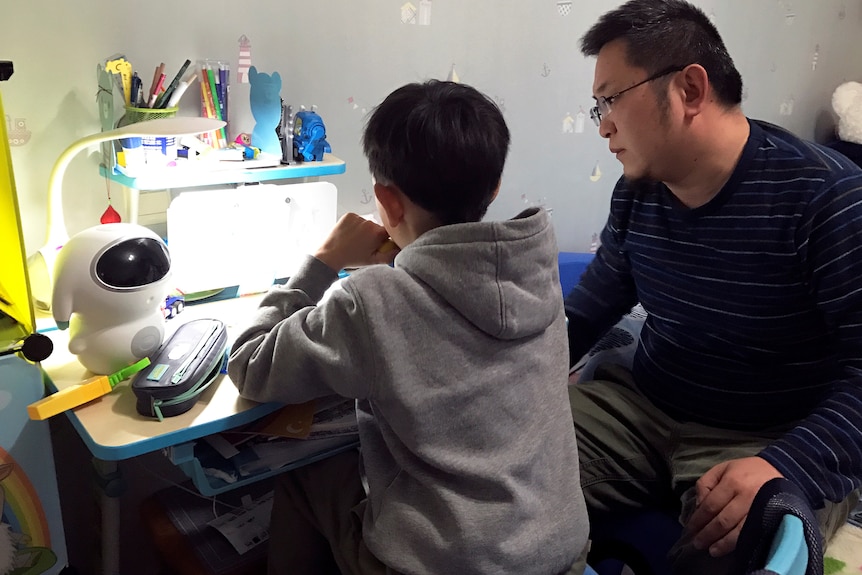
Some parents say the app also helps them avoid conflict with their children. (Reuters: Anita Li)
In most Chinese schools, parents are expected to remain closely involved long after the school day ends.
Homework and extra classes often fill the hours after school, with teachers assigning tasks and providing feedback through parent chat groups on social media platforms such as WeChat.
Parents are expected to respond, submit updates and report on their children’s progress.
For many working families, the demands can be constant.
Most parents raising children today belong to the generation shaped by China’s one-child policy, and need to support four aging parents while raising children of their own.
In traditional family settings, mothers are expected to have a job, manage the household and take primary responsibility for supervising children’s education after school.
Some parents say the app also helps them avoid conflict with their children.
Wu Yuting from the central province of Henan has two children in primary school.
She and her husband used to sit beside their children while they completed their homework, a routine that often ended in frustration.
“My children behave better in front of AI,”
Ms Wu said.
“They think I talk too much.”
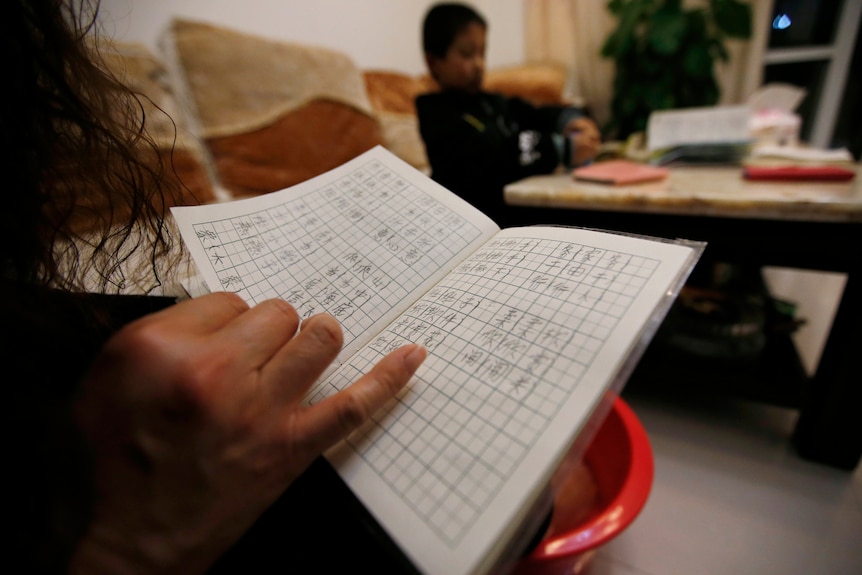
Parents believe completing homework diligently leads to academic success. (Reuters: Kim Kyung-Hoon)
Ms Wu said the AI bot spoke to their children in a calm tone — a contrast to the tension that can easily build between parents and children after a long day.
Dr Qi Jing, an associate professor at the Social Equity Research Centre at RMIT University, said the language used by artificial intelligence systems was designed to sound patient and encouraging.
“If parents use AI as part of children’s learning, they may be avoiding conflicts that need to be addressed,” she said.
“[Children’s] brain need conflict, struggle and challenges to develop properly.”
A tool, not a substitute

Education has long been central to Chinese family values and seen as the main pathway to social mobility and long-term security. (Reuters: Thomas Peter)
As AI becomes more widely used in education, learning-focused tools are attracting growing numbers of users.
Data from QuestMobile shows Dola’s learning app, Dola Aixue, has about 8.76 million monthly active users.
For parents like Ms Lu, the technology remains a tool — used carefully and adjusted as needed.
She limited how often it spoke, after finding too many prompts were distracting her son.
“I only use it when I’m too busy … If I have time, I still prefer to sit with him,” she said, citing concerns about emotional reliance.
“He’s still very young. I don’t want him to treat it as a companion.“

Parents wait anxiously outside exam centres while their children sit China’s university entry exam. (Reuters)
Elaine Zhou, a Shanghai-based mother who works in international education, said her two sons used AI tools to look up questions and check their homework.
However, she remained cautious about AI-led supervision and had concerns about overuse, privacy and exposure to content not suited to children.
“For children, AI is highly efficient and easy to use,” Ms Zhou said.
“But it can also reduce the process of thinking they do.“
Drawing the line
Experts say it’s essential to have clear boundaries.
Dr Qi Jing said artificial intelligence lacked the contextual understanding needed to replace the supervision of parents or teachers.
“AI can certainly be used, depending on how.”
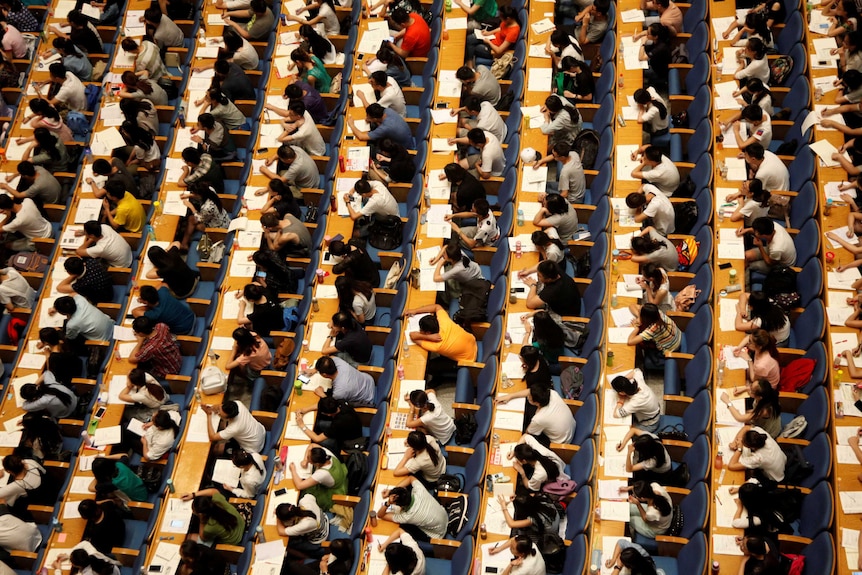
Students in China are known for putting hours and hours into preparing for exams. (Reuters: China Dail)
She said behaviours such as playing with a pen or pausing briefly did not necessarily signal distraction, but could be part of a child’s thinking process.
Jeannie Paterson, co-director of the Centre for AI and Digital Ethics at the University of Melbourne, said AI products designed for children should include limits on usage time, age-appropriate language and safeguards against harmful content.
Professor Paterson warned that excessive interaction with AI could weaken children’s engagement with the real world and hinder the development of essential social skills.
“Developers should monitor performance carefully for signs that the AI is not aligned with the best interests of the child,” she said.
She also argued developers must be careful not to suggest to children that the technology was alive or had human emotions.
“AI is a tool, not a friend,”
she said.
“It can assist with some tasks but does not care or love the child.”