
When Savannah listed her old iPhone for sale on Facebook Marketplace, she didn’t expect any trouble.
The single mum has been selling on the platform for years, and always followed Facebook’s official advice — never giving out her real address and meeting in open, public spaces for exchange.
Savannah was conscious that the high price of her sale item could attract scams, and thought she needed to be “a bit more careful”.
She felt safe meeting her prospective buyer at 3pm on a busy street in broad daylight. But that quickly changed.
“He was kind of trembling. He kept asking questions … but he wasn’t really listening to what I was saying,” she recalled.
“So that was when I went, ‘Uh oh, something weird is going to happen’.”
Savannah says she still feels shaken by her experience and is unsure if she’ll use Facebook Marketplace again. (ABC News: Yasmine Wright Gittins)
Moments later, the man — who was already holding and examining the phone for sale — lunged for Savannah’s personal phone that she held in her hand, causing her to fall.
“He freaked out and took off,” she said, taking with him the phone she’d had for sale.
Frustrated and shaken, she called police and lodged a report for the stolen phone.
“Essentially [they] said that they can’t do anything because the guy was on foot and there was nothing like a car registration,” she said.
The man’s Facebook profile was also fake, and he blocked Savannah after the incident.
She had been scammed.

Savannah says she went “through a process of being angry, sad, then almost blaming myself”, after she was scammed. (ABC News: Yasmine Wright Gittins)
‘I was too eager’
Online marketplace scams are included under the broader category of shopping scams.
This year, more than 19,000 reports of shopping scams have been made to Scamwatch, totalling $8.6 million in losses — a 19 per cent increase on the same period last year.
“They can be really quite sophisticated and detailed in the execution of these scams,” Catriona Lowe, Australian Competition and Consumer Commission (ACCC) deputy chair, said.
With scams on the rise, the National Anti-Scam Centre, run by the ACCC, is urging buyers and sellers to “stop, check, protect”.
Ms Lowe said the “stop” category was key.
“The stop part is really just not being rushed, because scammers know very well that when we’re in what’s called a ‘hot state’ — if we’re stressed or we’re hurried or we’re worried — that’s when some of our natural caution will be lower and we can be susceptible to the crime that they are trying to commit,” Ms Lowe said.

Jack Lenffer says she’s been using online marketplaces much less since she, her mother and her boss were scammed. (Supplied: Jack Lenffer)
Slowing down and taking more time to make a purchase is something Jack Lenffer wishes she’d done when she went to buy tickets for Canberra’s Spilt Milk festival in 2024.
She was scammed into sending money to a seller for a resold ticket.
“I think I didn’t want to admit to anyone that I’d actually been scammed, but you look back at it and you read the messages and you’re like, ‘Oh I was just too eager,’” she said.
The chef regularly shops on Marketplace and is becoming increasingly frustrated by scams.
She encountered some more recently, while trying to buy a couch.
“I noticed every single ad was just fake people who just wouldn’t reply, or they’re just demanding money straight away when you haven’t even gone over and looked at it yet,” Ms Lenffer said.
“They’re already asking for deposits and lying about how interest [in the item] is so high that you need to pay the money first.“
And while she says she can now identify a scam “pretty quickly,” she worries for those who can’t, with her mum and boss recently falling victim.
So, what are some of the red flags people should look out for when buying and selling via online marketplaces, and how can you protect against scams?
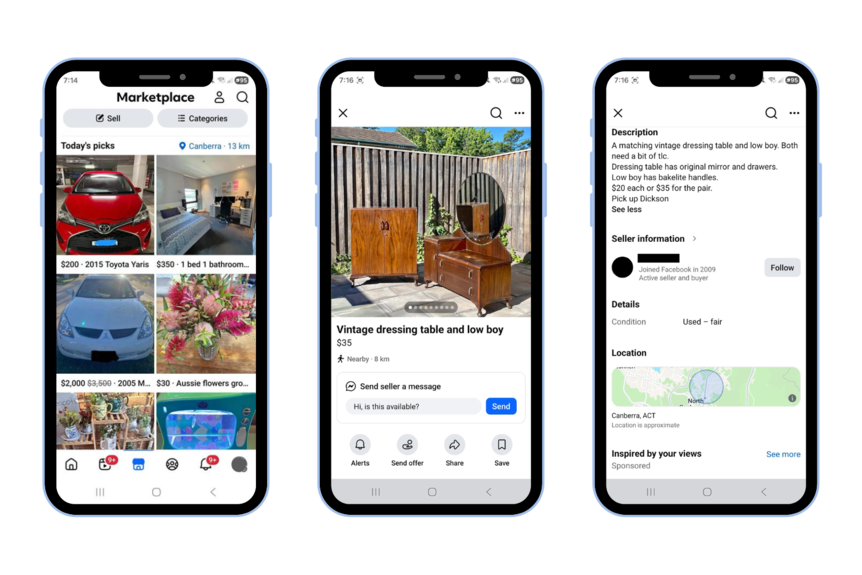
Since its launch in 2016, Facebook Marketplace has been a popular platform for people to buy and sell second-hand goods. (ABC News: Yasmine Wright Gittins)
Common online shopping red flags
Scammers can pose as both buyers and sellers on online marketplaces.
Those pretending to be sellers might advertise an item for sale at a price that’s too good to be true.
“Often there’s a compromised social media profile involved, and once a person pays for that item, the profile disappears and the product never arrives,” Ms Lowe said.
“Often that scammer will claim they’re travelling, or that they’ve moved overseas or a similar story like that, and that they only send the goods once the payment is received.
“And of course, that’s how they part people with their money.”
Ms Lowe said the scammer might also use the transaction to send phishing links to obtain personal and payment information, so you shouldn’t click on any links they send you or download anything to your computer.
Another thing to look out for is sellers insisting on payment up-front, or requesting unusual payment methods.
“Wire transfers, cryptocurrency, gift cards, or direct transfers all should put people on alert that they need to be careful,” Ms Lowe said.
If you are selling an item, Ms Lowe said to look out for fake payment confirmations from scammers posing as buyers.
“Typically what we see is that they will send a fake payment confirmation to a seller, like a screenshot, and claim that they’ve accidentally overpaid and seek a refund for this so-called overpayment amount,” Ms Lowe said.
“Of course, there was no payment, let alone an overpayment, so it’s a way of extracting money from the seller.“

Catriona Lowe urges people to report scams that they encounter to Scamwatch. (ABC News: Kyle Harley)
Tips when buying
As a buyer, Ms Lowe advises doing your due diligence on the seller.
Search for duplicate listings for an item and check the seller’s account profile.
“Sometimes we’ll see a number of very similar profiles with just slightly different names,” Ms Lowe said.
“Also if the profile is very recently created or there’s bad or no reviews about that profile, these are all red flags.“
If you’re buying in-person, don’t hand over money until you see the item for sale.
If you can’t see the item before purchasing — for example, if it is to be mailed — then consider asking to see multiple photos of the item, a live video, or an original sales receipt.
When paying for an item electronically, Ms Lowe said it was important to use secure payment methods.
“If you’re using PayPal or BPAY, for example, there are dispute resolution processes that those providers have, and if you use a credit card and you don’t receive the goods, you can charge back for those items,” Ms Lowe said.
For those who regularly purchase online, Ms Lowe said it was important to have multi-factor authentication set up for accounts.
She also suggested setting up a separate credit card with a low limit.
“Only use that card for online purchases so that even if it’s compromised, that limits the amount of loss that a consumer might be facing,” she said.
Tips when selling
When selling, Ms Lowe suggests not handing over items until you’ve received payment.
If selling for cash, take a moment to check the money isn’t counterfeit.
If payment is being made electronically, check your bank account to verify the money is there — don’t rely on the buyer providing transaction evidence.
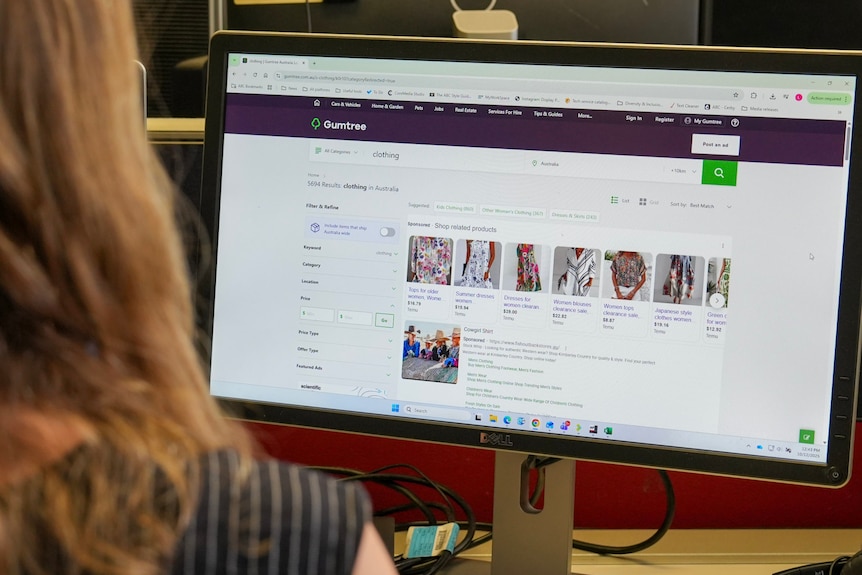
When shopping on Gumtree and Facebook Marketplace, it is a good idea to check for duplicate listings of the item you want to buy. (ABC News: Yasmine Wright Gittins)
When meeting someone in person to exchange, choose a public well-lit location, ideally one covered by CCTV.
If possible choose a time when there are likely to be other people around, or consider taking a friend or family member along with you.
Victoria Police has set up 35 “safer exchange sites” across the state for this purpose, and police in some other jurisdictions have encouraged people to use station car parks.
What to do if you think you’ve been scammed
Ms Lowe said to trust your instinct: if you feel like something may be wrong it’s best to act quickly.
The National Anti-Scam Council recommends:
- Contacting your bank immediately if you think you’ve lost money or shared financial details;
- Contacting IDCARE if you have shared personal information and think you are at risk of identify theft;
- Reporting the scam to Scamwatch and police to help protect others;
- Changing passwords and security details if you think they’ve been compromised;
- Monitoring your bank statements and credit reports for unusual activity.
“Even if you’ve spotted the scam and disengaged you should still report it, because we use that intelligence to warn other people and also to disrupt the scams,” Ms Lowe said.