Engineering the Future of Infrastructure
Strengthening America’s infrastructure starts with innovation — and one Cedarville University researcher is helping lead that charge. Dr. Hema Jayaseelan, assistant professor of civil engineering at Cedarville University, has received national recognition for pioneering research that could reshape how engineers design, monitor and maintain bridges across the United States and beyond.
Smarter Models, Safer Bridges
With more than 20 years of structural engineering experience, Jayaseelan has developed advanced analytical models that more accurately predict “pre-stress losses” in concrete bridges — the gradual reduction of internal tension that weakens structural performance over time. When these losses are miscalculated, bridges can experience deflections, vibrations and cracking that shorten their expected 50- to 75-year lifespan, creating costly and potentially hazardous outcomes.
Jayaseelan discovered that many traditional Department of Transportation (DOT) formulas overestimate or underestimate pre-stress losses. Her groundbreaking study introduced a data-driven method that uses real-time information from instrumented bridges, producing predictions that closely align with actual field performance.
National Recognition and Industry Impact
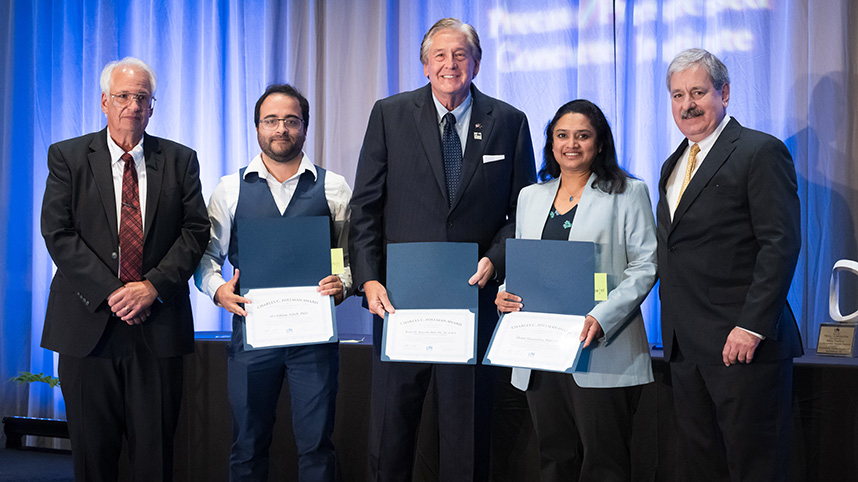
Her peer-reviewed paper, “Assessment and Validation of Prestresses Loss Prediction Models Using Real-Time Prestress Loss Measurements,” applied the new method of monitoring bridge data. Coauthored with structural engineering experts Alla Eddine Acheli, Ph.D.; Bruce W. Russell, Ph.D., P.E., S.E., F.A.C.I.; Walter Peters, P.E.; and Chris Filip, the piece was published in the 2024 September to October issue of the PCI journal. The research earned the 2025 Charles C. Zollman Award from the Precast/Prestressed Concrete Institute (PCI), honoring the year’s best technical paper discussing the use of precast concrete in transportation infrastructure.
“We were humbled and grateful to receive the PCI award,” Jayaseelan said. “It’s a blessing and a reminder that God’s timing is perfect. The recognition shows that DOTs nationwide are beginning to see the importance of this research.”
Her work has also been nominated for the prestigious T.Y. Lin Award from the American Society of Civil Engineers (ASCE), one of the highest honors in global structural engineering. The award celebrates research that advances the science and practice of prestressed concrete design and construction — a vital component of resilient infrastructure worldwide.
From South India to Smart Bridges
Jayaseelan’s passion for building began in Coimbatore, South India, where she grew up exploring how structures worked. “I’ve always loved working with my hands — playing in the mud, getting dirty. That’s still what I do today in the lab,” she said.
After earning her bachelor’s degree in civil engineering from the Government College of Technology in India and a master’s degree from Oklahoma State University, Jayaseelan pursued doctoral research at Oklahoma State integrating real-time data from sensors embedded in bridges — technology she describes as “listening to a structure’s heartbeat.”
These sensors use smart technology, solar power and wireless connectivity to transmit data remotely, allowing engineers to continuously monitor bridge performance. By combining traditional engineering principles with advanced data analysis, Jayaseelan’s approach creates an early warning system that can detect potential structural issues before they become critical.
Advancing Global Infrastructure Standards
Her current collaboration with U.S. Department of Transportation officials aims to simplify the new predictive equations for integration into national and international bridge design codes, supporting safer, longer-lasting infrastructure.
“We can’t change everything overnight,” Jayaseelan said. “But through smaller, smarter improvements guided by real-time data and sound engineering, we can make bridges stronger, safer and built to last.”
Jayaseelan’s research underscores a global movement toward smarter, sensor-integrated infrastructure — aligning with worldwide efforts to improve sustainability, safety and resilience in public works.
About Cedarville University
Cedarville University, an evangelical Christian institution in southwest Ohio, offers undergraduate and graduate residential and online programs across arts, sciences and professional fields. With 7,265 students, it is among Ohio’s largest private universities and is ranked among the nation’s top five evangelical universities in the Wall Street Journal’s 2026 Best Colleges in the U.S. Cedarville is also known for its vibrant Christian community, challenging academics and high graduation and retention rates. Learn more at cedarville.edu.