Modular and prefabricated homes could be used for public housing in Canberra to help “scale up” the local home manufacturing industry.
It’s just one method the ACT government is considering to meet its target of enabling 30,000 news homes in the territory by 2030.
The Master Builders Association has labelled the target “a pipe dream”, but Planning Minister Chris Steel says they’re doing all they can to achieve the goal, despite falling about 100 dwellings short of its first-year target of 4,200 new homes.
That’s why modular and prefabricated housing and components are increasingly viewed as potential solutions to Australia’s housing crisis.
They’re built off-site in factories and then transported to their final location for assembly, and are often a cheaper and quicker housing option.
But those in the industry warn there needs to be substantial changes in planning, regulation and finance rules to make modular and prefabricated housing an affordable, scalable solution.
Manufactured houses ‘the future of building’
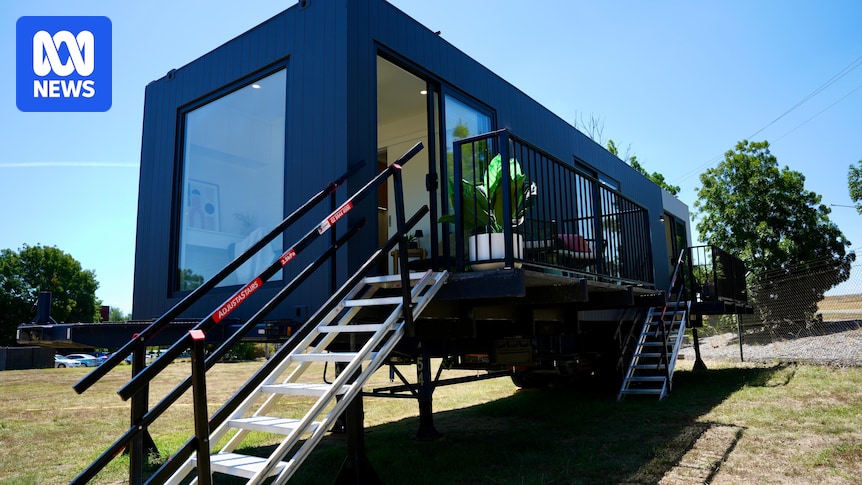
Geoff McGinley first looked into tiny homes to avoid the mortgage trap. (ABC News: Joel Wilson)
Geoff McGinley’s modular housing business began as a project to design and build his own home.
“I’d done 28 years in the Navy, and I was ready for the next dream, for the next passion to follow, and I needed an affordable housing solution,” Mr McGinley said.
“I didn’t want to get locked into the mortgage trap that I see and so I thought, ‘I’ll go for a tiny house’.”
Though tiny houses are comparatively affordable and quick to move and set up, Mr McGinley wasn’t happy with the size of the structures on offer.
“Tiny houses are, well, tiny, so … I went and found a really high-quality manufactured house,” Mr McGinley said.
“And manufactured houses really are, I think, the future of building in Australia.“
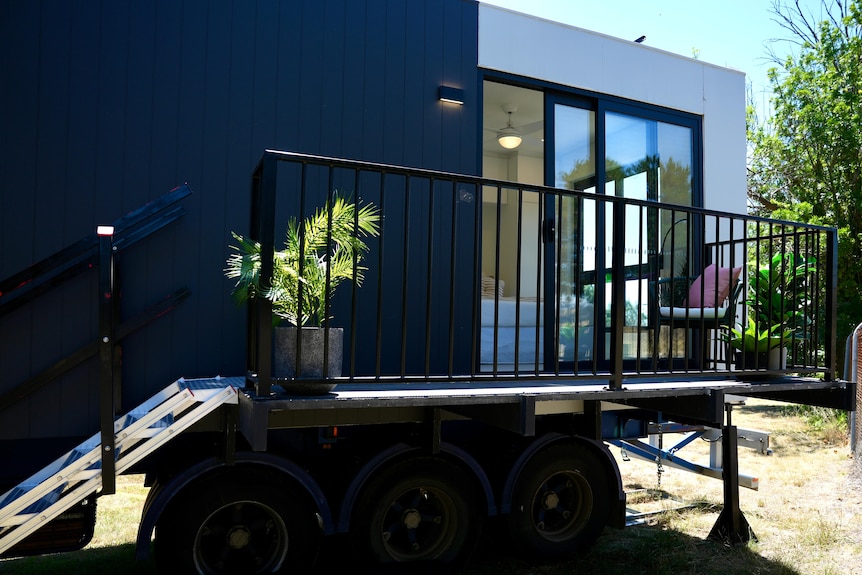
The biggest constraint Adapt Homes faces is the planning process, Geoff McGinley says. (ABC News: Joel Wilson)
Mr McGinley constructed what he says is like “an extra-large tiny house on wheels”.
“I took this National Construction Code modular house, and we put it onto a commercial truck trailer … it legally meets the definition of a caravan,” he explained.
“Having delivered my house and moved in, I sort of turned to my builder and said, ‘Hey, we can’t stop at one’.
“There is this housing crisis in Australia, and there’s a lack of options.
“People are looking for different ways to solve their housing solutions and they’re getting locked into a smaller range.
“We wanted to give people options so that they had a housing solution when traditional ways of doing this didn’t work.”
Mr McGinley’s company, Adapt Homes, now offers several moveable tiny houses, which range in size from 14 to 40 square metres, and can be joined together or stacked, like toy bricks, to make larger buildings.
Manufactured mostly in China, Mr McGinley argues the supply of these types of homes — which, once built, can be set up on a property in a matter of hours — could be easily scaled up to provide 1,000 a month.
“The biggest constraint is not our ability to manufacture the homes,” Mr McGinley said.
“The biggest constraint is the planning process.
“Obviously, we want to ensure that these homes are fit for purpose and suit the environment.
“But our planning processes take a long time — a really, really long time — they can take three to four times the duration to build a house.”
Mr McGinley said these factory-made homes could be used to provide crisis accommodation quickly and give more options to people for whom owning a home is currently out of reach.
“We see young families or old families, we see people escaping a crisis, we see people who are just trying to live life their way,” he said.
“Let’s accept that there is a path for long-term habitation on a tiny house on wheels. And let’s see this as both an option, but also as our sort of our go-to. Let’s fix something.“
High demand for prefabricated options

AJC Modular CEO Andrew Copley says there needs to be a change in regulation regarding modular housing. (ABC News: Callum Flinn)
AJC Modular chief executive Andrew Copley agrees changes to regulation are needed in order to meet the housing demand in both the ACT and nationally.
His company’s factory in Queanbeyan uses Australian-made structurally-insulated panels to build modular granny flats and homes.
The panels are an insulated foam core sandwiched between two structural facings — in AJC’s case, gyprock.
“We use structurally insulated panels for a few reasons,” Mr Copley said.
“The cost: because we can make them a lot quicker, they go together like Lego pieces; and the sustainability aspect — they’re highly efficient for energy efficiency ratings.”
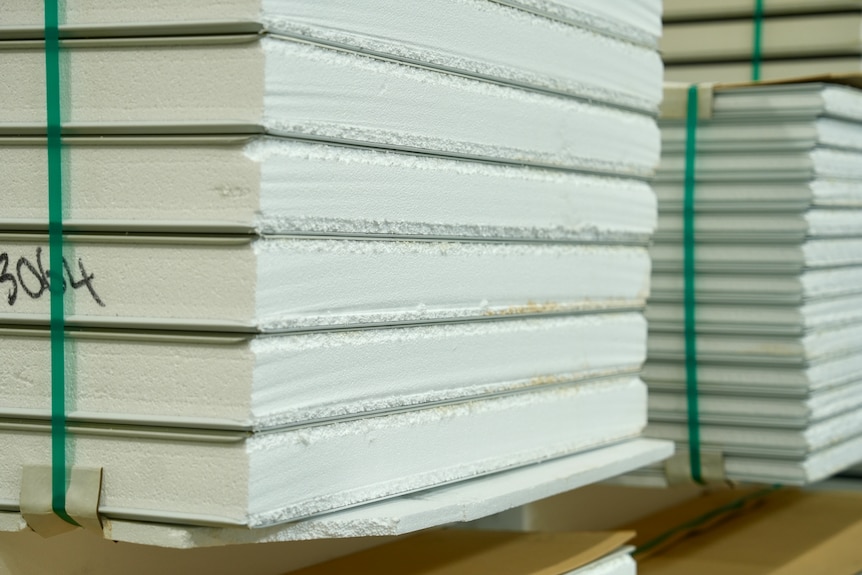
Prefab panels stacked up inside the modular housing factory in Queanbeyan. (ABC News: Callum Flinn)
He also said the panels are cut to size — so involve minimal wastage.
“And even if we do have wastage, we’ve got specialised recycling bins here to make the best use of that waste, whereas at a [traditional house] job site, it just all gets dumped into one generic waste bin,” he said.
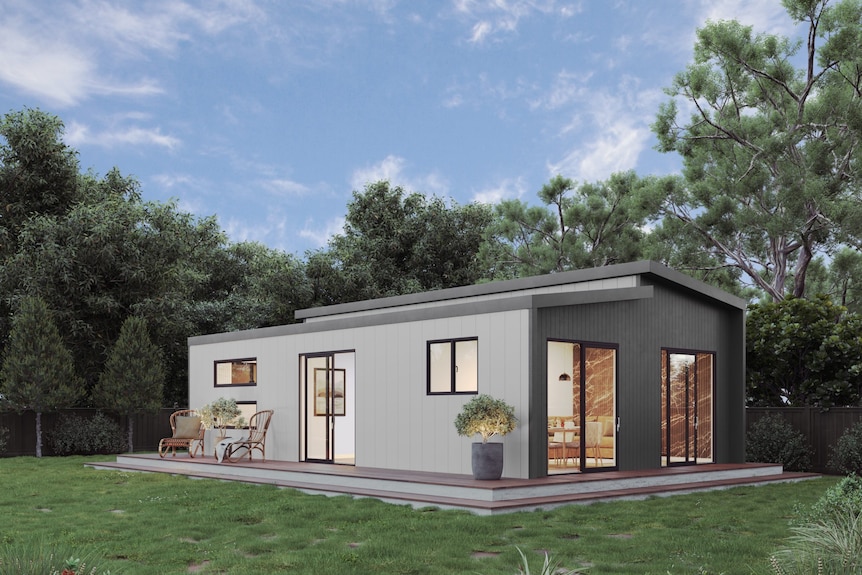
An artist’s impression of a modular home. (Supplied: AJC Modular )
Mr Copley said his company had seen so much demand that they’re now setting up a second factory in Brisbane.
But he argues design approval and certification processes stand in the way of building the number of homes needed to meet government housing targets.
“From the time it takes me to start a job and complete it, it’s about 12 to 14 weeks,” he said.
“However, getting it to that point where we’re actually allowed to start it is the biggest hurdle.
“It doesn’t matter what state it is, it’s just a massive red tape on this product where it shouldn’t be.
“These are all preset designs. They’re pre-engineered. Everything is built exactly the same way every single time.
“But yet we still have these massive hurdles and massive roadblocks to get the product through.”
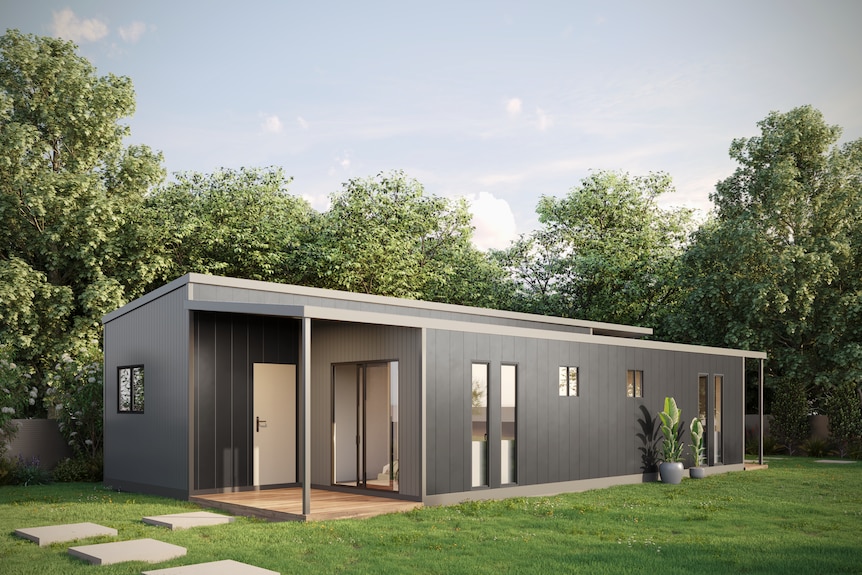
An artist’s impression of a modular home. (Supplied: AJC Modular )
Mr Copley thinks Australia could learn from the American industry.
“In America, they’ll come and inspect your factory, they’ll look over your building methods, they’ll look at your engineered drawings,” he said.
“And as long as you meet those set criteria and you tick all the boxes — like your setbacks are within the requirements, the house size is within the requirements — it’s an automatic approval.
“We should have the same here. It’s concerning that we’re not at that stage yet.“
Calls for more investment and less red tape
The ACT is ahead of achieving the national housing target to build 1.2 million homes over 5 years, but still fell about 100 dwellings short of its first-year target of 4,200 new homes.

Master Builders ACT Chief Executive Anna Neelagama is sceptical the territory will be able to build 30,000 homes by 2030. (ABC News: Callum Flinn)
Master Builders ACT Chief Executive Anna Neelagama is sceptical the target will be met in the territory.
“Master Builders ACT has labelled the 30,000 target a pipe dream,” she said.
“Our data indicates we will need to build a whopping 4,700 homes each calendar year in order to make up that shortfall and achieve that goal by 2030.
“The industry is suffering from a stranglehold of red tape and regulation and what we’ve said to the ACT government is that we need to give builders time and money back in order to get on with the job of building houses.”
Among the things the industry group are asking for to meet the target is a faster planning system; investment in critical construction trades; and a hold on implementing changes from the National Construction Code 2022 (NCC 2022) — the primary framework of minimum standards for new buildings and building work, which is reviewed every three years.
But the peak body has welcomed the proposed Missing Middle changes to the ACT’s planning system, and argues the inclusion of modern methods of construction — like the use of modular and prefabricated materials or buildings in their entirety — is necessary if demand for housing is to be met.
“They can reduce build times by up to 50 per cent, and they can also reduce the cost of a home end-to-end by about 20 per cent,” Ms Neelagama said.
However, she warned that modular housing “absolutely” should be built by a licensed builder, and raised several questions around compliance.
“In Australia, building a house is very highly regulated,” Ms Neelagama said.
“The homeowner is represented by an independent certifier, and it’s very heavily governed here in the ACT by the Construction Occupations Registrar.
“Modern methods of construction are obviously far less site-based, and there aren’t those checks and balances available yet, in order to deliver the quality consumer outcomes.
“So, at what point do the certification and quality checks occur? Is it in the factory? Is it on site? Who are the people responsible for putting it all together?
“These questions remain unanswered by the ACT government.”

Planning Minister Chris Steel says greater uptake of modular housing will require “a whole change in thinking”. (ABC News: Matt Roberts)
ACT government using prefabricated homes for public housing
Planning Minister Chris Steel said the government was indeed seeking answers on how to bring more modular and prefabricated homes into Canberra.
“The Commonwealth has put some money on the table to accelerate modern methods of construction, and so we’ll work with them and try to use that funding to try and demonstrate this type of housing in the ACT through public housing,” he said.
“Then that might enable the private sector to get on board.”
However, Mr Steel argued that the challenges of modular housing need to be met at multiple levels of government, and within industry.
“It’s required a whole change in thinking,” Mr Steel said.
“There is an opportunity through modern methods of construction to gain efficiencies and scale up production of new homes, and there is a considerable national effort that’s required to support that at every different level.
“We’re working with the Commonwealth on that, but we’ll need to work with industry.
“We also need to look at [how] the planning and building system [support] this type of development when it is built on site, so they can gain the necessary approvals — potentially part of that in the factory, but then certainly once it’s transported out on site and put in place.”
Mr Steel said the government had been talking with banks and financial institutions about what they need to do to restructure loans to support this type of housing.
However, he said one of the fundamental problems is the cost of transporting modular housing, which can be quite high if coming from interstate.
“But if we’ve got local suppliers, then there may be the opportunity through procurement standards that the ACT government might set for public housing, for example, to try and scale up the industry through government procurement,” he said.
“That might also entice the private sector and mums and dads who want to build this housing … if we can show some great examples of it being used in public housing in the ACT.“
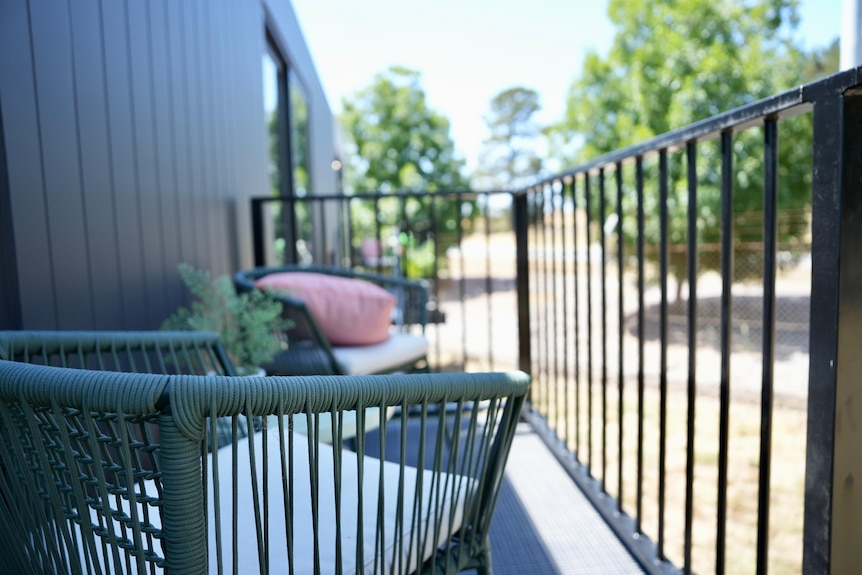
One of the biggest costs for modular housing is transporting the structures into place. (ABC News: Joel Wilson)
Missing middle focus remains
Mr Steel said the government’s focus on providing housing for the missing middle remained sharp.
Missing middle housing refers to terraces, townhouses, duplexes and low-rise apartment buildings, and the government wants them in areas currently zoned for standalone houses.
“One of the commitments that we made at the election was to deliver a pattern book for housing in the ACT,” he said.
“This Canberra housing pattern book would be a set of pre-approved designs, which could then have an accelerated pathway through the planning system.
“We want to focus on missing middle housing and provide the opportunity for prefabricated or modular housing as part of the pattern book in Canberra.“
Despite the pessimism in the industry and concerns about delays in implementing the proposed missing middle changes, Mr Steel remains optimistic the government’s housing target can be met, through a combination of planning changes and land release.
“We’re on track to meet the national housing target, and we are at the moment putting in place all of the regulatory changes, the zoning changes, to enable the 30,000 homes,”
Mr Steel said.
“We’re confident at this stage that we’ve already pretty much met the target in year one, and we’ve got the future reforms currently before the Assembly, and more to come next year that will enable us to reach the target.”