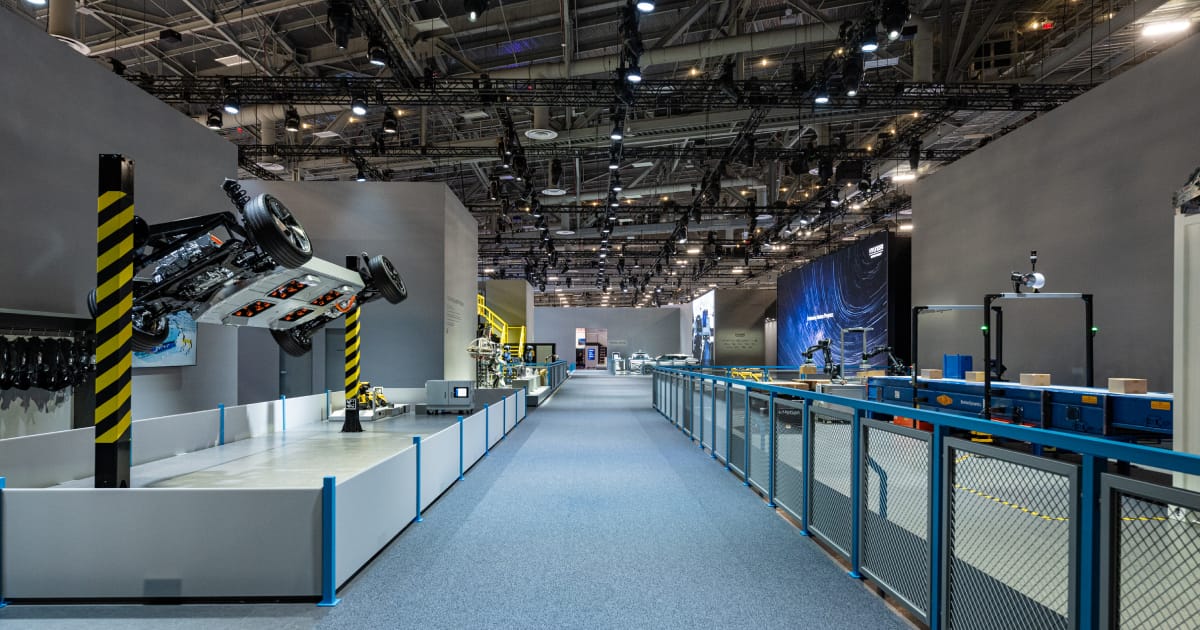
Tech Lab: Atlas and Spot demonstrate their skill
At the Tech Lab located at the center of the booth, visitors can explore Boston Dynamics’ ongoing journey of experiments and challenges to create robotics that contribute to everyday life. Designed as a research lab concept, the exhibition space features the humanoid robot Atlas and the quadruped robot Spot, both performing processes of self-learning and testing.
First, meet Boston Dynamics’ Atlas in two versions: the ‘Atlas prototype’ and the ‘Atlas product’ model. The Atlas prototype, first unveiled in 2024, was built to test core functions required for commercialization. Equipped with joints that rotate 360 degrees, it enables natural walking and efficient, stable movements, performing fully autonomous actions in work environments. In October 2025, it successfully completed pilot testing at Hyundai Motor Group’s Meta Plant America (HMGMA). Atlas repeatedly performs sequencing tasks – picking up automotive parts and aligning them in a different rack – within automotive assembly processes. Through this process, Atlas accumulates training data to continuously refine its capabilities.
Building on the Atlas prototype, we introduce a new model with enhanced efficiency and stability – the Atlas product. Leveraging Boston Dynamics’ extensive experience, Atlas product is capable of autonomous learning and adapting to any work environment, maximizing productivity in real manufacturing settings. This version features 56 DoFs(degrees of freedoms), allowing full joint rotation, and offers 360-degree vision through an integrated camera. It also boasts a maximum payload capacity of 50 kg (approximately 110 lbs), water and dustproof, and an autonomous battery-swapping function for more efficient operation. These advancements enable Atlas to learn and adapt to diverse environments and therefore is expected to significantly improv manufacturing efficiency. Hyundai Motor Group plans to mass-produce the Atlas and deploy it widely across its global manufacturing sites, including HMGMA and gradually expand its deployment through process-by-process validation.