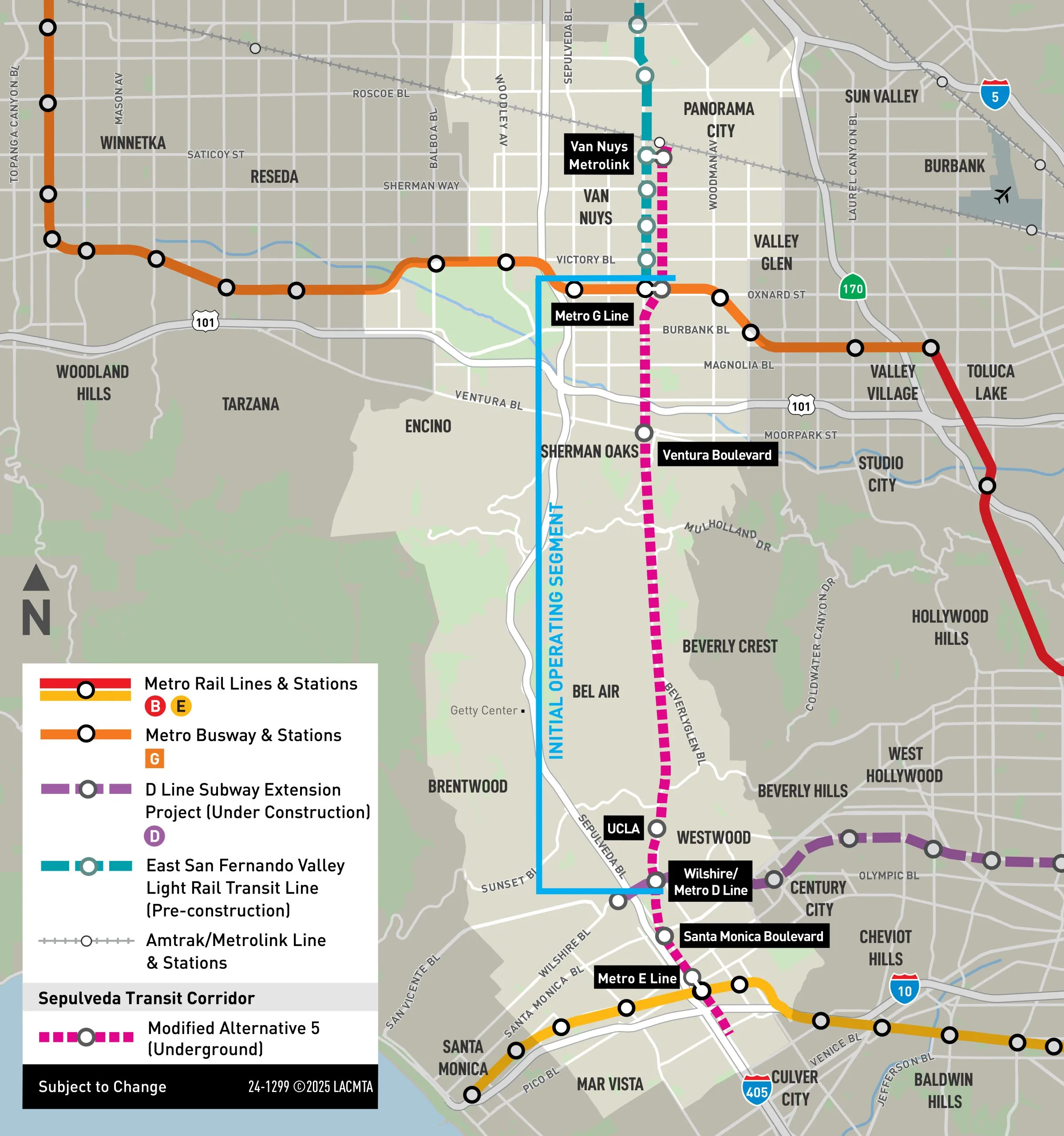
Continuing to fulfill its commitment to voters when Measure M passed in 2016, Metro has reached significant milestones for two pillar projects that would transform the way Angelenos move around the County. At the January Board meeting, the Metro Board will consider certification of the Final Environmental Impact Report (FEIR) for the C Line Extension to Torrance and selection of the Locally Preferred Alternative (LPA) for the Sepulveda Transit Corridor Project.
“Connecting the San Fernando Valley and West Los Angeles and extending rail in the South Bay means opening doors to better jobs, classrooms, entertainment centers and more. It means cleaner air and less time stuck in traffic. This is the kind of bold, future-driven investment that carries a region and its people into the future,” said Metro Board Chair and Whittier City Councilmember Fernando Dutra. “These projects represent an important step in the right direction for Los Angeles County’s public transportation system.”
C Line Extension to Torrance
The Board will consider certifying the Final Environmental Impact Report (FEIR) for the voter-approved C Line Extension to Torrance, which will operate as part of the K Line. This critical 4.5-mile project would launch a new age of mobility in the South Bay, promising commuters, travelers and families a fast, convenient 19-minute trip from Torrance directly to Los Angeles International Airport (LAX), while seamlessly connecting Torrance and Redondo Beach to Los Angeles County’s expanding transit network. The project will also create easy transfers to the C and E lines for people connecting to Santa Monica, downtown Los Angeles, Norwalk and other locations throughout the county.
Metro studied three light rail and a high frequency bus alternative for this project. The Board selected LPA was chosen for its efficient use of the existing Metro-owned historic freight rail corridor, which significantly reduces the need for costly private land acquisition and minimizes construction-related disruptions to neighborhoods. And provides new walking paths in neighborhoods to serve as active green spaces, as well as upgrades to existing freight to enhance safety and reduce freight horn noise from nearby homes. This project is also designed to support economic growth in the South Bay. By linking directly to the Redondo Beach Transit Center and Torrance Transit Center, the LPA ensures superior local and regional connectivity. And the project will generate roughly 15,000 jobs and is estimated to deliver $16.47 billion in regional economic benefits over 20 years.
Sepulveda Transit Corridor
Also, during its January meeting, the Board will consider the staff recommendation for a Locally Preferred Alternative (LPA) for the voter-approved Sepulveda Transit Corridor Project, marking another step forward for this major project that is planned to connect the San Fernando Valley and West Los Angeles.
The selection of the LPA follows the release this past summer of the Draft Environmental Impact Report (EIR), which analyzed five alternatives for a fast, reliable rail transit option for those traveling through the Sepulveda Pass. Community members and stakeholders submitted more than 8,000 comments — a historic number of comments — on the future of the Sepulveda Transit Corridor during the Draft Environmental Impact Report (DEIR) public comment period, during which Metro held 10 public meetings in both virtual and in-person formats to educate stakeholders.
Based on technical evaluation and community and stakeholder input, Metro staff proposed Modified Alternative 5 as the LPA. Modified Alternative 5 is heavy rail transit underground between the Van Nuys Metrolink Station and E Line Expo/Sepulveda Station modified to connect to the Van Nuys G Line Station and future East San Fernando Valley Light Rail station at the G Line at Van Nuys Boulevard.
Modified Alternative 5 incorporates key elements of Alternative 5, including automated vehicles in a single-bore tunnel, a terminus at the E Line Expo/Sepulveda Station and 2.5-minute frequencies during peak travel times. It leverages the strengths of Alternative 5 – high ridership, high frequencies, and shorter station construction sites, while avoiding construction of a ventilation shaft in the Santa Monica Mountains. It also offers the connectivity benefits of Alternative 6 along Van Nuys Boulevard instead of Sepulveda Boulevard, which reduces the project’s overall length and is anticipated to reduce cost.
The staff recommendation also includes project phasing to allow for mobility benefits to be realized as funds become available. Nearly all Metro rail projects have been phased. Specifically, the recommendation includes focusing on an initial operating segment (IOS) between the San Fernando Valley (at the Metro G Line) and Westside (at the Metro D Line). The modifications to Alternative 5 facilitate direct connections to the transit network, avoiding the need to transfer twice to access the project. Direct connections enhance the time competitiveness of transit and anticipated ridership.
After carefully reviewing comments received during the Draft EIR public comment period, Modified Alternative 5 addresses many of the key themes voiced by the community and stakeholders:
- Fast travel times: May even be less than the current fastest end-to-end travel time of 18 minutes from the Van Nuys Metrolink to the E Line or approximately 10 minutes from the G Line in Van Nuys to the D Line in Westwood
- Seamless connection to other transit lines: Direct connections to Metrolink, Metro G Line, D Line, E Line and East San Fernando Light Rail. Direct connections to Metro G Line, D Line and East San Fernando Light Rail as part of an IOS.
- Station locations that connect to key destinations, including UCLA
- Cost effectiveness. Alternative 5 was the 2nd most cost-effective alternative evaluated in the Draft EIR and Modified Alternative 5 presents opportunities to further reduce costs and increase cost effectiveness
- No ventilation shaft in the Santa Monica Mountains
- No aerial alignment along Sepulveda Boulevard in the Valley
- Concerns about property acquisitions/displacements
- Interest in an on-campus UCLA Station
- Compatible with LADWP Mid-Valley Water facility and Stone Canyon Reservoir and Dam
The preliminary capital cost for Alternative 5 is $24.2 billion (in 2023). This would be updated to reflect Modified Alternative 5. Beyond funds provided under Measure M and other local sources, Metro anticipates the need for additional funding and financing for the project, including from federal, state and local sources, as well as private investment through a potential public-private partnership (P3).
The project is an investment in the local and regional economy. During construction alone, the project would result in 12,000 to 17,000 jobs per year, increasing economic output in the Los Angeles region by $25.5 billion to $42.9 billion, and generating $7.3 billion to $12.1 billion in additional wages due to construction.
Following Board approval of the LPA, Metro would initiate design refinement efforts consistent with the LPA, which includes evaluating phasing, identifying opportunities for value engineering, evaluating the P3 delivery model, and making refinements to Alternative 5 to allow for connection to the G Line at Van Nuys Boulevard. Following design refinements, the environmental process would continue, including corresponding community outreach and opportunities for public comment.
Continuing to Build Connectivity
Metro has the most ambitious capital program in the country. Over the past 40 years, Metro has built 118 miles of rail and more than 20 additional miles are currently in the planning or construction phase. Metro recognizes what is possible when people have a real alternative to driving. These two projects offer the promise of a more connected, accessible and hopeful future for Angelenos.
Both of these projects will also help California achieve its climate goals through the significant reduction of vehicle miles travelled and greenhouse gases. By providing high-capacity transit alternatives, these new lines will remove tens of millions of vehicle miles from our roads annually, reduce greenhouse gas emissions, reduce smog and ease congestion to ensure a cleaner, more mobile Los Angeles County for generations to come.
“In 2016, LA County voters told us, loud and clear, that they want a robust Metro system to transform their commutes and improve their quality of life,” said Stephanie Wiggins, CEO of Metro, “By advancing these two projects, Metro is making good on this promise. These two projects will transform transportation for people from the South Bay to the San Fernando Valley and beyond, improving access to jobs, education, health care, and all the things that make living in LA great. We look forward to continuing to work with the Board and project stakeholders as we take the next steps on these two transformative projects.”
The Metro Planning & Programming Committee will consider these projects at its meeting on January 14, 2026 at 11:00am. More information can be found at: https://boardagendas.metro.net/
Related
Discover more from The Source
Subscribe to get the latest posts sent to your email.