One big pay package to start: Tesla investors have overwhelmingly backed Elon Musk’s $1tn pay deal, hoping that the prospect of the largest payday in corporate history will persuade the billionaire to focus his attention on the electric vehicle maker.
A scoop: The Messina Group, the US political consulting firm run by a former aide of Barack Obama, is seeking to sell off its stake in Global Counsel, the lobbying outfit co-founded by Lord Peter Mandelson.
And another thing: Swiss commodity trader Gunvor said on Thursday that it was scrapping its $22bn bid to buy Lukoil’s overseas assets after the US moved to block the deal.
Welcome to Due Diligence, your briefing on dealmaking, private equity and corporate finance. This article is an on-site version of the newsletter. Premium subscribers can sign up here to get the newsletter delivered every Tuesday to Friday. Standard subscribers can upgrade to Premium here, or explore all FT newsletters. Get in touch with us anytime: Due.Diligence@ft.com
In today’s newsletter:
-
The chaos of First Brands lands in Houston
-
Brighthouse Financial sells . . . finally
-
Hong Kong’s lucrative capital flight trade
First Brands: Houston, we have a $1.1bn problem
Bankers and lawyers make millions of dollars a year, but for the rainmakers, the wealth and glamour can’t always make up for the job infringing on their personal lives.
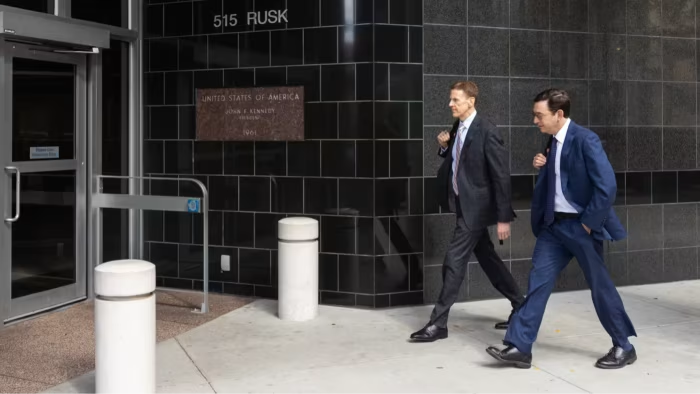
DD’s Amelia Pollard made the trek to Houston for the first in-person courtroom gathering of the claimants in the messy freefall bankruptcy of First Brands, the scandalised Ohio auto parts maker.
Lazard’s Tyler Cowan, the all-important banker to First Brands, was in Paris and expected to testify on Thursday in front of the federal bankruptcy court via video.
But as the FT saw up close and personal, the chaos of the session over court approval of the final $600mn tranche of a $1.1bn bankruptcy loan was contentious.
So much so that Cowan had to depart in the France evening for an anniversary dinner before he could address the court, First Brands’ lawyers from Weil, Gotshal & Manges told the judge overseeing the case.
Cowan’s virtual appearance was then dragged into Friday while his Lazard junior colleagues were in the Houston court rerunning spreadsheet models.
Just as well. While some groups such as the official unsecured creditors committee were able to cut deals with the debtor to share future potential litigation proceeds, there were a few remaining creditor holdouts over the loan legalities, with negotiations to continue through the night.
In the meantime, the court and the world got updates on the state of the First Brands business. Interim chief executive Charles Moore, an Alvarez & Marsal executive, had spent the week in Las Vegas for the biggest trade show in “after-market auto parts”.
Moore and other executives have spent the past several weeks triaging the company’s fleet of auto parts brands, including collecting more than 7mn documents and looking through bank account records for hundreds of clients.
They have also set up a “whistleblowing hotline” for employees in hopes of understanding previous misconduct.
The plan is for the company to keep operating and sell itself to maximise recoveries for all parties, which include on- and off-balance sheet creditors owed $12bn.
But that will probably require the $1.1bn bankruptcy loan to get approved in the next day or two with various advisers having their weekend plans scrambled.
The new insurance-funded private capital giant
It was a deal that had hedge funds on the edge of their seats and advisers pulling their hair out.
The sale of Brighthouse Financial, scooped by the FT in January, had many twists and turns as a handful of private capital giants, including Apollo, TPG, Sixth Street and Carlyle, studied whether they could resuscitate the beleaguered insurer.
Most buyers bowed out after their due diligence uncovered potential headaches, or they were only willing to pay a bargain price for the insurer.
But one relatively small and unheralded bidder emerged as Brighthouse’s most fervent suitor, Aquarian Holdings, a Mubadala Capital-backed, insurance-focused private capital group founded in 2017 by Rudy Sahay, a former executive at Guggenheim.
Aquarian agreed to pay $70 per share, or $4.1bn, for Brighthouse, confirming an FT scoop last week that the two parties were in advanced talks and days away from a deal.
The buyer had been in months of on-and-off negotiations with Brighthouse that included times when talks froze and other potential buyers such as Sixth Street re-emerged. Many interested watchers and advisers questioned whether Aquarian, which manages $25bn in assets, had the financial wherewithal to buy an insurer about nine times its size.
Ultimately, with the backing of Mubadala Capital, Aquarian convinced Brighthouse’s advisers Goldman Sachs and Wells Fargo that it was good for the money in a deal that will propel the nascent outfit into the big leagues of the nexus between insurance and private capital.
If the transaction closes as planned in 2026, Sahay will oversee an insurance empire with similar if not greater size than those managed by billionaires Todd Boehly and Mark Walter, his mentors at Guggenheim, the pioneer of matching the assets of sleepy life insurance companies with higher-octane private debt investments.
Thursday’s deal, while niche in the greater pantheon of dealmaking, could be the seed of the next big insurance-funded private capital giant.
But that’s if all goes as planned in Sahay’s efforts to revamp Brighthouse, an insurer spun off by MetLife in 2017, which has drifted for years on public markets.
The insurance problem gripping Hong Kong
A crucial gauge for Chinese capital leakage has hit an all-time high in Hong Kong this year, in a sign that the world’s largest middle class is looking to move money out of mainland China.
Sales of investment-style insurance reached a record level in Hong Kong in the first half of 2025, according to the territory’s Insurance Authority.
Annualised new premiums in the six months to the end of June were HK$99bn (US$13bn) — the highest recorded by the agency.
Figures on how the Chinese move money out of the country are scarce and insurance sales are seen as a key metric for analysts to understand how mainland investors feel about the local market.
Sales of insurance in Hong Kong are driven in large part by mainland Chinese who have to physically cross the border to purchase US dollar insurance policies and open local bank accounts to pay premiums.
The big beneficiaries of this trade, seen by analysts as a legal form of capital leakage that is tolerated by authorities on a small scale, are the big insurance sellers including AIA, FWD and Prudential.
The giant in the territory is HSBC: 25 cents in every dollar sold goes to HSBC or Hang Seng’s insurance brokers.
Mainlanders making the journey in many cases are looking to hedge their renminbi exposure by holding dollar assets or holding funds offshore.
They’re also looking to take advantage of the higher interest rates offered in Hong Kong and the US versus mainland China.
It’s great business. One industry executive told DD’s Arjun Neil Alim such deals amounted to 30 to 40 per cent of their company’s sales. Another estimated the proportion of total sales was more than a third. That could be more than HK$33bn — a pretty hefty flight to safety.
Job moves
-
Goldman Sachs has tapped 638 people for promotions to become managing directors starting in the new year. The number of women as a percentage of the class fell from 31 per cent two years ago to 27 per cent this year.
-
Bank of America has named Peter Luck as chair of UK and Ireland investment banking. James Robertson will head UK corporate and investment banking, while Duncan Stewart and Stephen Little will be co-heads of UK investment banking.
Smart reads
Red tape Over the past 20 years, Australian banking giant Macquarie Group has transformed itself into a US energy trading powerhouse, Bloomberg reports. But a recent compliance crackdown has slowed it down, leading to an exodus of top traders.
Money driven The New York Times asks, would Elon Musk work harder for $1tn than he would for $1bn?
Fools game? The bidding war over Metsera, a maker of obesity drugs, has only one winner, writes Lex. The hot-headed bidders could be set to benefit least.
News round-up
Tesla shareholders approve Elon Musk’s $1tn pay deal (FT)
UBS to liquidate funds with substantial First Brands exposure (FT)
Comcast holds talks about buying ITV’s television business (FT)
Novo Nordisk challenges Pfizer to raise offer for obesity biotech (FT)
Sam Altman says OpenAI is not ‘trying to become too big to fail’ (FT)
Three biggest US airlines to cancel hundreds of flights due to government shutdown (FT)
Solar power producer Pine Gate files for bankruptcy (FT)
Due Diligence is written by Arash Massoudi, Ivan Levingston, Ortenca Aliaj, Alexandra Heal and Robert Smith in London, James Fontanella-Khan, Sujeet Indap, Eric Platt, Antoine Gara, Amelia Pollard, Kaye Wiggins, Oliver Barnes and Jamie John in New York, George Hammond and Tabby Kinder in San Francisco, Arjun Neil Alim in Hong Kong. Please send feedback to due.diligence@ft.com
Recommended newsletters for you
The AI Shift — John Burn-Murdoch and Sarah O’Connor dive into how AI is transforming the world of work. Sign up here
Unhedged — Robert Armstrong dissects the most important market trends and discusses how Wall Street’s best minds respond to them. Sign up here