Unlock the Editor’s Digest for free
Roula Khalaf, Editor of the FT, selects her favourite stories in this weekly newsletter.
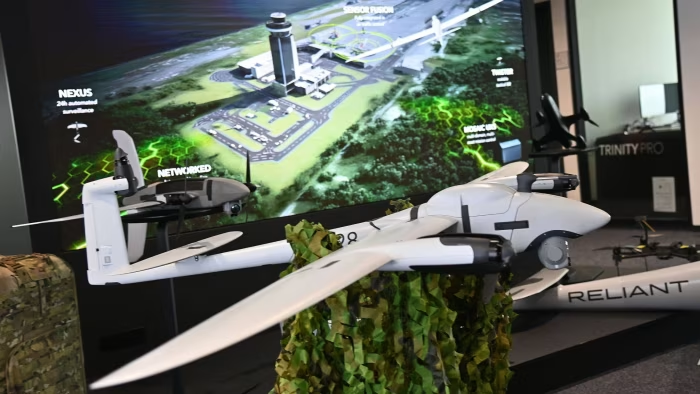
German spy drone maker Quantum Systems has tripled its valuation to €3bn, becoming one of the biggest defence start-ups in Europe as it reaps the benefits of a pivot into military sales.
The Bavaria-based company on Thursday closed an €180mn extension of a funding round led by Balderton Capital, with investors including US tech billionaire Peter Thiel. The fundraising brings the total amount raised by the company this year to €340mn.
It propels Quantum higher up the list of most valuable European drone start-ups. Investors have flocked to funding rounds of drone groups this year, with Munich-based kamikaze drone maker Helsing, backed by Spotify founder Daniel Ek, securing a €12bn valuation. Portuguese surveillance drone maker Tekever was valued at more than €1bn.
Quantum’s chief financial officer Jonas Jarosch told the Financial Times that sales at the company would double to more than €200mn this year as it mulls a possible IPO.
Jarosch said that the company was targeting annual revenues of up to €1bn within a few years and was “on a trajectory to become a neo-prime” akin to the big established players in defence and dual-use technologies.
“Our sales are lower than the traditional primes,” Jarosch said. “But in relative terms, in terms of profitability and growth rates, we are far outperforming the other traditional players out there.”
Quantum was co-founded in 2015 by former army officer Florian Seibel as a commercial drone company offering surveillance technology for purposes such as agriculture.
After Russia’s full-scale invasion of Ukraine in 2022, it branched into defence. Seibel was forced to create a new company, Stark, after Quantum’s investors blocked the company from producing weaponised drones.
Today, about 95 per cent of its revenues come from military customers, including in the US and Australia.
Its contracts include a forthcoming deal to supply around 750 of its short-range Twister spy drones to the German armed forces, according to a document submitted to the Bundestag and seen by the FT.
The €85mn contract, which must still be approved by members of parliament, is small compared to the tens of billions being won by traditional “primes” such as tank maker Rheinmetall and missile maker Diehl.
But it shows how the German government’s vast military spending spree — which will see the country spend €650bn on defence by 2030 — is beginning to reach younger players. It will bolster Quantum’s revenue stream as it considers possible exit strategies for its investors.
The company is currently undergoing a process of “professionalisation”, according to two people familiar with the details, to bring its auditing and financial reporting in line with the standards that would be required of a publicly listed entity.
Jarosch said that no final decision had been reached but that an IPO was one of two options being considered along with a private sale. He added: “With a €3bn valuation . . . the number of exit scenarios does reduce.”