Editors’ Highlights are summaries of recent papers by AGU’s journal editors.
Source: AGU Advances
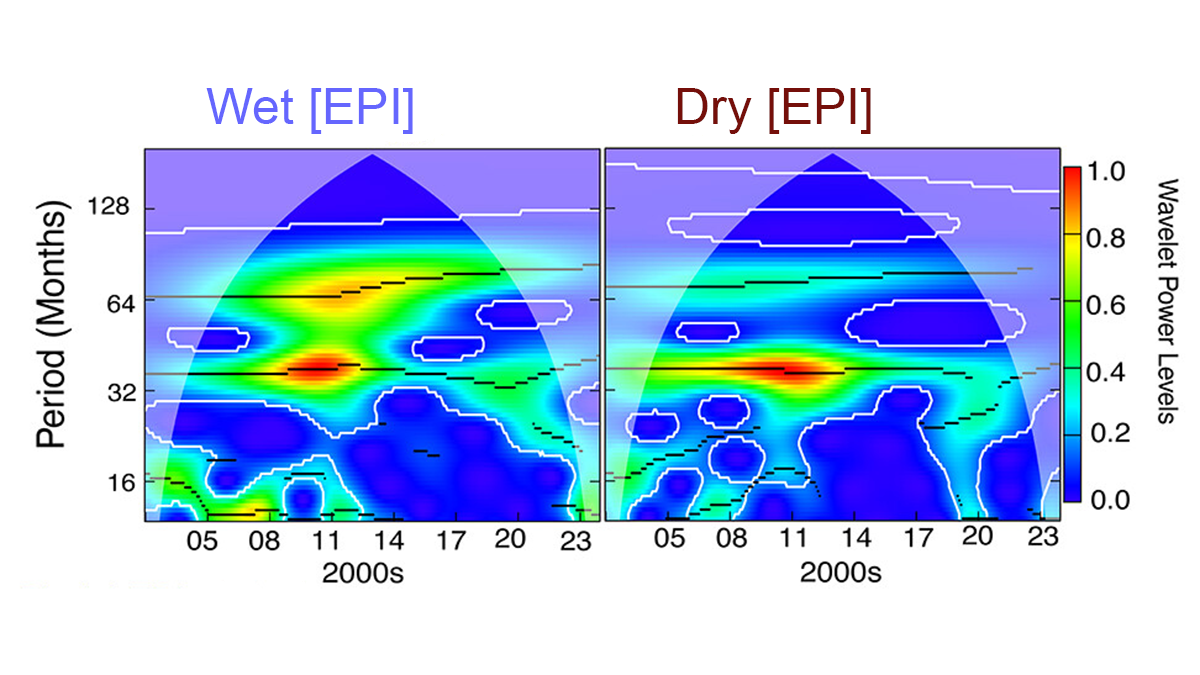
Using data from the GRACE and GRACE-FO satellite missions, Rateb et al. [2025] monitored global changes in terrestrial water storage to study how hydrological extremes—floods and droughts—have developed over the past two decades. Their analysis indicates that these extremes are mainly driven by climate variability in tropical oceans, with both interannual and multi-year patterns playing a significant role.
However, the approximately 22-year satellite record is still too short to fully identify long-term drivers, which limits the ability to determine whether global extremes are increasing or decreasing. To fill data gaps in certain months, the authors use non-parametric probabilistic methods to reconstruct storage anomalies. The reconstructed data closely matched independent datasets, confirming the reliability of their approach. Overall, the study highlights the need to extend satellite observations to capture multi-decadal climate variability and better distinguish natural fluctuations from human-induced changes.
Citation: Rateb, A., Scanlon, B. R., Pokhrel, Y., & Sun, A. (2025). Dynamics and couplings of terrestrial water storage extremes from GRACE and GRACE-FO missions during 2002–2024. AGU Advances, 6, e2025AV001684. https://doi.org/10.1029/2025AV001684
—Tissa Illangasekare, Editor, AGU Advances
Text © 2025. The authors. CC BY-NC-ND 3.0
Except where otherwise noted, images are subject to copyright. Any reuse without express permission from the copyright owner is prohibited.
Related