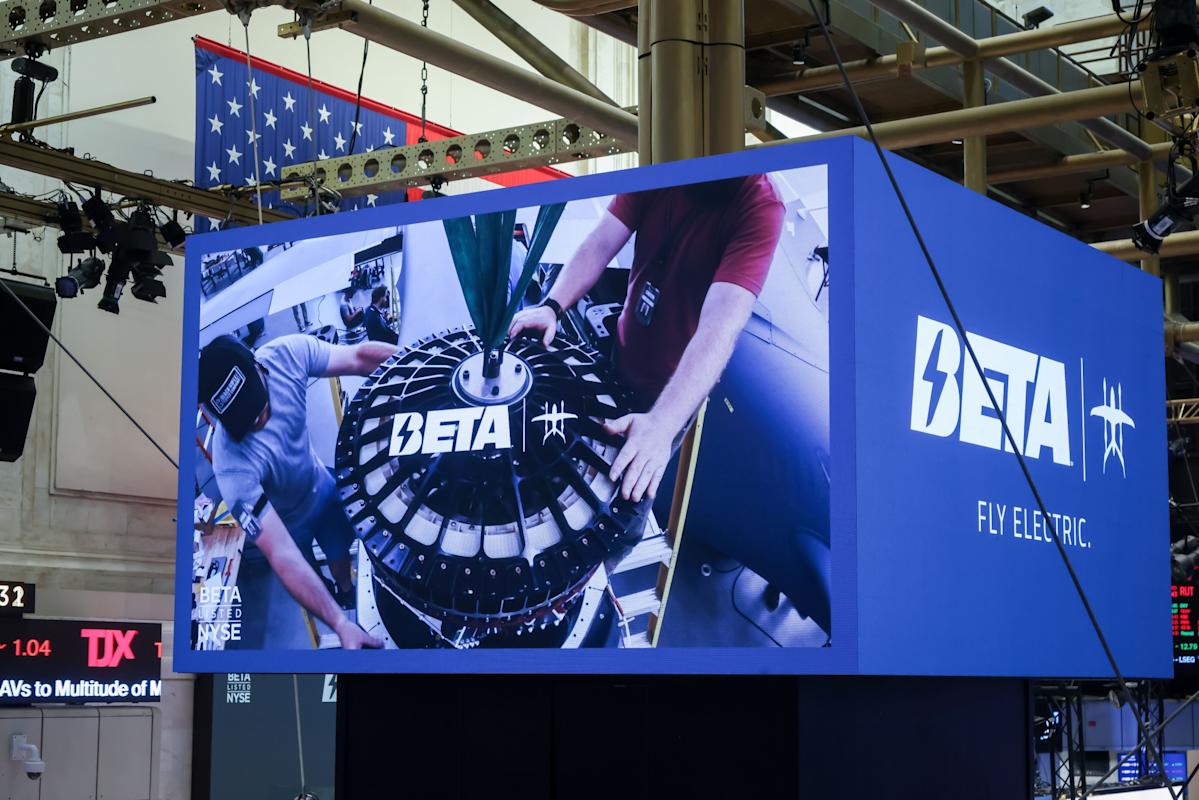
(Bloomberg) — Wall Street is bullish on Beta Technologies Inc. (BETA), calling the electric-powered plane maker an early leader in the regional aircraft industry.
Most Read from Bloomberg
Most of the eight analysts who have initiated coverage on the South Burlington, Vermont-based company as of Dec. 1 have a buy-equivalent rating on shares, according to data compiled by Bloomberg. The wave of approval comes a month after Beta’s public-market debut in which it raised $1.02 billion.
Beta is “akin to a young Tesla, but with a more attractive end market of aerospace, which has higher barriers to entry than autos,” said Morgan Stanley analysts in a note.
The company, which develops both electric conventional takeoff and landing (eCTOL) aircraft and electric vertical takeoff and landing (eVTOL) models, is ahead of its peers as it gains traction across cargo, medical transport, passenger mobility and defense markets, according to analysts.
Investors, however, remain skeptical. Despite having an average 12-month price target of $37.88, which implies a 43% upside from Friday’s close, shares are down 22% from their initial public offering price, data compiled by Bloomberg show.

To Jefferies’ Sheila Kahyaoglu, who has the only hold rating on Beta, the weakness in its stock price can be attributed to broader declines in small caps and aerospace shares.
“We continue to see an upside and think that Beta will be a winner in the space,” Kahyaoglu said.
Beta’s positive reception on Wall Street underscores growing investor conviction that electric aviation could be one of the most significant developments in short-haul transportation.
Needham, which estimates a $1 trillion total addressable market for electric regional mobility, argues Beta is positioned to capture early market share as the industry shifts toward low-emission short-haul aviation.
Beta’s approach to first certify an eCTOL, “and to commercialize via cargo and medical as its primary use cases (before expanding to passenger flights) provides a faster and better-defined route to” Federal Aviation Administration certification, according to Cantor Fitzgerald’s Andres Sheppard, who predicts the firm will get certification between the end of 2026 and 2027, “creating a significant first-mover advantage.”
“Furthermore, Beta is already generating revenue (unlike most peers in the space),” Sheppard wrote in a note.
Beta is streamlining its manufacturing practice by consolidating motors, batteries, software, charging hardware and high-voltage distribution into a single design process, according to Citigroup Inc. analysts led by John Godyn. While more capital-intensive in early years, Citi expects this approach to “improve Beta’s return on R&D dollars” and “reduce reliance on suppliers.”