
Innovation clusters, embedded in grassroots solutions and inclusive businesses, can pave the way to true climate resilience.
The Banyan tree and the clusters
The twisting, sprawling Banyan trees have watched over Bengaluru, India, or ‘the Garden City’, for hundreds of years. Their aerial roots that grow from the branches descend to the ground, cover vast areas, and resemble multiple trees growing in unison in all directions. As sustainability leaders, we should take cues from the longevity of these trees which can typically live for 200–300 years. These botanical marvels serve as a powerful metaphor for the climate innovation landscape and are living proof of how strong, interconnected systems can create resilience and long-term impact.
In this article, we explain the methodology that we have applied along with our partners to establish innovation clusters in Bengaluru, India, Nairobi, Kenya and in Tanzania.
What are innovation clusters?
At a high level, the major climate challenges that we face require multiple sources of innovation to bridge the gap between where we are and where we need to be. Just as the Banyan supports a thriving ecosystem under and around its canopy, an innovation cluster reinforces the core of geographically based innovation. For Climate KIC and our partners, an innovation cluster is a flexible approach that adapts to and strengthens the needs of all involved. This enables all people, institutions, and organisations to collectively nurture more inclusive and sustainable economies.
Roadmap for collaboration*:
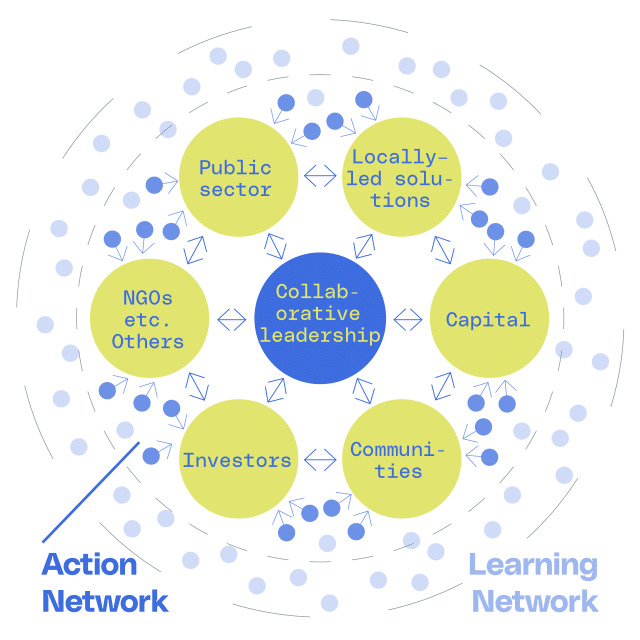
A cleantech example
Copenhagen has earned a global reputation as a leader in clean energy, driven by the Copenhagen Cleantech Innovation Cluster (CCIC) and Denmark’s broader decarbonisation strategy. In 2009, CCIC brought together energy companies, government and non-governmental organisations (NGOs), and research institutions to foster cleantech growth, support start-ups, and attract international businesses. The initiative helped Copenhagen cut CO2 emissions by 80% between 2009 and 2022 while securing 24 million euros in funding, creating over 1,000 jobs, and establishing 120+ new businesses. Though this cluster was government-backed, not all innovation clusters need to be led by public investment to thrive.
The Climate KIC approach
Innovation clusters by Climate KIC and partners strengthen climate innovation ecosystems by connecting a range of collaborators who usually work in isolation. The first step is to engage and build momentum with a broad range of partners and collaborators within the ecosystem. Together, we go through the exercise of mapping, engaging, and collective vision-building.
These clusters foster collaboration, innovation and learning to build circular and climate-resilient economies. We believe that supporting new business models, creating a shared vision, developing skills, and mobilising capital is the way to foster transformative climate action. Centred on social inclusion, they amplify diverse voices to ensure solutions address real needs and create fair, lasting impact.
Our tested approach:
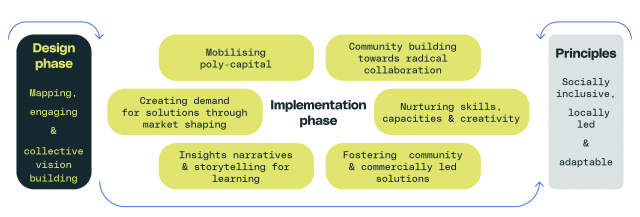
Alongside partners, we focus initially on three key outcomes:
- Building meaningful collaboration and driving mindset shifts: going beyond transactional interactions to build deeper collaborations among diverse groups of people.
- Unlocking impact-driven innovation: supporting innovators at every stage with tailored opportunities and connections to societal demand.
- Strengthening capacities and learning: improving the capacities of different groups (start-ups, Entrepreneurship Support Organisations (ESOs), investors, governments, partners) to enable more effective collaborations within the ecosystem
An opportunity to rethink the system
Certainly, Climate KIC hasn’t pioneered the concept of innovation clusters, but what sets us apart is how we organise and operate them. Rather than structuring our work around traditional sectors like manufacturing or agriculture, we focus on complex, systemic challenges such as circularity or rural resilience. In theory, this systems-thinking approach enables us to address interconnected issues holistically, rather than treating them in isolation.
Our 15-year journey developing innovation ecosystems across Europe has evolved into creating a methodology that prioritises social inclusion, honours local contexts, and leverages global insights through deep local partnerships.
Together with local partners, we address interconnected challenges that reflect shared priorities across diverse contexts – from reimagining urban waste through circular economies that uplift vulnerable communities and informal workers, to nurturing resilient rural communities through adaptation innovation, sustainable livelihoods, and regenerative landscapes. Looking ahead, we aim to apply similar approaches to additional contexts such as fostering resilient coastal regions and healthy oceans that support thriving small island communities.
A call for deep collaboration
What the climate crisis needs is a level of collaboration and systems thinking we haven’t seen before. The best innovation clusters take their cues from the Banyan tree, operating not as isolated entities, but as interconnected systems that expand through strong, distributed support. Each node in the cluster (whether a start-up, researcher, policymaker, or investor) reinforces the structure, driving resilience and compounding growth. And the strength of the ecosystem comes not from any single part, but from how tightly those parts are linked: capital supporting talent, research driving product, regulation enabling scale. Over time, this dense network becomes hard to replicate and even harder to compete with. Real innovation doesn’t happen in isolation and is not limited to technology: it takes root in ecosystems and solutions built for scale, speed, and shared momentum.
We nurture innovation clusters with implementing partners, including GrowthAfrica in Nairobi, SecondMuse in Bengaluru, and SmartLab in Tanzania. This article is part of our series spotlighting these innovation clusters, supported by the IKEA Foundation and Irish Aid. Climate KIC also contributes to adaptation innovation clusters in Sierra Leone and Madagascar with the United Nations Industrial Development Organisation (UNIDO).
Contact our Partnerships Team if you’d like to learn more about investment opportunities.
Contact us
* image based on: Ehrlichman et al (2018) SSIR, Cutting Through the Complexity: A Roadmap for Effective Collaboration