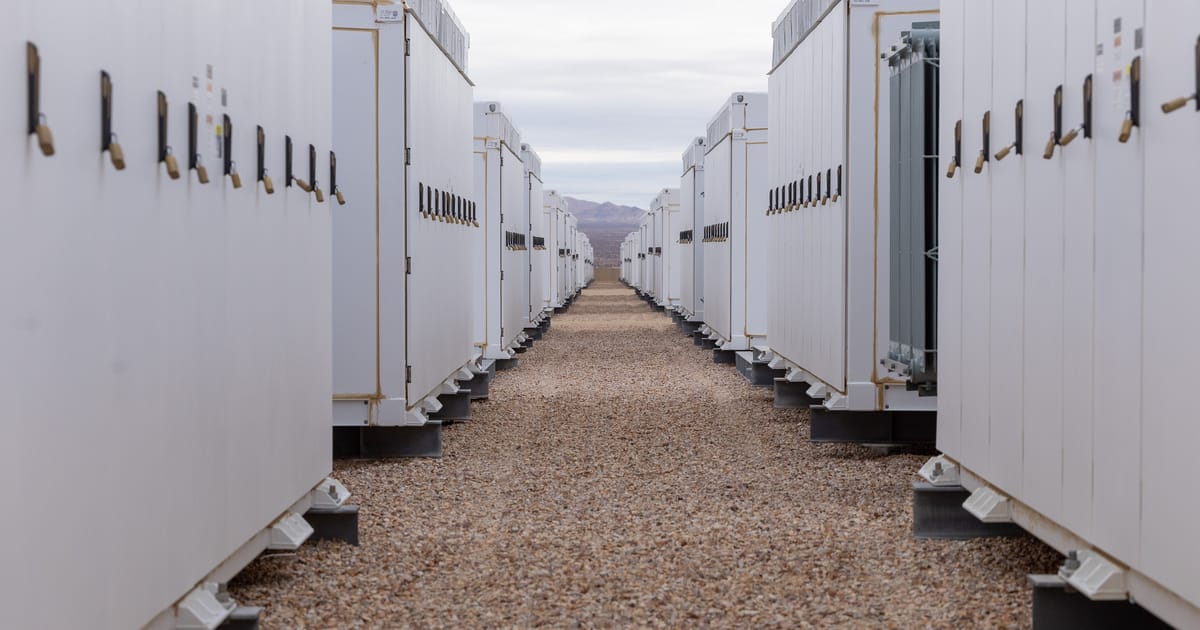
In 2017, the early leaders in energy storage made an audacious bet: 35 gigawatts of the new grid technology would be installed in the United States by 2025.
That goal sounded improbable even to some who believed that storage was on a growth trajectory. A smattering of independent developers and utilities had managed to install just 500 megawatts of batteries nationwide, equivalent to one good-size gas-fired power plant. Building 35 gigawatts would entail a 70-fold growth in just eight years.
The number didn’t come out of thin air, though. The Energy Storage Association worked with Navigant Research to model scenarios based on a range of assumptions, recalled Praveen Kathpal, then chair of the ESA board of directors. The association decided to run with the most aggressive of the defensible scenarios in its November 2017 report.
In 2021, ESA agreed to merge with the American Clean Power Association and ceased to exist. But, somehow, its boast proved not self-aggrandizing but prophetic.
The U.S. crossed the threshold of 35 gigawatts of battery installations this July and then passed 40 gigawatts in the third quarter, according to data from the American Clean Power Association. The group of vendors, developers, and installers who just eight years ago stood at the margins of the power industry is now second only to solar developers in gigawatts built per year. Storage capacity outnumbers gas power in the queues for future grid additions by a factor of 6.5, according to data compiled by Lawrence Berkeley National Laboratory.
“Storage has become the dominant form of new power addition,” Kathpal said. “I think it’s fair to say that batteries are how America does capacity.”
Getting from basically no grid batteries to 35 gigawatts
Back in 2017, I was covering the young storage industry for an outlet called Greentech Media, a beat that was complicated by how little was happening. There was much to write about the “enormous potential” of energy storage to make the grid more reliable and affordable, but it required caveats like “if states change their grid regulations to allow this new technology to compete fairly on its merits, yada yada yada.”
Those batteries that did get built in 2017 look tiny by today’s standards. The locally owned utility cooperative in Kauai built a trailblazing 13-megawatt/52-megawatt-hour battery, the first such utility-scale system designed to sit alongside a solar power plant. And 2017 saw the tail end of the Aliso Canyon procurement, a foundational trial for the storage industry in which developers built a series of batteries in Southern California in just a handful of months to shore up the grid after a record-busting gas leak — adding up to about 100 megawatts.
“You saw green shoots of a lot of where the industry has gone,” said Kathpal.
California passed a law creating a storage mandate in 2010, then found a pressing need for the technology to neutralize the threat of summertime power shortages. Kauai’s small island grid quickly hit a saturation point with daytime solar, so the utility wanted a battery to shift that clean power into the nighttime. These installations weren’t research projects; they were solving real grid problems. But they were few and far in between.
Kathpal recalled one moment that encapsulated the storage industry’s early lean era. At the time, he was developing storage projects for the independent power producer AES. One night around midnight, he parked a rented Camry off a dirt road and pointed a flashlight through a sheet of rain. It was his last stop on a trip to evaluate potential lease sites for grid storage ahead of a utility procurement — looking at available space, proximity to the grid, and stormwater characteristics. But once the utility saw the bids, it decided not to install any batteries after all.
“The storage market is built not only from Navigant reports but also from moments like that,” he said. “We had to lose a lot of projects before we started winning.”
Now that same utility is putting out a call for storage near its substations — exactly the kind of setting Kathpal had toured in the rain all those years ago.
Indeed, many of the projects connected to the grid this year started with developers anticipating future grid needs and putting money on the line for storage back around the time ESA was formulating its big goal, said Aaron Zubaty, CEO of early storage developer Eolian.
“Eolian began developing projects around major metro areas in the western U.S. starting in 2016 and putting the queue positions in that then became operational in 2025,” Zubaty said. The 200-megawatt Seaside battery site at a substation in Portland, Oregon, is one example.
Storage market twists and turns
Though the storage industry pioneers somehow nailed the 35-gigawatt goal, market growth defied their expectations in several important ways.
ESA had expected more of a steady ramp to the 35 gigawatts, said Kelly Speakes-Backman, who served as its chief executive officer from 2017 to 2021. But the storage market ran into plenty of false starts, such as when states passed mandates to install batteries but never enforced them, and when federal regulators ordered wholesale markets to incorporate storage but regional implementation dragged on for years.