Like many of Porsche’s technical inventions, PTM’s roots can be traced back to Ferdinand Porsche. The ingenious engineer laid the foundation for the brand’s sporty all-wheel drive as early as 1900, using the means available at the time. The idea, now in series production at Porsche for almost 40 years, has been continuously developed.
Today, a particularly powerful drive system called Porsche Traction Management (PTM) is installed in many of the sports car manufacturer’s all-wheel-drive models. This active system ensures rapid distribution of drive torque between the rear and front axles, enhancing driving dynamics, safety, traction and therefore delivering even greater driving pleasure. In other words, everything that constitutes the core philosophy of the brand.

PTM makes optimal use of the physical conditions to improve driving dynamics. Depending on the driving situation, axle loads change. This dynamic load transfer causes the tyres to transmit different forces depending on the axle and position during driving. For example, when driving straight uphill, the rear wheels are more heavily loaded and can transmit higher forces. In this case, PTM reduces the torque transferred to the front axle.
How does the ePTM work?
During the development of the Macan Electric, the engineers completely reimagined the system and created the electronically controlled Porsche Traction Management (ePTM). Through power electronics, the two electric motors of the all-wheel-drive Macan models are controlled individually and almost in real time. The ePTM reacts around five times faster than a conventional hang-on part-time all-wheel-drive system and can respond to slip within 10 milliseconds. Additionally, the all-wheel distribution depends on the selected driving mode.

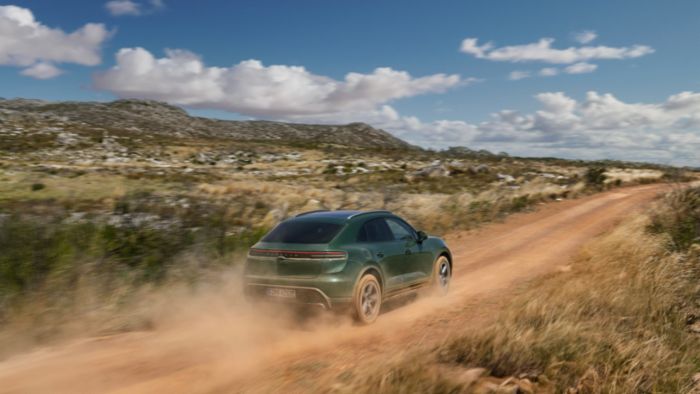
In Normal mode, the drive distribution is optimised for high efficiency and range, meaning rear-wheel drive is used as often as possible. In Sport and Sport Plus modes, the focus of the ePTM is on optimal traction, with the front axle drive engaged more frequently. In Offroad mode, the Macan switches to all-wheel drive with off-road specifications. In this case, a virtual longitudinal lock limits the differential speed between the front and rear axles, improving traction. The ride height is also adjusted, increasing by 20 millimetres or 40 mm in special terrain mode.
In the Macan Turbo, Porsche Torque Vectoring Plus (PTV Plus), an electronically controlled rear-axle differential lock, contributes to traction, driving stability, and lateral dynamics. Macan models with air suspension are generally equipped with Porsche Active Suspension Management (PASM), an electronic damper control system. This system can also be combined with steel suspension.
New to PASM are dampers with two-valve technology. Thanks to the expanded damper characteristic map, there is a wider spectrum of adjustments between comfort and performance settings. This is especially noticeable when driving over rough asphalt as well as on winding mountain roads. The latter can be taken with precision and excellent tracking even at high speeds. On rough terrain, shocks and jolts are filtered so that passengers in the electric Macan hardly feel them. And that’s the appeal: the interplay of suspension systems ensures safety, comfort and driving pleasure. It’s the power of all four wheels – reinterpreted.
“Enter Electric!“
The Volkswagen Group invites you to find out much more about electromobility with a cross-brand communication campaign. You can find more information about electromobility at Porsche on this Newsroom microsite.
Info
Text first published in the Porsche Fahrer Special Edition: Porsche E-Performance.
Text: Wolfgang Schäffer
Images: Porsche AG
Copyright: All images, videos and audio files published in this article are subject to copyright. Reproduction in whole or in part is not permitted without the written consent of Dr. Ing. h.c. F. Porsche AG. Please contact newsroom@porsche.com for further information.