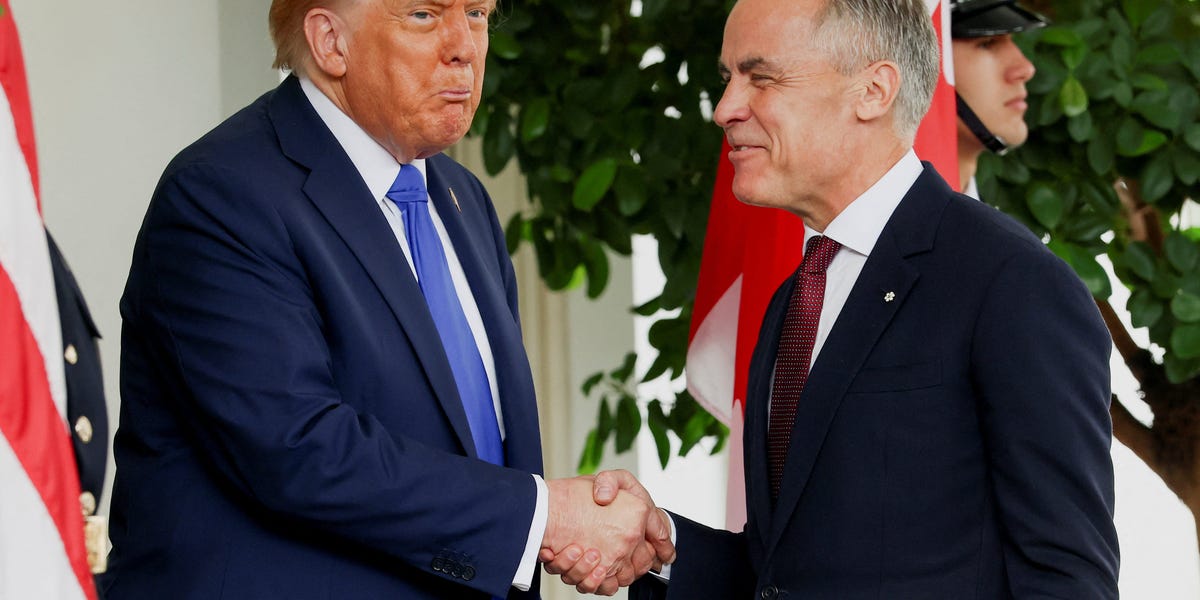
Canada has had a very busy year.
Within a year, the US’s second-largest trading partner has rapidly ramped up efforts to explore new deals with regional powers in Asia, or to revive talks that had been previously put on ice.
As of November, the US has imposed a 35% tariff on all goods from Canada that are not covered by the USMCA. Canadian exports of steel and aluminum to the US also face a 50% duty. The northern neighbor has since matched some of Trump’s levies, and Trump has repeatedly threatened to end trade negotiations with Canada.
International trade experts in both Canada and the US told Business Insider that the pivot is spurred by a lack of progress in negotiations with the Trump administration, which has made tariffs a cornerstone of its policy, and doubt about whether a good deal with the current administration is still possible.
Phil Luck, the director of the Economics Program at the Center for Strategic and International Studies, told Business Insider that he observed similar efforts to diversify trade during the first Trump administration, and that the current trend is “an indication” of how trade discussions have progressed with the US this year.
“Canada took our extreme turn in our trade relationship with them pretty seriously,” said Luck, “because this is a very big change in how the US has sort of traditionally treated Canada, and it has really drawn the ire of the Canadian people as a result.”
“So even if there was a somewhat palatable sort of middle ground, our partners also have democracies, and they need to find a solution that’s palatable to their population,” Luck added.
The diversification push
In September, Ottawa signed a comprehensive free-trade agreement with Indonesia, the first with the Asian Pacific country. Two months later, Canada secured a bilateral investment treaty with the United Arab Emirates that came with an expanded air-services pact. Canada is also fast-tracking a previously stalled trade agreement with India and pushing for a free trade agreement with the entirety of ASEAN by the end of 2026.
A campaign page promoting foreign investment had appeared by August on the Canadian government website, featuring a slogan that reads, “Diversification is a national imperative.”
Meredith Lilly, professor of international affairs at Carleton University and a former International Trade Advisor to former Canadian Prime Minister Stephen Harper, told Business Insider that even though some negotiations with Asian countries have been in the works for a long time, the current government of Canada is touting the efforts that the country is making and accelerating them as a “response to slow and difficult negotiations” with the US.
“It is a very difficult administration to work with at the moment,” said Lilly of Trump’s team. “But we should have no expectation that these diversification efforts can move quickly — it’s a project that we should always be undertaking, and we should be working on it consistently.”
There is more that Canada can do, too, Lilly said.
One thing Canada can do more quickly to make up for the US tariffs’ impact on the economy is to increase trade relations with countries it already has agreements with. That includes Korea, Japan, and the 12 Pacific Rim countries that are part of the Trans-Pacific Partnership, Lilly said, all of which are highly interested in Canada’s natural resources.
According to data from the Canada Energy Regulator, Canadian oil exports outside the US reached a record 525,000 barrels per day in July 2025 and remain elevated throughout the third quarter of 2025.
Canada, while initially expecting a larger hit on the economy due to Trump’s tariffs, has also reported surprisingly robust GDP growth. In the third quarter of 2025, the country reported a 2.6% GDP growth rate, according to Statistics Canada, surpassing a previously revised 1.8% projection.
A decline in confidence in the US
Carlo Dade, the Director of International Policy at the School of Public Policy at the University of Calgary, told Business Insider that it may not be worth it to make a deal with the US now, because most Canadian goods are covered by the existing USMCA trade agreement, and because many of Trump’s foreign policy moves seem “personal.”
“I argue that we shouldn’t be trying to get an agreement with the US,” said Dade. “If you look at what happened to Malaysia, Vietnam, the UK — if that’s a deal, do you want that?”
Malaysia and Vietnam, despite agreeing to remove most tariffs on the US, still ended up with 19% and 20% of tariffs, respectively. The UK, despite having secured a deal with Trump fairly early in the year, is not exempt from a general 10% tariff on most goods and a 25% duty on steel and aluminum.
“No one gets a good deal from Trump. ‘The Art of the Deal’ says there are winners and there are losers, and the US is going to be the winner,” Dade added, referring to Trump’s book on dealmaking strategies. “So what you’re looking for is not a good deal. You’re looking for the least worst deal.”
Luck said that even though the US has a lot of leverage over its closest trading partners, he is concerned about the long-term reputational damage the country will suffer among allies.
“Just because you have the biggest stick doesn’t mean you have to use it,” said Luck. “If you insist on cashing in on all your leverage today, you have a situation where you have the most ability to harm and therefore the most leverage over your closest allies and partners whose trade is most integrated with yours.”