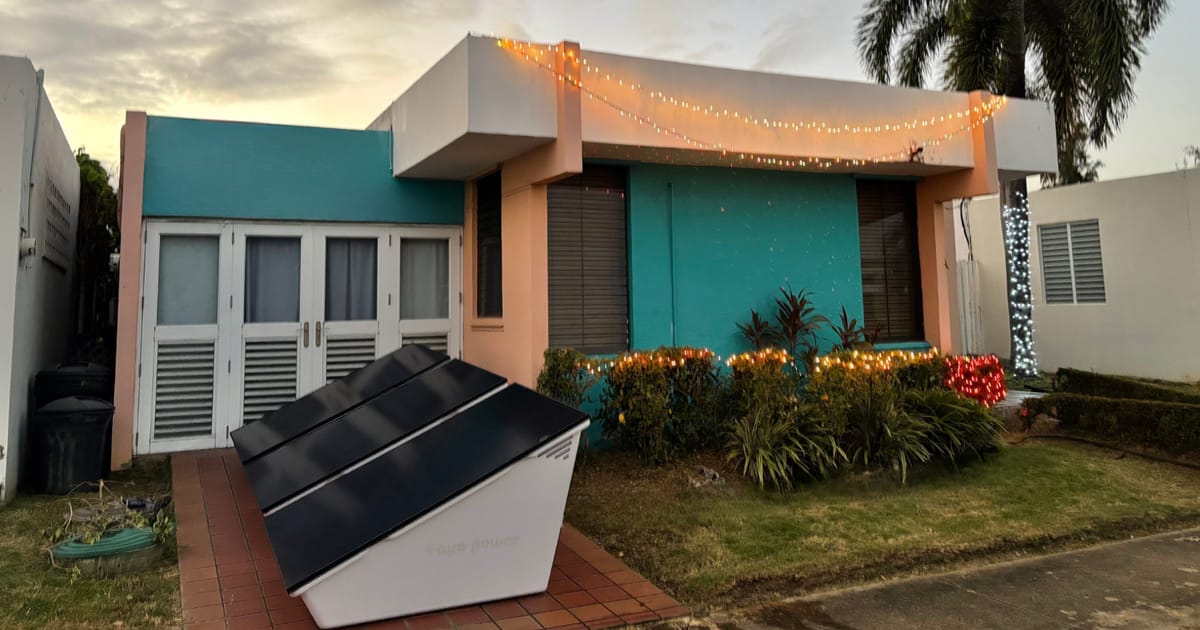
Meghan Wood, CEO of Raya Power, thinks solar and batteries should be as easy to install as a typical household appliance, durable enough to provide backup power for critical devices during storms and heat waves, and sophisticated enough to help lower everyday energy bills.
“Solar can give you a return on investment; it can give you resilience — and I want that to be as normal as getting Wi-Fi,” Wood said.
The Raya Power unit that Wood and cofounder Nicole Gonzalez designed is meant to hit all those marks. Think of it as a portable alternative to rooftop solar, one that looks a bit like an external cellar door from the space age.
The white triangular boxes are topped with 1.35 to 1.8 kilowatts of solar panels and contain 2.5 to 5 kilowatt-hours of battery storage. That blended solar and battery power can be fed into appliances using typical 120-volt or 240-volt plugs, or wired directly to air conditioning systems — all without touching broader household wiring and triggering the need for electrical permits.
In essence, Wood said, it’s a backyard solar “all-in-one box — a hybrid inverter, battery, communications, and electronics.” It even comes with enough ballast to keep it solidly on the ground in Category 3 storms. And unlike rooftop solar systems that can take days or weeks to install, permit, and interconnect under utility supervision, a Raya Power installation takes about two hours, “and then you’re running dedicated appliances.”
Rooftop solar and battery systems are great for those who can afford them, she said. But they’re out of reach for low-income households and people who rent their homes, like Wood does — an early inspiration for her research into alternative solar-battery combos.
Meanwhile, do-it-yourself balcony solar systems, which are popular in Germany, aren’t yet compatible with current U.S. electrical codes and standards, and that bars them from being plugged into household power sockets — at least for now.
Wood and Gonzalez, who met at a wedding during graduate studies at Stanford University, thought they could design a product that married the best of both those worlds. Gonzalez, a Puerto Rico native who was working on the NASA Mars Rover project when Hurricane Maria hit in 2017, wanted something her parents could have used to keep their lights on and communications up and running after the storm devastated the island’s electrical grid.
And Wood, a Stanford Impact Founder fellow at the university’s Doerr School of Sustainability, wanted a system that could avoid the “soft” costs of labor, permitting, and interconnection, which constitute about two-thirds of the total price tag of a typical U.S. rooftop solar and backup battery installation.
“That was the whole goal from the start: How do we eliminate the soft costs?” Wood said. “What can you do that avoids any type of permitting, and then go from there?”
Trying out the systems in the real world
Now, with $1 million in pre-seed funding, Wood and Gonzalez are ready to put the technology into the field. Over the coming months, the startup will deploy its first 20 or so units at homes in Puerto Rico and California.
Those units will draw from the grid to power the air conditioners, refrigerators, and other devices they’re connected to when that’s the cheapest option, Wood explained. When the sun is shining, they’ll switch to using solar power for those appliances. But they’ll never push power back to the utility grid, which obviates the need to win utility interconnection approvals.
The startup’s first systems are being installed in partnership with philanthropic organizations looking for solar-battery options for low-income communities. That includes the Environmental Defense Fund, which has spent the past few years helping the island of Culebra, Puerto Rico, more toward 100% carbon-free power.
That project has put rooftop solar-battery systems on some commercial buildings and homes, said Dan Whittle, who leads the Environmental Defense Fund’s work in the Caribbean. “But without subsidies, public or private, it’s just too expensive to cover 100 percent of low-income homes,” he said.