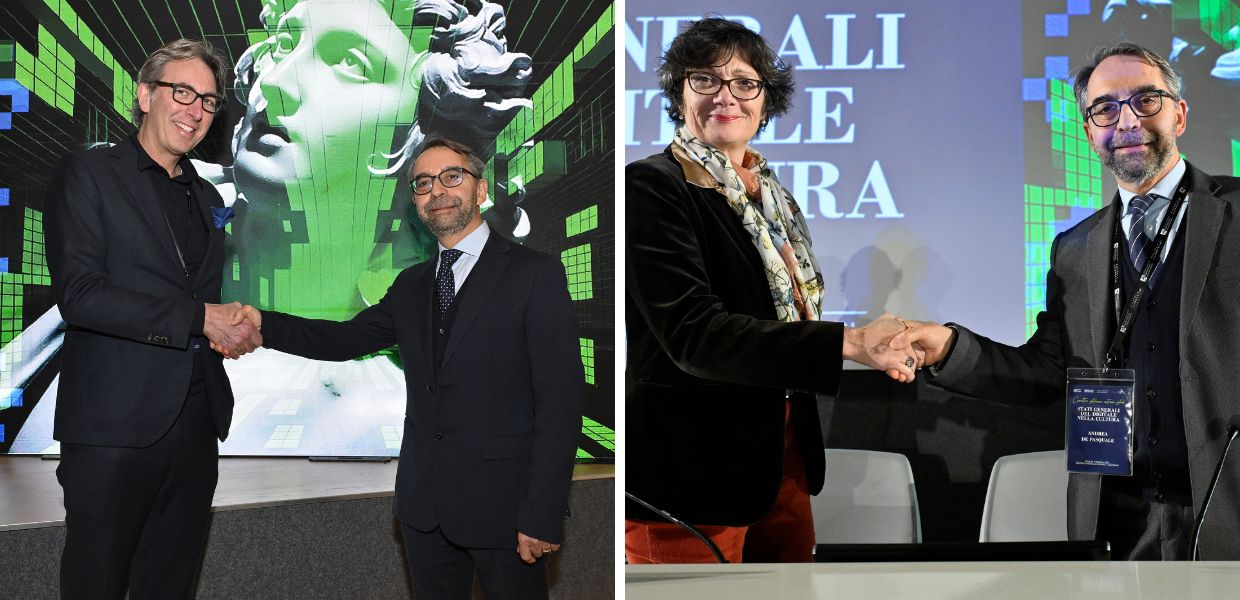
As the first MoU of its kind ever signed between the Europeana Foundation and an EU Member State, the partnership aims to accelerate Italy’s participation in and contribution to the common European data space for cultural heritage, stewarded by Europeana. The partnership was formalised at the closing of the high-level conference “Connettere patrimoni, costruire futuri – Stati generali del Digitale nella Cultura”, held in Rome on 10–11 December 2025.
Among its key provisions, the MoU establishes a milestone commitment: the The Directorate-General for Digitisation and Communication of the Italian Ministry of Culture will provide 10 million aggregated data records to the data space by the end of 2026. The Europeana Foundation will offer technical advice, specialised expertise and capacity-building to support the contribution of these valuable resources. Achieving this target by 2026 would make Italy the largest national contributor to the data space, reinforcing its leadership role in Europe’s digital heritage landscape. The Italian Digital Library will play a central role in this endeavor.
A shared vision for the data space for cultural heritage
Inspired by the vision set out in the European Commission Recommendation of 2021 on a common European data space for cultural heritage, the MoU renews and strengthens the long-standing collaboration between the MiC and Europeana. At the heart of the MoU is a shared, ambitious vision: to enhance Italy’s contribution to the data space while maximising the benefits it gains from the broader data space ecosystem. Through this joint effort, Italy’s rich and diverse digital cultural heritage will be made more accessible, discoverable and reusable, reaching diverse audiences and sectors across Europe and around the world, and keeping it alive for generations to come. The partnership will also spur innovation, particularly in advanced technologies such as AI and 3D digitisation, enabling new ways to explore, reuse and experience cultural heritage.
A milestone commitment: 10 million records by 2026
A central pillar of the MoU is Italy’s commitment to contribute at least 10 million digital cultural heritage records to the data space by the end of 2026.
The Europeana Foundation will provide technical support to optimise aggregation and ensure interoperable data flows, paving the way for a robust, sustainable and scalable national aggregation system. This system will serve as a core component of the Italian Digital Library and will enable a seamless contribution of Italy’s cultural heritage to the data space. The Europeana Foundation will also provide specialised knowledge and operational expertise to the Digital Library, supporting its accreditation as an official partner of the common European data space for cultural heritage.
‘With this Memorandum of Understanding, we are taking a decisive step in building the digital infrastructure for Italy’s cultural heritage, in full alignment with the 2021 Recommendation on the common European data space for cultural heritage. Thanks to our collaboration with the Europeana Foundation, we will be able to strengthen the role of the Directorate-General for Digitisation and Communication and the Digital Library as the national hub for the aggregation, quality and interoperability of data, building on the work launched with CulturaItalia and taking it to an entirely new scale. Contributing at least ten million new records by 2026 is ambitious but within our reach, and will be accompanied by a structured programme of technical support, training and skills development for cultural institutions across the country. This investment in data, professionals and digital infrastructures will make our heritage more accessible, usable and reusable, serving the scientific community, education, tourism and new applications based on advanced technologies such as 3D and artificial intelligence. It is a challenge that we face with a strong sense of responsibility and with the awareness that the richness of Italy’s heritage can and must make a decisive contribution to building data space f and the digital future of culture’, said Andrea De Pasquale, Director General for Digitisation and Communication at the Italian Ministry of Culture.
‘We stand at a pivotal moment, driven by a new policy impetus in the EU’s digital agenda and the ambition to make Europe the continent of AI. Trustworthy, multilingual data powers Europe-based AI, and the common European data space for cultural heritage is set to provide it. Member States are essential: their data and commitment form the foundation of the data space, driving its potential for innovation. With this ambitious step, Italy makes its rich heritage widely accessible and reusable across sectors — from science and tourism to AI training. I hope it inspires other countries to harness Europe’s digital heritage as a resource for the future’ said Harry Verwayen, General Director of the Europeana Foundation.
‘Italy already stands proudly among the top ten EU Member States contributing to Europeana and the data space. Our network of cultural heritage institutions and professionals across Italy is thriving, and through this partnership, the Europeana Foundation and the Italian Ministry of Culture are joining forces to build Europe’s digital cultural future. By 2026, Italy will become the top contributor to Europeana and the data space — a milestone that makes me incredibly proud, and one that will concretely boost support to and engagement from cultural institutions across the country; from making technological innovations in 3D and AI more accessible, to sharing best practices and finding shared solutions’, said Martina Bagnoli, Chair of the Europeana Foundation Supervisory Board.
About the Ministry of Culture (MiC)
The Directorate-General for Digitisation and Communication of the Ministry of Culture coordinates the Ministry’s policies for digital transformation and institutional communication. Working in synergy with the other central offices and with state cultural institutions, it defines strategic guidelines, oversees information systems and the main online platforms, ensuring consistency, accessibility and quality of the services provided to citizens and professionals.
Through the National Plan for the Digitisation of Cultural Heritage and the measures of the National Recovery and Resilience Plan (PNRR), it promotes the creation and management of digital resources on cultural heritage, supports skills development, fosters the adoption of innovative technologies and ensures the security of infrastructures. In doing so, it helps to make collections, data and cultural content more easily accessible and reusable in the educational, scientific, professional and creative fields.
About the Europeana Foundation
The Europeana Foundation is an independent, non-profit organisation that stewards the common European data space for cultural heritage in collaboration with a pan-European consortium, and contributes to other digital initiatives that put cultural heritage to good use in the world. It works to democratise access to culture digitally, empowering everyone to explore, learn from, and benefit from Europe’s rich heritage. Through projects, partnerships, and innovative services, models and frameworks, the Foundation drives the digital transformation and sustainability of the cultural heritage sector, making collections accessible, trustworthy, and reusable across society.
Media contacts
-
At MiC: Arianna Nastasi, Secretariat and Director-General’s Staff, Directorate-General for Digitalisation and Communication, Italian Ministry of Culture (MiC) < [email protected]>
-
At the Europeana Foundation: Lorena Aldana, Head of External Relations and Advocacy <[email protected]>