Released: 2025-12-18
Average weekly earnings — Canada
$1,312.16
October 2025
2.2%
(12-month change)
Average weekly earnings — N.L.
$1,293.43
October 2025
4.0% 
(12-month change)
Average weekly earnings — P.E.I.
$1,141.86
October 2025
4.3%
(12-month change)
Average weekly earnings — N.S.
$1,179.42
October 2025
3.5%
(12-month change)
Average weekly earnings — N.B.
$1,193.47
October 2025
2.1%
(12-month change)
Average weekly earnings — Que.
$1,259.63
October 2025
2.0%
(12-month change)
Average weekly earnings — Ont.
$1,357.26
October 2025
2.9%
(12-month change)
Average weekly earnings — Man.
$1,177.18
October 2025
1.8%
(12-month change)
Average weekly earnings — Sask.
$1,277.40
October 2025
3.3%
(12-month change)
Average weekly earnings — Alta.
$1,353.54
October 2025
0.5%
(12-month change)
Average weekly earnings — B.C.
$1,310.62
October 2025
1.7%
(12-month change)
Average weekly earnings — Y.T.
$1,514.94
October 2025
3.2%
(12-month change)
Average weekly earnings — N.W.T.
$1,753.40
October 2025
0.8%
(12-month change)
Average weekly earnings — Nvt.
$1,774.16
October 2025
0.8%
(12-month change)
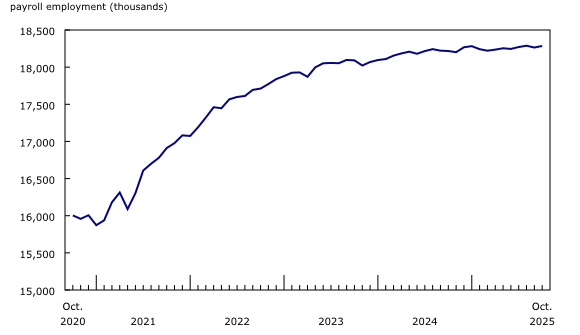
The number of employees receiving pay and benefits from their employer—measured as “payroll employment” in the Survey of Employment, Payrolls and Hours—increased by 21,200 (+0.1%) in October, largely offsetting a decline of 24,300 (-0.1%) in September. On a year-over-year basis, payroll employment was up 68,300 (+0.4%) in October.
Chart 1

Payroll employment increases in October, offsetting the decline in September
In October, monthly payroll employment increases were recorded in 9 of the 20 sectors, led by health care and social assistance (+10,300; +0.4%), followed by finance and insurance (+5,500; +0.6%), public administration (+5,100; +0.4%), and transportation and warehousing (+4,700; +0.5%). The gains were partially offset by declines in administration and support, waste management and remediation services (-5,200; -0.6%), retail trade (-2,000; -0.1%), wholesale trade (-1,600; -0.2%), and professional, scientific and technical services (-1,500; -0.1%).
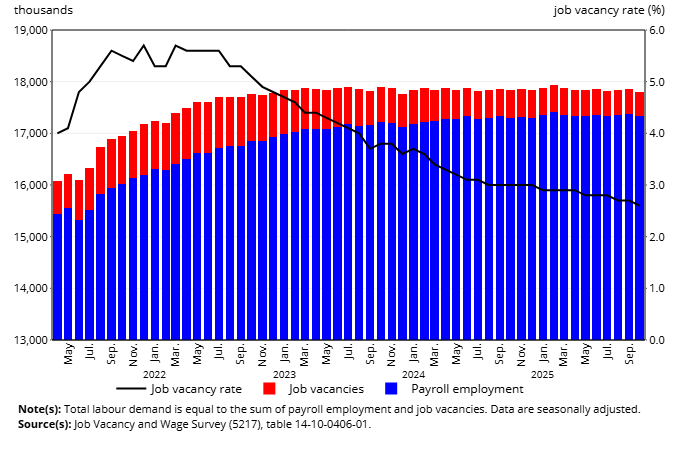
Meanwhile, job vacancies in Canada decreased by 19,100 (-3.9%) to 467,000 in October, more than offsetting the uptick in September (+11,000; +2.3%). The number of vacancies in October was the lowest since October 2017. On a year-over-year basis, job vacancies were down 65,200 (-12.3%) in October 2025.
Chart 2
Payroll employment increases in nine sectors and decreases in four in October
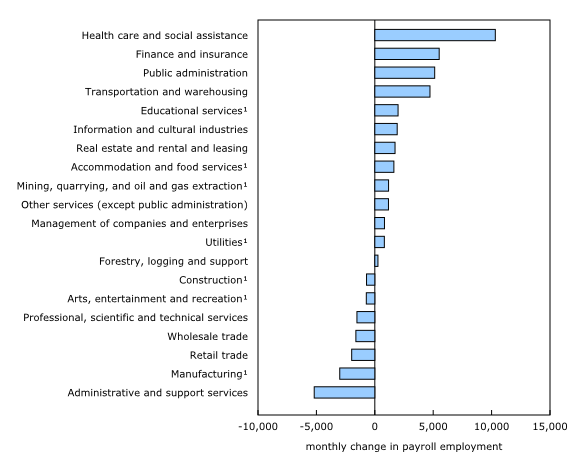
Health care and social assistance records payroll employment increase in October
Payroll employment in health care and social assistance rose by 10,300 (+0.4%) in October, following an increase of 9,100 (+0.4%) in September. Payroll employment in this sector has generally trended upward since 2022. On a year-over-year basis, payroll employment in health care and social assistance was up by 71,700 (+3.0%) in October 2025.
In October, monthly payroll employment increases were recorded in 13 out of 18 industries in the sector, led by child day-care services (+2,900; +1.4%), nursing care facilities (+2,100; +0.9%) and general medical and surgical hospitals (+1,900; +0.3%).
Payroll employment in finance and insurance increases for the fourth consecutive month
Payroll employment in finance and insurance (+5,500; +0.6%) rose for the fourth consecutive month in October, bringing the cumulative gain to 16,700 (+2.0%) since July. The increase since July was concentrated in credit intermediation and related activities (+8,700; +2.1%) and in insurance carriers and related activities (+5,500; +2.0%).
On a year-over-year basis, payroll employment in finance and insurance was up by 15,600 (+1.8%) in October.
Payroll employment in public administration increases in October
Payroll employment in public administration (+5,100; +0.4%) increased for the third consecutive month in October, bringing the cumulative gain to 9,000 (+0.7%) since August. The three-month gain in the sector partially offset the cumulative decline of 10,300 (-0.8%) recorded from April to July 2025.
Year over year, payroll employment in public administration was up 7,100 (+0.5%) in October. Net gains in provincial and territorial public administration (+11,800; +3.4%) and local, municipal and regional public administration (+10,000; +2.0%) were partially offset by a decline in federal government public administration (-16,500; -4.3%).
Transportation and warehousing records payroll employment increase in October
Payroll employment in transportation and warehousing increased by 4,700 (+0.5%) in October, following little variation from July to September.
On a year-over-year basis, payroll employment in the sector was up by 15,100 (+1.8%) in October. Year-over-year increases were recorded in 8 out of 11 subsectors, led by warehousing and storage (+5,300; +7.1%), couriers and messengers (+4,600; +5.9%), transit and ground passenger transportation (+4,200; +3.4%) and rail transportation (+3,200; +7.5%). Meanwhile, truck transportation (-4,500; -2.1%) was the lone subsector to record a year-over-year decline in October.
Payroll employment in administrative and support, waste management and remediation services decreases for the second consecutive month
Payroll employment in administrative and support, waste management and remediation services (-5,200; -0.6%) fell for a second consecutive month in October, following a decline of 5,900 (-0.7%) in September. The cumulative decline over September and October was led by employment services (-5,700; -3.0%) and business support services (-1,900; -2.9%).
On a year-over-year basis, payroll employment in the sector was down 3,400 (-0.4%) in October.
Average weekly earnings continue to increase on a year-over-year basis
Year over year, average weekly earnings were up 2.2% to $1,312 in October, following a 2.9% increase in September. In general, growth in average weekly earnings can reflect a range of factors, including changes in wages, composition of employment, hours worked and base-year effects.
Month over month, average weekly earnings were little changed in October.
In October, average weekly hours worked were down 0.3% to 33.3 hours, compared with 33.4 hours in September. On a year-over-year basis, average weekly hours were down 0.3% in October.
Job vacancies decrease in October
In October, job vacancies in Canada decreased by 19,100 (-3.9%) to 467,000, more than offsetting the uptick in September (+11,000; +2.3%). The number of vacancies in October was the lowest since October 2017. On a year-over-year basis, job vacancies were down 65,200 (-12.3%) in October 2025.
The job vacancy rate—which corresponds to the number of vacant positions as a proportion of total labour demand—was 2.6% in October, down 0.1 percentage points from September (2.7%) and down 0.4 percentage points from October 2024 (3.0%).
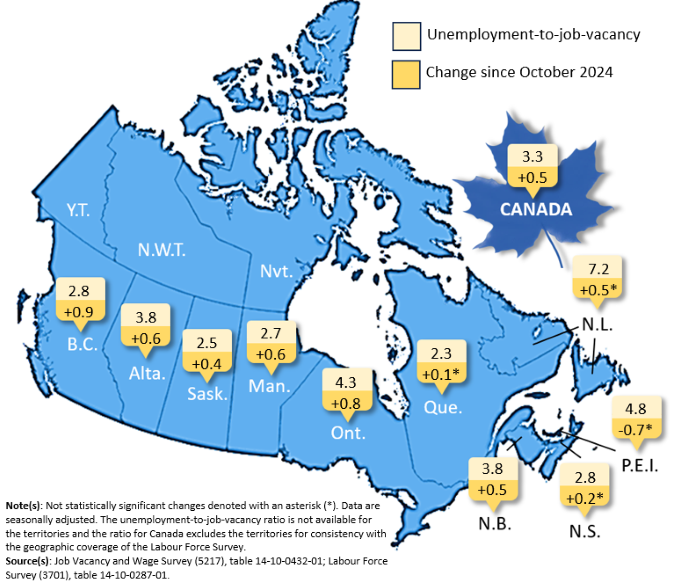
There were 3.3 unemployed persons for every job vacancy in October 2025, little changed from September. On a year-over-year basis, the unemployment-to-job vacancy ratio was up by 0.5. This reflected a decrease in the number of job vacancies (-64,800; -12.2%, excluding the territories), coupled with an increase in the number of unemployed persons (+81,000; +5.5%). Over the same period, the unemployment rate rose from 6.6% to 6.9% (according to the Labour Force Survey). The unemployment-to-job vacancy ratio excludes the territories for consistency with the comparable Labour Force Survey data.
Infographic 1
Job vacancies and job vacancy rate decrease in October
Job vacancies decrease in four sectors and increase in one
In October, job vacancies were down in finance and insurance (-4,500 to 14,300), administrative and support, waste management and remediation services (-3,200 to 23,200), real estate and rental and leasing (-1,600 to 6,300), as well as information and cultural industries (-1,100 to 6,700). Meanwhile, job vacancies increased in mining, quarrying, and oil and gas extraction (+1,400 to 5,000).
In administrative and support, waste management and remediation services, the decline in October brought the number of vacancies (23,200) to a level comparable with January 2016. The job vacancy rate in the sector fell to 2.7% in October 2025, the lowest since comparable data became available in the Job Vacancy and Wage Survey in April 2015.
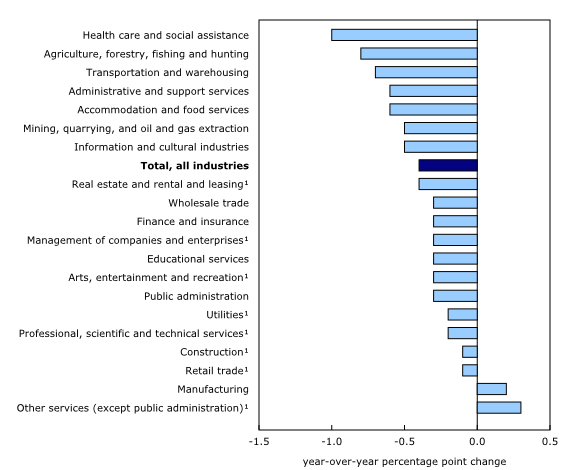
On a year-over-year basis, the job vacancy rate fell in 11 out of 20 sectors in October 2025. Health care and social assistance (-1.0 percentage points to 3.8%) saw the largest percentage point decline in the job vacancy rate, followed by agriculture, forestry, fishing and hunting (-0.8 percentage points to 2.9%) and transportation and warehousing (-0.7 percentage points to 2.6%).
The only sector to record a year-over-year increase was manufacturing, where the job vacancy rate rose by 0.2 percentage points to 2.2% in October. This increase in the job vacancy rate in manufacturing was primarily due to the decline in payroll employment over the period.
Chart 3
Job vacancy rate falls in 11 out of 20 sectors year over year
Job vacancy rate down in seven provinces on a year-over-year basis
Year over year, the job vacancy rate in October was down in seven provinces, with Saskatchewan (-0.8 percentage points to 2.8%), Manitoba (-0.7 percentage points to 2.7%) and British Columbia (-0.7 percentage points to 3.0%) recording the largest declines.
In October, there were 7.2 unemployed persons for every job vacancy in Newfoundland and Labrador, the highest ratio among the provinces. In comparison, the unemployment-to-job vacancy ratio was lowest in Quebec (2.3), followed by Saskatchewan (2.5) and Manitoba (2.7).
Map 1
Unemployment-to-job vacancy ratio increases in six provinces
Sustainable Development Goals
On January 1, 2016, the world officially began implementation of the 2030 Agenda for Sustainable Development—the United Nations’ transformative plan of action that addresses urgent global challenges over the next 15 years. The plan is based on 17 specific sustainable development goals.
The Survey of Employment, Payrolls and Hours is an example of how Statistics Canada supports the reporting on the Global Goals for Sustainable Development. This release will be used in helping to measure the following goals:


Note to readers
Survey of Employment, Payrolls and Hours
The key objective of the Survey of Employment, Payrolls and Hours (SEPH) is to provide a monthly portrait of the level of earnings, employment and hours worked, by detailed industry, at the national, provincial and territorial levels.
Payroll employment, as measured by the SEPH, refers to the number of employees receiving pay and benefits (employment income) during a given month. The survey excludes the self-employed, owners and partners of unincorporated businesses and professional practices, and employees in the agricultural sector.
SEPH estimates are produced by integrating information from three sources: a census of approximately 1 million payroll deduction records provided by the Canada Revenue Agency; the Business Payrolls Survey, which collects data from a sample of 15,000 establishments; and administrative records of federal, provincial and territorial public administration employment, provided by these levels of government.
Estimates of average weekly earnings and hours worked are based on a sample and are therefore subject to sampling variability. This analysis focuses on differences between estimates that are statistically significant at the 68% confidence level. Payroll employment estimates are based on a census of administrative data and are not subject to sampling variability.
With each release of SEPH data, data for the preceding month are revised. Users are encouraged to use the most up-to-date data available for each month.
Statistics Canada also produces employment estimates from its Labour Force Survey (LFS). The LFS is a monthly household survey, the main objective of which is to divide the working-age population into three mutually exclusive groups: the employed (including the self-employed), the unemployed and those not in the labour force. This survey is the official source for the unemployment rate, and it collects data on the sociodemographic characteristics of all people in the labour market.
Employment trends from the SEPH and from the LFS generally track each other closely, especially over longer periods of time. That said, because of differences in concepts, definitions and methodologies, variations in employment levels in SEPH and in the LFS may differ, especially over shorter periods. For a more in-depth discussion of the conceptual differences between employment measures from the LFS and the SEPH, refer to Section 8 of the Guide to the Survey of Employment, Payrolls and Hours (72-203-G).
The SEPH and LFS both also provide monthly indicators of pay received by employees. Used together, average weekly earnings (from SEPH) and average hourly wages (from the LFS) can provide a comprehensive portrait of pay dynamics in Canada. For information on definitions for each indicator, key conceptual and measurement differences, and guidance to data users on when to use each indicator, refer to the report “Earnings and Wages – A guide to using indicators from the Survey of Employment, Payrolls and Hours and the Labour Force Survey.”
Unless otherwise stated, this release presents seasonally adjusted data, which facilitate comparisons because the effects of seasonal variations are removed. For more information on seasonal adjustment, see Seasonally adjusted data – Frequently asked questions.
Non-farm payroll employment data are for all hourly and salaried employees and for the “other employees” category, which includes piece-rate and commission-only employees.
Unless otherwise specified, average weekly hours data are for hourly and salaried employees only and exclude businesses that could not be classified to a North American Industry Classification System (NAICS) 2022 version 1.0 code.
All earnings data include overtime and exclude businesses that could not be classified to a NAICS code. Earnings data are based on gross taxable payroll before source deductions. Average weekly earnings are derived by dividing total weekly earnings by the number of employees. Changes in average weekly earnings can reflect a range of factors, including changes in wages, composition of employment, hours worked and base-year effects.
The base-year effect refers to the impact that trends from 12 months earlier (the base month) have on the current month’s estimate of year-over-year change. In the case of SEPH, when the average weekly earnings in the base month is at the peak of a short-term trend, this tends to have a downward effect on year-over-year average weekly earnings growth in the current month. In contrast, if the value of the base month is at a low point of a trend, this tends to have an upward effect on the current month’s year-over-year growth in average weekly earnings.
Job Vacancy and Wage Survey
The Job Vacancy and Wage Survey (JVWS) collection is done on a quarterly basis. The quarterly sample of business locations is allocated to the three collection months of the quarter, approximately balanced by province and by industrial sector across each of the three months. This allows both quarterly and monthly estimates to be produced.
Preliminary monthly estimates are produced for job vacancies, job vacancy rates and payroll employment using available responses from business locations sampled in the corresponding reference month. The reference period for the JVWS is the first day of the respective month. This analysis focuses on differences between estimates that are statistically significant at the 68% confidence level.
These preliminary monthly estimates are revised and finalized when the corresponding quarterly estimates are released or shortly thereafter. Users are encouraged to use the most up-to-date data available for each month.
Unless otherwise stated, this release presents seasonally adjusted data, which facilitate comparisons because the effects of seasonal variations are removed. For more information on seasonal adjustment, see Seasonally adjusted data – Frequently asked questions.
While JVWS employment is calibrated to the SEPH, SEPH payroll employment and JVWS preliminary monthly employment figures may differ because of calibration grouping and differences in scope and reference period.
The unemployment-to-job vacancy ratio excludes the territories for consistency with the geographic coverage of the comparable LFS data (table 14-10-0287-01).
The JVWS also provides comprehensive quarterly data on job vacancies by industrial sector and detailed occupation for Canada and the provinces, territories and economic regions; offered hourly wages; and job vacancy characteristics. More information about the concepts and use of data from the JVWS is available in the Guide to the Job Vacancy and Wage Survey (75-514-G).
Real-time data tables
Tables 14-10-0357-01 and 14-10-0358-01 have now been achieved.
Real-time data tables 14-10-0331-01 and 14-10-0332-01 will be updated on January 12, 2026.
New data table on monthly payroll employment for agriculture and support activities
A new data table (14-10-0481) presenting the number of payroll employees in the agriculture and support activities industries is now available on the Statistics Canada website. This new monthly table includes all industries primarily engaged in crop production, animal production and aquaculture, and their respective support activities since January 2025.
To classify employment data by industry, the SEPH program uses industry codes assigned to businesses based on their main revenue-generating activity, using the North American Industry Classification System (NAICS). The population covered in this new SEPH data table includes crop production (NAICS 111), support activities for crop production (NAICS 1151), animal production and aquaculture (NAICS 112), and support activities for animal production (NAICS 1152). It is important to note that these agriculture-related industries are excluded from the total SEPH employment counts presented in table 14-10-0201-01.
Next release
November 2025 data for SEPH and JVWS will be released on January 29, 2026.
Products
More information about the concepts and use of the Survey of Employment, Payrolls and Hours is available in the Guide to the Survey of Employment, Payrolls and Hours (72-203-G).
The product “Earnings and payroll employment in brief: Interactive app” (14200001) is now available. This interactive data visualization application provides a comprehensive picture of the Canadian labour market using the most recent data from the Survey of Employment, Payrolls and Hours. The estimates are seasonally adjusted and available by province and largest industrial sector. Historical estimates that go back 10 years are also included. The interactive application allows users to explore and personalize the information presented quickly and easily. Combine multiple provinces and industrial sectors to create your own labour market domains of interest.
Contact information
For more information, or to enquire about the concepts, methods or data quality of this release, contact us (toll-free 1-800-263-1136; 514-283-8300; infostats@statcan.gc.ca) or Media Relations (statcan.mediahotline-ligneinfomedias.statcan@statcan.gc.ca).