Unlock the Editor’s Digest for free
Roula Khalaf, Editor of the FT, selects her favourite stories in this weekly newsletter.
Two executives behind Europe’s newest battery plants have voiced support for a plan by Brussels to boost local content levels for car products as the continent seeks to weaken China’s grip on technologies critical to the electric transition.
Some carmakers have panned the “made in Europe” proposal as “very dangerous” and said it could slow the shift to electric vehicles. But the chief executive of Seat-Cupra said such rules for car parts were necessary for Europe to remain competitive as the carmaker opened its battery assembly plant in Barcelona last week.
“I think having a minimum amount of parts and also materials to be sourced from Europe for Europe is the natural answer,” said Markus Haupt, who heads the Spanish mass-market brand that is part of Volkswagen group. “It’s also the basis that we need to create to allow Europeans to stay competitive in Europe.”
Europe’s ambitions to build a homegrown battery industry took a hit with the collapse of Sweden’s Northvolt in March. Other battery projects have moved ahead elsewhere in Europe but face stiff competition from Asian competitors who lead the field.
Proponents of the rules say having locally sourced materials will help to boost European competitiveness and jobs by reducing the continent’s reliance on China. European manufacturers remain particularly dependent on China for the manufacturing of battery cells as well as the battery metals supply chain.
The EU’s local sourcing targets for parts in products such as cars and solar panels are part of a set of proposals to be presented in late January aimed at strengthening the EU’s flagging industrial base.
Echoing Seat-Cupra, which is part of the Volkswagen group, French battery maker Verkor also called for strict local content rules to boost the nascent European battery sector, as the company inaugurated its first gigafactory in Dunkirk last week.
Benoit Lemaignan, chief executive and founder of the start-up Verkor, said that in order to protect the nascent battery sector, “made in Europe” rules were essential. Having a minimum capacity of European-made components would not only protect “industrial activity in Europe and France”, but also avoid Europe being excessively reliant on Chinese imports.
The French government is leading calls for the content rules and at the Dunkirk event, industry minister Sébastien Martin said that Europe should follow the US and China in insisting on locally made content in vehicles. “In Europe, we need an extremely significant level of locally made content in our vehicles — 75 per cent — to save our industry.”
Lemaignan is focusing the newly inaugurated Dunkirk facility on a single client and a single vehicle: the A390 SUV developed by Renault brand Alpine. He said this was a similar approach to that taken by China’s CATL and South Korea’s LG in earlier stages of development.
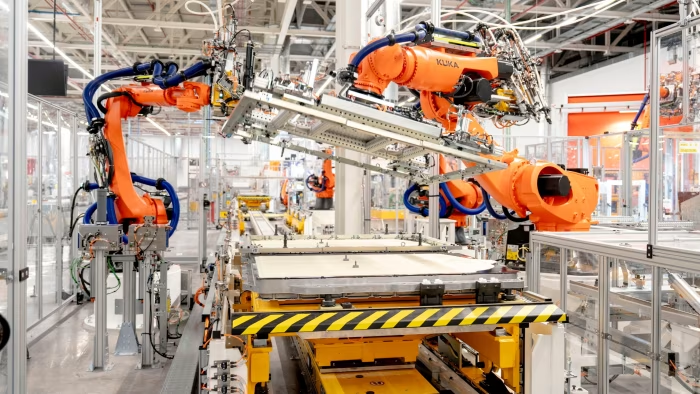
In Spain, the opening of Seat-Cupra’s battery assembly plant in Barcelona is a key pillar of Volkswagen’s broader strategy to establish its independent supply chains for EVs. At maximum capacity, the facility will be able to assemble 300,000 battery systems per year and roughly half of its battery cells will be sourced from VW’s battery division.

Volkswagen earlier this month began the increase of production at its flagship battery plant in Salzgitter, close to its German headquarters.
The new facility at the Martorell plant is also part of the German group’s €10bn investment into Spain’s electric transition. The VW group plans to take on Chinese rivals with a series of affordable electric vehicles produced in Spain and has spent about a third of its budget to transform Martorell into a production hub for EVs, hybrids and combustion engine vehicles.
The battery systems will be used in Cupra’s sporty small EV Raval and Volkswagen’s ID. Polo, which will both go on sale next year starting at €25,000.
“We think this segment could be the game changer for us,” Haupt said. “We strongly believe that we can be very competitive with this Cupra Raval.”
Jordi Hereu, Spain’s industry minister, welcomed the opening of the facility as “one step forward towards ensuring strategic autonomy starting here in Europe”.
Europe’s local sourcing proposal has divided the industry and EU’s member states. It has faced opposition from carmakers who source many parts from outside the bloc.
Verkor has been backed by the French state to develop its gigafactory, with €650mn of French subsidies as part of a more than €2bn fundraise in 2023.
France has led efforts to develop the battery industry in Europe, with the Dunkirk region serving as a home not just to Verkor’s factory but also to Stellantis and Mercedes-Benz-backed battery maker ACC, Taiwanese developer Prologium and AESC, the Sino-Japanese battery maker whose cells are used in Renault’s R5 cars made at the nearby Douai plant.