26 December 2025
Glenn Forde farms in Ballinadee, near Bandon, running a spring calving dairy herd which supplies milk to Bandon Co-op. Mark Treacy, Teagasc Dairy Specialist and Mark O’Sullivan, Teagasc Dairy Advisor outline how good grass management and breeding are the key on an unusually dry farm.
The farm overlooks the Bandon River and is a dry farm due to its elevation and free-draining soil type. This provides opportunities and challenges, with the farm having definite benefits for grazing in spring and autumn but also being liable to drought during the summer. Since taking over the farm from his father Maynard in 2006, Glenn has grown the herd from about 90 cows to today’s 250 cow herd.
“Throughout the development, process we have tried to stay focussed on working to the strengths of the farm, investing where there are good paybacks, and trying to avoid distractions along the way,” says Glenn. There have been 20-plus years of eProfit Monitors completed for the farm. Glenn says he finds the data invaluable for assessing the impact of his decisions and guiding him where next to go with the farm. “The figures show that our best investments have been in improving grazing infrastructure, herd genetics, soil fertility, reseeding and facilities for the comfort of both stock and farm workers.”
The farm has consistently delivered strong financial performance. Last year was no exception, with a combination of good cost control and strong output allowing the farm to maximise the benefits of the high base milk price. When compared to other spring calving dairy farms which completed a Teagasc ePM for 2024, the Forde’s financial performance places them close to the top 10% of farms for profitability, both on a whole farm hectare and per cow basis. So, what drives this strong financial performance? “I put down a lot of the financial success of the farm to the herd’s genetics and our strong focus on grassland management,” says Glenn. “Grass is by far the cheapest feed available, so it stands to reason that focussing on high levels of grass utilisation will drive profitability.”
In 2024 four tonnes of grass DM/cow (10.5 tonnes of grass DM/ha) were utilised on the farm. Glenn has been recording grass growth rates for over 10 years and considers his weekly grass walk an essential farm management task. During periods of rapid growth or tight grass supply, the frequency of grass walks is increased, and a total of 35 grass covers were recorded on PastureBase Ireland in 2025.
“I aim to provide the cows with a good quality sward with a pre-grazing cover of 1,400 to 1,500 kg DM/ha,” says Glenn. “Any paddock that is too strong is taken out for bales where possible, providing valuable winter feed while also allowing us to maintain quality in the sward.”
Recent dry summers have made grass management a challenge. During the main grazing season, the targeted milking platform stocking rate is just 3LU/ha. While this midseason stocking rate may sound low, Glenn notes that in previous years when the farm had a higher stocking rate during the main season, it was difficult to take out any surplus paddocks or to do much reseeding.
“The total intake of cows was compromised,” says Glenn. “In recent years, we only use the strip wire in the spring and paddock sizes have been changed to allow three grazings per paddock.” Glenn says he believes that the heifers and more-docile animals perform better when cows are offered 36-hour allocations. While the dry nature of this farm poses challenges in midseason, it is of huge benefit in spring and autumn, with a grazing season of 290 days achieved in 2024. Glenn is very focussed on getting cows out grazing early in spring. There is a high grass demand in spring as the six-week calving rate is consistently above 85% (89% in 2025). “Cows are buffered early in the season but once weather conditions start to improve, we cut the buffer and grass and meal make up the full diet,” says Glenn, “assuming adequate grass is available on farm.”
There have been substantial investments made in the grazing infrastructure in recent years, with an excellent network of farm roadways and multiple access points available for many of the paddocks. Glenn also uses a Batt-Latch to good effect in springtime to facilitate on-off grazing. The Batt-Latch is also used in mid-season when cows are grazing paddocks more than 800m from the parlour, opening one hour before milking to allow cows to come in at their own pace.
Soil fertility
“We put a lot of emphasis on maintaining and improving the soil fertility of the farm,” says Glenn. “I consider it to be vital for maximising grass production and maintaining clover in the sward.”
Soil samples are taken every second year with every paddock individually sampled. Paddocks which are low in P and K are targeted with slurry, using LESS, in spring and again during the grazing season. The farm has excellent slurry storage facilities, far exceeding regulatory requirements.
Glenn says he sees huge value in this infrastructure as it allows him to target slurry where it is most needed rather than having to spread wherever is available in spring to lower tanks. As the farm has a good nutrient status there is a modest chemical P allowance available making it more critical that slurry is applied where it is most needed. “The overall nutrient status on the milking platform is excellent,” says Mark O’Sullivan, Glenn’s local advisor. “Seventy-two percent of the farm is Index 3 or 4 for P, while 76% of the farm is Index 3 or 4 for K. Glenn has been targeting a pH of >6.5 to incorporate clover into the sward on the platform. Soil pH is over 6.5 for 91% of the farm.”
Clover is incorporated into all reseeds and is found in 65% of the milking platform swards, with 35% of the platform having what Glenn considers ‘good clover’. In 2025, there was no chemical fertiliser N applied after May on 18ha of the platform as Glenn was satisfied that there was sufficient clover in these paddocks. “We apply soiled water on these high-clover paddocks, while 11kgN/ha per rotation is applied to the remaining clover paddocks as protected urea,” says Glenn. “We apply 20kg sulphur/ha across the farm from April onwards.”
Genetics
Glenn’s excellent grassland management allows him to capitalise on the strong genetic potential of his high-EBI crossbred herd. Far back, the herd was split calving and supplied a winter milk contract. In 2018, Glenn decided to fully switch to spring milk production. “I wanted to lower our cost of production, streamline operations and increase the labour efficiency of the farm,” he says.
The cows at the time were high EBI Holstein Friesian and were crossed with Jersey AI bulls. After the initial first cross the replacements today are mainly sired by high EBI Friesian AI bulls. A small amount of sexed Jersey AI is used on the animals with lower fat and protein percentages and on the higher volume cows.
In 2024, the herd delivered 540 kg MS/cow to Bandon Co-op. This was achieved through the delivery of 6,174 litres of milk per cow with 1.25 tonne of concentrate fed per cow. Output in 2025 is likely to exceed 550kg MS/cow with a similar level of concentrate. Importantly for Glenn, the current level of production allows the herd to remain in nitrates band 2. The ability to achieve a high level of milk solids production with a moderate level of milk volume is due to the strong genetics for fat and protein % in the herd with the pta’s for fat and protein at 0.16 and 0.1 respectively.
The herd is in the top 10% for overall herd EBI in the country at €166, and the top 2% for milk sub-index (€46). It’s worth noting that the milk kg pta of the herd is -58. The maintenance sub index for the herd is €34, indicating an average mature cow bodyweight of 543 kg. This lower-than-average cow bodyweight is resulting in a larger proportion of the feed consumed being used for milk production.
“Our focus over recent years has been to increase production by increasing milk constituents while maintaining the herd’s milk volume,” says Glenn. Since 2018, MS/cow has increased by 35 kg with the increase coming from an increase in milk constituents. During this period average fat % has increased from 4.02% to 4.7%, while the protein has increased from 3.56% to 3.79%. Milk volume per cow over that same period has remained relatively consistent, fluctuating between 6,100 and 6,300 litres. Milk price received on this farm is 5c/l above the co-op average.
“When selecting bulls I go for high pta’s for both fat and protein %, as well as a high genetic potential for fat and protein kgs combined,” says Glenn. The heifers due to calve down in 2026 have the genetic potential to deliver over 9% solids (5.03% fat and 4.13% protein). Glenn commented that “If the milk price deduction for volume (C component) was ever to increase to reflect transportation and processing costs, I feel the farm is in a strong position to capitalise on this.”
It is important not to underestimate the importance of the strong fertility genetics of the herd in delivering good milk output. Glenn’s herd has a fertility sub index of €64 and consistently achieves a six-week calving rate of over 85% each year, with a calving interval of 368 days in 2025. This allows the full production potential of the cows to be realised.
This article first appeared in Today’s Farm – November/December 2025, find it here
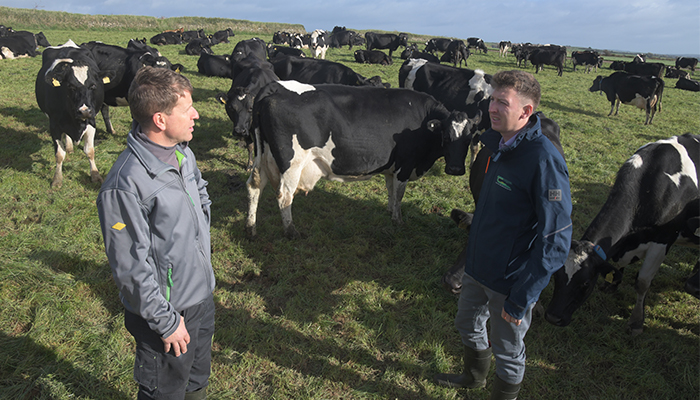
Featured photo: Glenn Forde, dairy farmer is pictured with Mark O’Sullivan, Teagasc Dairy Advisor