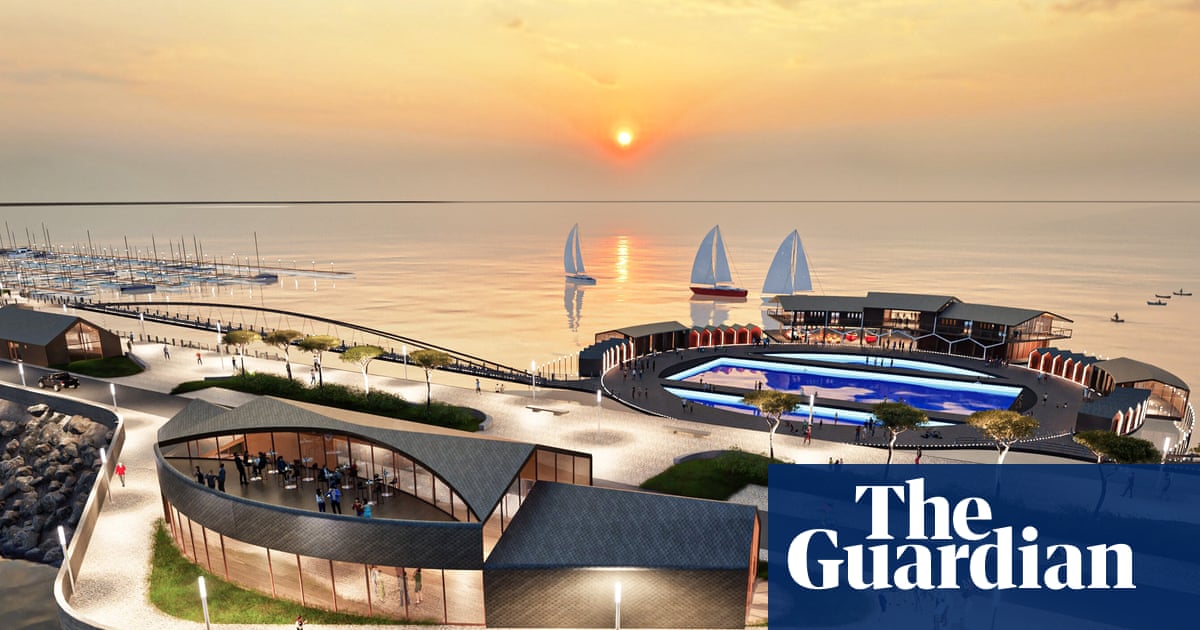
The architect of the London Eye wants to build a vast tidal power station in a 14-mile arc off the coast of Somerset that could help Britain meet surging electricity demand to power artificial intelligence – and create a new race track to let cyclists skim over the Bristol Channel.
Julia Barfield, who designed the Eye and the i360 observation tower in Brighton, is part of a team that has drawn up the £11bn proposal. It would curve from Minehead to Watchet and use 125 underwater turbines to harness the power of the second-highest tidal range in the world.
The proposal comes amid growing concern that rapidly rising use of AI in Britain will drive up carbon emissions unless more renewable energy sources are found. The AI boom is expected to add to sharp increases in demand for electricity across the UK, which the government estimated this month could more than double by 2050.
“If the decision is to go ahead with adopting more and more AI – which I am surprised is not being questioned more at a time of climate emergency – then it is going to be better with a renewable energy source,” said Barfield. “Datacentres could double energy demand and this is a predictable and reliable source.”
The barrage would not cross the full breadth of the channel but would instead curve to and from the Somerset coast with a 2.5GW maximum output – not far short of the peak energy that will be created by the Hinkley Point C nuclear power station just 12 miles east. It would be enough to power 2m homes.
The vision includes a path along the top of the semi-circular barrage for walkers and cyclists willing to brave the south-westerlies, a water-sports marina, a lido and an observation tower. Local MP Rachel Gilmour, who is backing the plan, said the pathway “will become absolutely iconic”.
The designers have tentatively suggested it also might be possible to install datacentres within the structure, allowing them to benefit from cheap seawater cooling. There are hopes for oyster and mussel beds, arrays of floating solar panels and a coastal amphitheatre to boost the economy of Minehead, once a popular holiday resort and now one of the 20% most deprived areas in Britain.
The latest UK energy policy states that tidal and wave energy could play a role “if their costs can be reduced”.
“We have got people who want to fund it but they will only do so if the government is supportive,” said Aidan Clegg, chief executive of the consortium. “They need to take this seriously. This is not hypothetical – we have a strong plan in place.”
A spokesperson for the Department for Energy Security and Net Zero said: “We are open to considering well-developed proposals for harnessing the tidal range energy in the bays and estuaries around our coastlines, which demonstrate strong value for money. The AI energy council is bringing together the likes of Neso [the National Energy System Operator], EDF, Microsoft and Google in solving the energy demands of AI, exploring opportunities to attract investment and support the development of low carbon power for datacentres.”
Tidal power is more predictable than wind and solar, even though there are several hours when tides turn each day with little or no power. The backers of the West Somerset Lagoon project believe it would last 120 years and would therefore produce power more cheaply than nuclear power.
It was first conceived several years ago with the aim of reducing the UK’s carbon footprint. Since then, the AI revolution began and is now on course to dramatically increase energy demand. Britain’s national energy system operator, Neso, has predicted electricity demand for datacentres will treble by 2035. The vast racks of microprocessors needed to train and run AI models and store the ever-increasing mountains of data on which the tech-enabled 21st-century economy relies will account for the largest part of the overall increase in electricity demand in the commercial sector.
The West Somerset Lagoon is the latest in a line of proposals to harness the tidal power of the Severn estuary. In the 1980s, other lagoons were proposed in the narrower part of the estuary, closer to Bristol, while a full barrage from near Cardiff to near Weston-super-Mare was suggested more recently, raising concerns about large-scale and irreversible change to the estuary system. The latest sponsors of the idea say the lagoon will not interrupt navigation channels to the ports of Bristol and Cardiff, and is outside protected areas such as local nature reserves and special areas of conservation.
“Minehead and that whole area of West Somerset is an area of deprivation and this project will drive positive transformation,” Barfield said. “It will create skilled full-time jobs, an area for water-sports, a lido, a visitors’ centre, an observation tower and cultural facilities. It could also become a hub for marine farming mussels, seaweed and oysters. These are the types of businesses that local young people could develop because the tidal range would be more controlled.”